



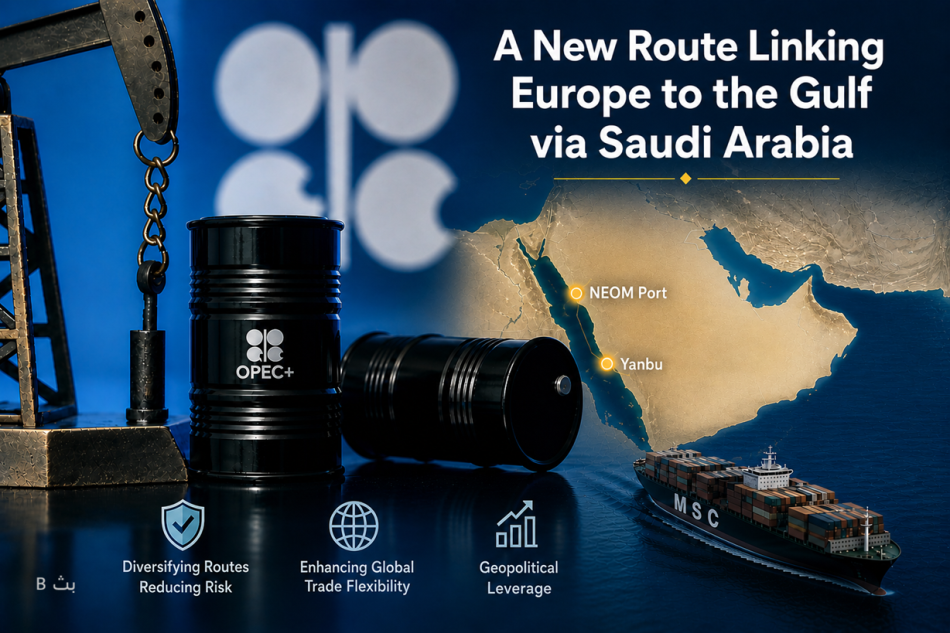
A New Route Linking Europe to the Gulf via Saudi Arabia
OPEC+ to Discuss Production Increase Tomorrow, Sunday
Riyadh | B
Between the Red Sea and the Strait of Hormuz,
a new equation is taking shape:
Trade seeks security,
and politics redraws geography.
Overview
MSC has announced the launch of a new shipping route linking Europe to Gulf ports via Saudi Arabia, in a move that reflects a rapid shift in global shipping maps.
In parallel, the OPEC+ alliance is set to discuss increasing oil production by about 188,000 barrels per day, but the implementation of this decision remains conditional on the stability of supply, amid ongoing U.S.–Iran tensions and their impact on navigation in the Gulf.
In the background, Saudi Arabia’s shift toward the Red Sea is not a temporary response, but rather an extension of a long-term strategic direction that began decades ago, particularly after the “Tanker War” in the 1980s, which exposed the vulnerability of relying solely on the Strait of Hormuz as a primary route.
Today, this direction is materializing through the development of Red Sea ports, the NEOM project, and their integration into trade corridors extending from Europe to the Gulf, via Egypt and into the Arabian Peninsula.
“Mawani” Enhances Maritime Connectivity
The Saudi Ports Authority (Mawani) has added the new shipping service Middle East Express (Europe to Red Sea), operated by MSC, to Jeddah Islamic Port and King Abdullah Port in Rabigh, in a move that enhances maritime connectivity between the Kingdom and Europe.
The new service connects Jeddah Islamic Port with several major global ports, including Gdansk, Klaipeda, Bremerhaven, Antwerp, Valencia, Barcelona, and Gioia Tauro, with a capacity of up to 16,000 TEUs.
The service also extends through an integrated logistics route, starting with maritime shipping to Red Sea ports, followed by land transport to King Abdulaziz Port in Dammam, before being redistributed to Gulf countries via feeder vessels.
This step contributes to strengthening supply chain integration and improving regional logistics connectivity, within a direction aimed at expanding access to neighboring markets and reinforcing the Kingdom’s position as a global logistics hub.
This move comes in parallel with MSC launching a new route linking Europe to the Gulf via Saudi Arabia, reflecting a shift in logistics transformation from the planning phase… to execution.
BETH Analysis
The scene should not be read as separate movements,
but as a shift in the philosophy of supply:
From reliance on a single route
to distributing risk across multiple routes
Saudi Arabia here is not reacting,
but acting as a designer of alternatives
At the same time:
Tensions in Hormuz increase the value of the Red Sea,
and the Red Sea is shifting from an option… to a necessity
As for OPEC+, its decision remains tied to one factor:
Stability of flows… before increasing production
Deeper Perspective
What is happening today is a transition from:
Securing routes
to
Diversifying routes
This shift means:
Reducing the impact of geopolitical crises
Enhancing global trade resilience
Increasing the value of countries that offer alternatives
Routes are no longer just pathways,
but instruments of power
What Saudi Arabia is doing today is not about finding an alternative route,
but about:
Redefining the route itself
BETH (بث B) – All rights reserved