



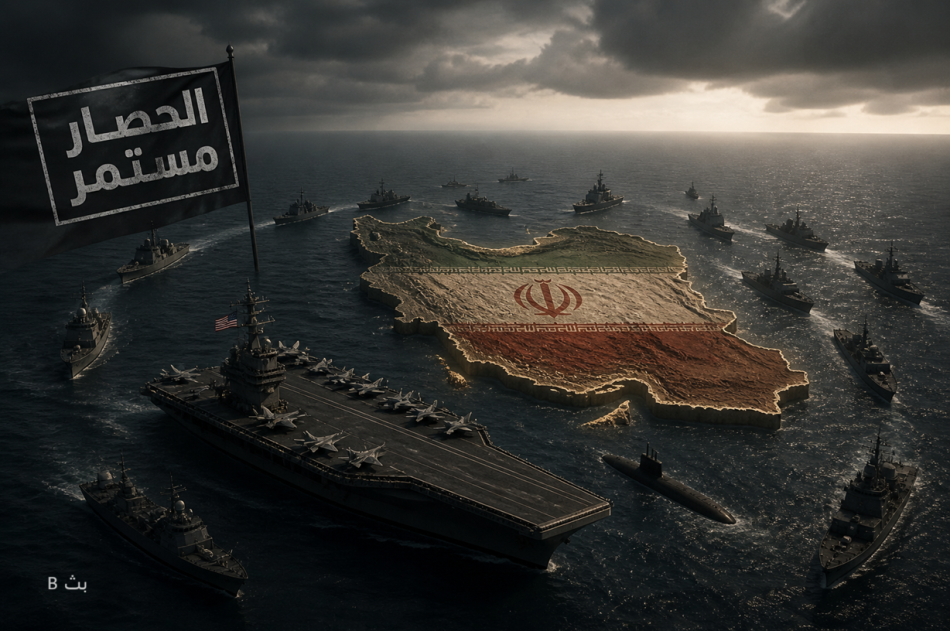
Day 62: The Blockade Continues
Riyadh | B
The conflict enters its sixty-second day on a steady rhythm:
an ongoing blockade.. stalled negotiations… and deferred escalation.
Overview
U.S. President Donald Trump, in a speech delivered in Florida, confirmed that Washington will not end the blockade imposed on Iranian ports prematurely, stating that “time is on our side,” and adding that ending the confrontation before achieving its objectives could lead to the crisis resurfacing within a few years.
In contrast, an Iranian military official said that a renewed war with the United States remains a “possibility,” amid stalled talks, accusing Washington of failing to honor agreements.
Diplomatically, Pakistan’s Foreign Minister Mohammad Ishaq Dar affirmed that his country continues efforts to promote dialogue, as negotiations remain stagnant with both sides maintaining distant positions.
On the ground, the naval blockade on Iranian ports continues, while the Strait of Hormuz remains effectively closed to maritime navigation, reflecting mutual pressure on energy and trade routes.
In a related development, retired U.S. General Jack Keane called for halting negotiations and resuming military operations, arguing that Iran’s leadership is not affected by internal pressures.
A U.S. official also indicated that Iran is using the ceasefire period to retrieve missiles and ammunition from underground sites, reflecting continued military readiness despite the pause in fighting.
BETH Analysis
The situation is moving toward a prolonged war of attrition:
- Blockade = sustained pressure
- Negotiation = accompanying tool
- Military readiness = active option
Washington is betting on time,
while Tehran seeks to endure… and reorganize its capabilities.
In the background:
- Negotiations are not advancing
- Pressure is not easing
- Major decisions remain deferred
On Day 62,
there is no full-scale war… and no imminent peace
but a state in between:
Sustained pressure… and waiting for the moment of decision
Potential Operations
Israeli media: The Chief of Staff is holding communications with the CENTCOM commander to discuss options against Iran.
BETH Analysis
The contact does not necessarily mean an operation has begun,
but it signals that the military option has moved from political threat to operational planning.
The question is no longer: Is there pressure?
but: Have Washington and Tel Aviv concluded that negotiations are no longer sufficient?
Reading the Delay
Iran’s delay may be an attempt to buy time,
rebuild capabilities, and test Washington’s patience.
But it may also have created the opposite effect:
giving the United States and Israel more time to gather intelligence, refine targets, and close maneuvering space.
In clearer terms:
- Iran is betting on time
- Washington is betting on pressure
- Israel is betting on precision strikes
Is an Operation Coming?
A limited operation or a wave of targeted strikes is now increasingly likely,
especially if Iran’s proposal fails to offer clear concessions on the nuclear file or freedom of navigation.
However, it is unlikely to begin as a full-scale war.
More likely:
- A calculated strike
- Designed to break the delay
- And shift negotiations from waiting… to enforcement
Conclusion
If Tehran is using time to rebuild strength,
Washington and Tel Aviv are using time to reduce the cost of striking it.
The next moment may not mark the end of the war,
but the beginning of a new phase:
Decisive action under controlled escalation.
BETH (بث B) – All rights reserved