



Minds That Rule the World
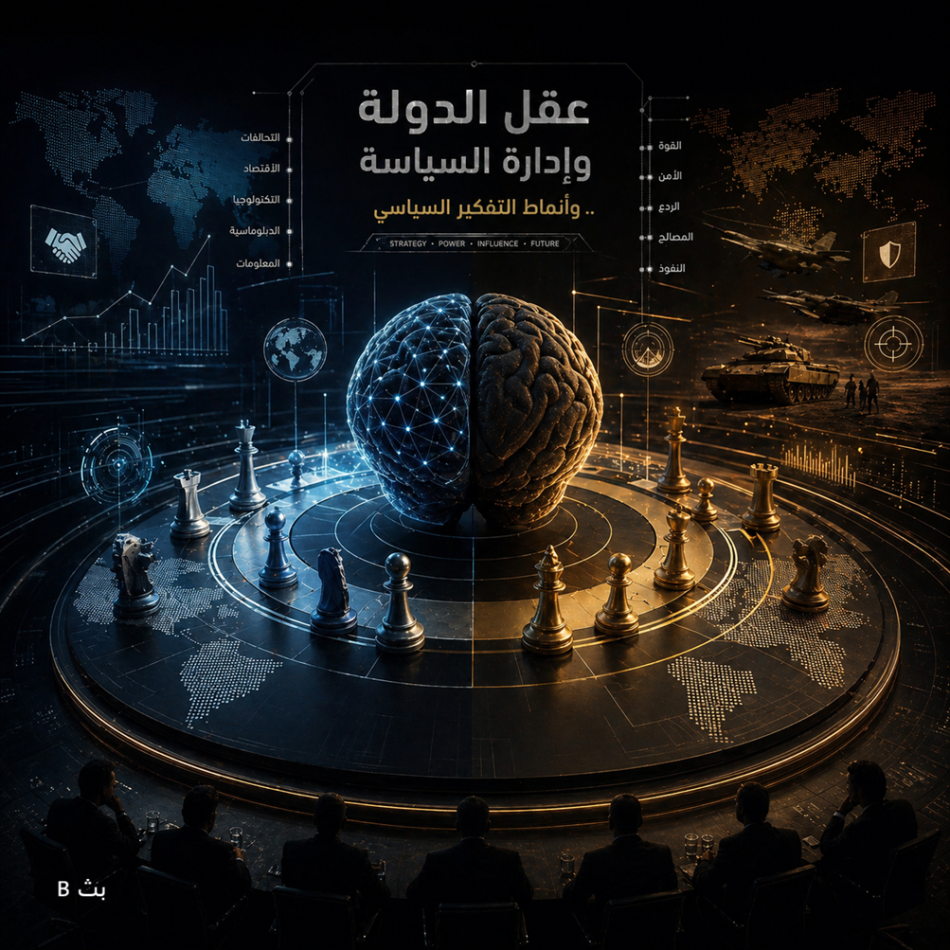
State Mind and the Management of Politics … Patterns of Political Thinking
Riyadh | B
Introduction
In a world where events are not managed by chance, politics is shaped by deep patterns of thinking that reflect the history of states, their anxieties, ambitions, and tools.
Politics is not merely momentary decisions; it is the product of a “state mind” that determines how a nation sees itself, how it sees others, and how it acts in moments of balance or conflict.
This is a precise analysis conducted by B of patterns of political thinking among the world’s major international and regional powers. It reads beyond the decision and reveals how politics is actually managed… not as it is narrated in rhetoric.
State Mind and the Management of Politics
First: Patterns of Political Thinking
The United States: The Policy of Moving Power
American political thought is based on the idea that the world is an open arena for influence.
The United States does not manage politics as a fixed balance, but as a continuous movement to reshape reality.
It uses:
diplomacy, sanctions, media, economy, technology, and military power.
The American mind is highly pragmatic:
what does not serve interest is redefined, what cannot be resolved is managed, and what threatens influence is contained.
Britain: The Policy of the Cold Mind
Britain manages politics with a historical, long-breath mindset.
It does not always move in the front line, but it excels in crafting back channels.
Its strength lies not only in direct decision-making, but in:
reading balances, managing influence, building networks, and using institutions.
The British mind does not favor noise; it prefers to leave an impact without leaving a clear fingerprint.
France: The Policy of Pride and Identity
France thinks politically from a deep sense of its historical and cultural identity.
It seeks to remain a major power, even when its material tools are sometimes insufficient for that role.
Thus, it combines:
diplomacy, culture, language, influence in Africa, and a European presence.
The French mind is both political and philosophical, but at times its imagination advances ahead of its realistic capability.
Russia: The Policy of Geography and Fear
Russia thinks through the lens of security, borders, and imperial memory.
The Russian mind sees weakness as an invitation to invasion, and geographic retreat as an existential threat.
Thus, Moscow tends toward:
power, deterrence, strategic depth, and expanding spheres of influence.
In Russian politics, war is not a departure from politics, but a tool for تثبيت المكانة (consolidating status).
China: The Policy of Long Time
China does not think in years, but in decades.
Chinese political thought is based on patience, economy, internal control, and expanding influence without direct confrontation whenever possible.
China does not only ask: what do we gain today?
It asks: where will we be in fifty years?
The Chinese mind tends to convert economic power into political influence, then transform that influence into a quiet alternative global system.
Israel: The Policy of Permanent Anxiety
Israel thinks from within a mindset of security and survival.
The Israeli political mind does not see the region as a natural neighborhood, but as a constant arena of threat.
Thus, its political management is based on:
intelligence, deterrence, military superiority, penetration of adversaries, and global image management.
Israel does not wait for threats to mature; it seeks to strike them in formation.
Here lies both its strength and its danger.
The Gulf States: The Policy of Survival and Transformation
The Gulf states, particularly in their modern phase, have moved from a policy of caution to a policy of action.
Historically, they managed politics through balances, protection, and alliances, but today they are moving toward building self-capacity.
The new Gulf mindset is based on:
economy, energy, investment, stability, flexible alliances, and strategic diversification.
The Gulf no longer wants to be a region managed from the outside, but a player that participates in shaping the equation.
Iran: The Policy of Ideology and Survival
Iran thinks politically from within a complex blend of:
ideology, revolution, security, and historical memory.
The Iranian political mind does not see itself as merely a state…
but as a project carrying a message, confronting an environment it perceives as threatening or hostile.
How does Iran manage its politics?
Iran does not rely on a single tool, but on a multiplicity of tracks:
Negotiation… without abandoning leverage
Building indirect influence through allies
Using extended geography rather than traditional borders
Blending ideological discourse with pragmatic calculations
Keys to the Iranian Mind
1. Strategic patience
Iran does not rush decisive outcomes… it accumulates influence gradually, even under pressure.
2. Managing contradiction
It can negotiate and escalate at the same time, without seeing this as a contradiction.
3. Indirect action
It relies on tools outside the traditional state framework (allies, proxies, regional influence).
4. Turning pressure into opportunity
Sanctions and pressure are not read only as crises… but as tools to reshape the الداخل (internal sphere) and reinforce control.
Strength
Iran possesses a high capacity for endurance and maneuvering,
and excels at operating within the gray zones between war and peace.
Weakness
Continuous expansion creates strain,
and ideological discourse may at times override realistic calculations.
Moreover, the tension between the internal sphere (economy and society) and the external sphere (the regional project) represents a persistent challenge.
Conclusion
Iran does not manage its politics solely with a state mind…
but with a project mind.
Here lies its complexity:
it does not negotiate merely to gain…
but to ensure its survival and the continuity of its idea.
Dealing with Iran does not succeed through a single approach:
neither force alone is sufficient…
nor negotiation alone is sufficient.
Because you are not facing a conventional state…
but a mind that combines ideology and interest… and knows how to move between them.
Second: Major Relationships
Reality and Politics
Politics is not what we wish for, but what can be done within the limits of reality.
Yet the intelligent politician does not surrender to reality; he reads it, then seeks to reshape it.
The difference between an ordinary politician and a great one is that the former deals with reality as it is, while the latter searches for its weak points to redefine it.
Politics is the art of dealing with reality without becoming its prisoner.
Politics and War
War is not always the opposite of politics.
Sometimes it is its continuation when soft tools fail.
But a rational state does not enter war merely to fight; it enters knowing:
when to start, what it wants, how to exit, and what cost is acceptable.
War without a political objective turns into chaos.
Politics without power turns into rhetoric.
Realism and Imagination
Realism prevents سقوط (collapse).
Imagination prevents stagnation.
A state that possesses realism without imagination becomes cold and administrative.
A state that possesses imagination without realism becomes adventurous or delusional.
Political genius is to see what others do not see, then possess the tools to turn it into reality.
Imagination and the Culture of Myth
Imagination is a creative force, while myth is an escape from reason.
Imagination builds a project.
Myth justifies failure.
Imagination asks: how do we create the future?
Myth says: someone will come and create it for us.
Therefore, societies that confuse imagination with myth lose their ability to act, because they wait for miracles instead of building causes.
BETH Conclusion
The world is not run by intentions, but by organized minds.
Nations do not prevail because they have louder slogans, but because they understand reality, manage imagination, and know when to negotiate, when to pressure, and when to use force.
Real politics is not a speech on a platform, but a mind working within the storm.
The External Advisor: Influence and Decision
States do not “hand over their minds” to an advisor, but they may draw on an additional mind when they need:
A different perspective
Specialized expertise not available internally
A relatively neutral assessment
Or even “justification” for a decision already taken
Here, the distinction becomes clear:
who decides… and who influences
When is the influence strong?
An external advisor becomes truly influential when three conditions are present:
1. Ambiguity or a deep crisis
When the picture is unclear, states tend to seek an “external eye” that sees what the الداخل (inside) does not.
2. Lack of expertise or a new experience
Rising states or those undergoing rapid transformations rely on external expertise to accelerate learning.
3. Desire for professional cover
At times, a state needs an “external professional” opinion to give the decision international weight or to reduce its political burden.
How does the advisor actually influence?
Not through the decision… but through shaping the way of thinking:
Changes how the problem is defined
Reorders priorities
Proposes scenarios that were not on the table
Defines “what is possible” rather than “what is desired”
More precisely:
The advisor does not write the decision… but reshapes the mind that will write it
Hidden risks
This is the point many overlook:
1. Imposing ready-made models
Some advisors apply experiences from other countries without understanding local specificity.
2. Unstated bias
An advisor may carry a vision or background that serves the interests of a certain party (a state, a company, a school of thought).
3. Overstating technical solutions
At times, “theoretically perfect” solutions are presented… but they are not politically or socially applicable.
Major powers… do they need them?
Major states such as:
The United States
Britain
China
Do not rely on external advisors in the traditional sense, but they use:
Think tanks
Consulting firms
International experts
Yet they keep the decision inside their “sovereign kitchen.”
Conclusion of this axis
An external advisor may change how a state sees a crisis…
but should not change its identity in dealing with it.
A smart state:
listens… but does not follow
benefits… but does not depend
takes the idea… and reproduces it with its own mind
If desired, this can be turned into a full analytical section within your report under a title such as:
“Who Thinks for the State?”
or
“Borrowed Minds… or Complementary Expertise?”
It would be a strong addition to the spirit of the report.
Arab States: Between Need and Influence
Arab states do not fall into a single model, but in general they are more open to external advisors compared to major powers… for several reasons:
Rapid transformations (economic, political, developmental)
The need for specialized expertise in modern fields
Weakness of some historical institutional structures in certain states
The desire to accelerate achievement through ready-made experiences
But this openness has two sides.
Where is the advisor useful?
In many cases, the external advisor has played a positive role in:
Knowledge transfer (economics, management, urban planning)
Building modern systems (governance, digitalization, investment)
Improving government efficiency
Providing condensed global experiences instead of reinventing them
This is particularly evident in some Gulf states, where advisors have been used as:
tools of acceleration… not tools of القيادة (leadership)
Where does the problem begin?
The risk does not come from the “presence of the advisor”… but from how they are handled:
1. Replacing the local mind
When the advisor shifts from “assistant” to “final authority.”
2. Importing an unsuitable model
A model’s success in one country does not mean it suits another with different cultural and social contexts.
3. Weak adaptation
Some states transfer the solution as is… instead of reshaping it to fit their environment.
The difference between two Arab patterns
The Arab landscape can be summarized into two models:
An aware model (rising)
Uses the advisor as a tool
Keeps the decision internal
Reproduces the idea locally
Gradually builds its own expertise
A dependent model (declining)
Relies heavily on the advisor
Executes without deep understanding
Repeats solutions without adaptation
Remains permanently in need
The most important transformation today
What is happening now in some Arab states—especially in the Gulf—is a shift from:
“Using the advisor” → to “creating the advisor”
Meaning:
Building local capacities
Establishing think tanks
Developing an internal strategic mind
Gradually reducing external dependence
This is a major strategic shift.
Conclusion
Arab states do not suffer from the presence of advisors…
but from the absence of “a mind that manages them.”
The advisor can be:
a lever of progress… or a gateway to dependency
The difference is not in the advisor…
but in the state that uses them:
Does it think through them?
Or does it let them think instead of it?
Prepared & Analyzed by: Strategic Media Department – B Agency
BETH (بث B) – All rights reserved