



Day 58: Decision Nears
Riyadh | B
28 Shawwal 1447 AH | April 28, 2026
Introduction
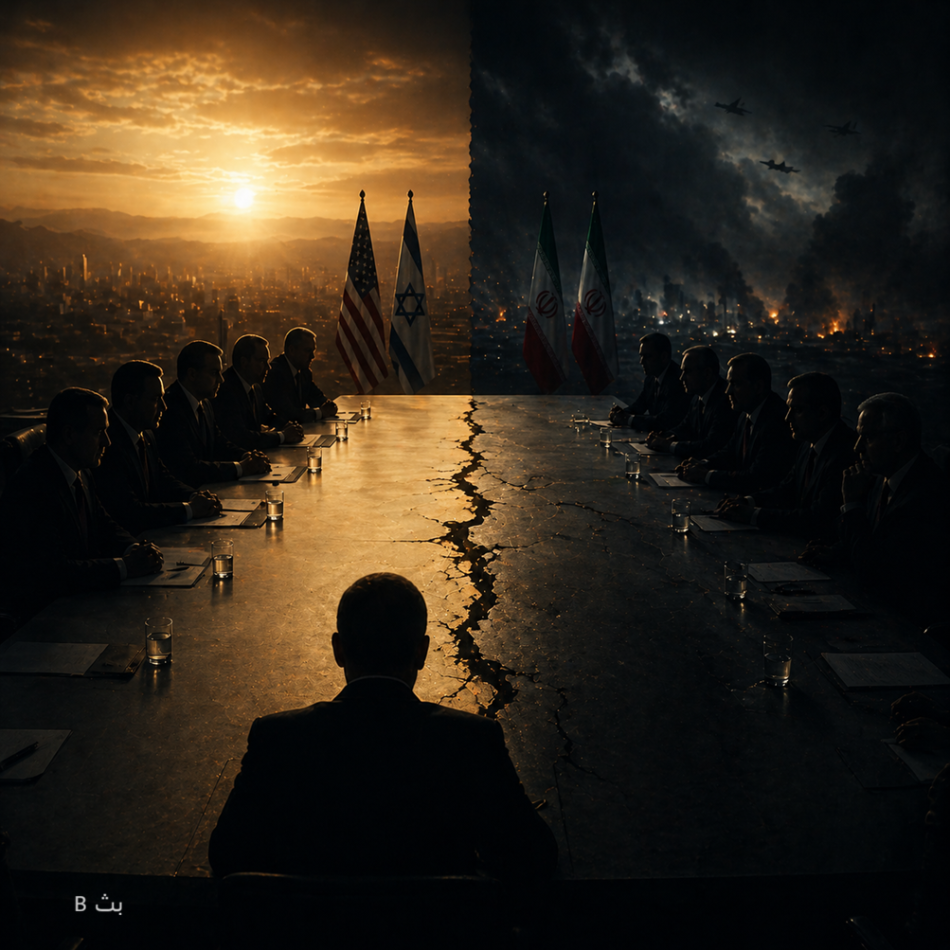
The U.S.–Israeli war on Iran enters its 58th day amid heightened anticipation, caught between an unripe negotiation track… and the persistent risk of renewed escalation at any moment.
This is no longer merely a war or a negotiation—it is a test of will unfolding on the edge of decision.
Overview
Sources revealed that U.S. President Donald Trump expressed clear reservations about the Iranian proposal during a meeting with senior national security officials, signaling dissatisfaction with the level of concessions offered.
Meanwhile, a senior Iranian official suggested a scenario involving “limited escalation” followed by a return to negotiations—indicating that escalation may serve as leverage rather than a final option.
The core dispute remains centered on uranium enrichment and near-weapons-grade stockpiles. Washington views any easing of maritime restrictions or reopening of the strait without resolving these issues as a loss of its primary negotiating leverage.
In parallel, Tehran escalated its political rhetoric, asserting that the United States is no longer in a position to impose its policies on independent nations—a message aimed at both domestic and international audiences.
On the intelligence front, Mossad chief David Barnea confirmed significant operational breakthroughs inside Iran and Lebanon, highlighting access to highly sensitive information and advanced capabilities.
Diplomatically, Iranian Foreign Minister Abbas Araghchi welcomed Russian support, following his meeting with Vladimir Putin, in efforts to advance a political resolution.
Regionally, Jeddah hosts an extraordinary Gulf consultative summit aimed at coordinating a unified regional stance ahead of potential developments.
BETH Analysis
The situation is evolving across three intersecting layers:
Washington:
Keeps negotiations open… while signaling readiness to withdraw.
Message: No deal without strategic concessions.
Tehran:
Raises rhetoric… while hinting at calculated escalation.
Objective: Improve negotiation terms without triggering full-scale war.
The Hidden Field:
Advances quietly through intelligence operations.
This may be the track that decides… without announcement.
Conclusion
We are facing a moment of compounded pressure:
Measured escalation… suspended negotiations… and a decision drawing near.
No final call has been made yet—
but everything unfolding now is being shaped by what is likely to happen within days.
Trump discusses escalating economic and military pressure on Iran to force it to respond to demands
What does Washington want?
Economic and military pressure is a tool…
to force Iran to make a strategic concession in:
Nuclear enrichment
Sensitive stockpiles
Regional influence
The objective:
An agreement on American terms
What will Iran do?
It will not concede directly… but will:
Pursue calculated escalation
Activate its regional levers
Continue negotiations without resolution
The objective:
Raising the cost of pressure
Most likely scenarios
1. Limited escalation followed by negotiation (most likely)
Field pressure → quick return to negotiations → improved terms
2. Prolonged tug-of-war
No full-scale war → no final agreement → intermittent negotiations
3. Uncalculated escalation (most dangerous)
Excessive escalation → stronger response → expanded confrontation
What does “more pressure” mean?
It means the current pressure is not sufficient for a decisive outcome
and signals:
Intent to escalate
Testing Iran’s capacity to endure
Washington is pressing to break will
Tehran is enduring to break pressure
The outcome will not be decided by power alone…
but by the management of timing and limits
Trump: Iran told us it is “in a state of collapse” and is seeking the reopening of Hormuz
The statement is not merely about describing Iran’s condition…
it implicitly reveals a channel of communication between Washington and Tehran.
When Trump says “Iran told us”…
he is not addressing Tehran as much as he is addressing the world:
Communication is ongoing… even at the peak of escalation
First indication: Negotiations have not stopped
Despite all signs of escalation,
the statement confirms that a backchannel is active.
This means:
- What is visible is not the whole picture
- Escalation does not negate negotiations… it may be part of them
Second indication: Dual messaging, not a clear contradiction
If Trump’s claim is accurate,
we are looking at two levels of messaging:
- A domestic/media narrative emphasizing resilience
- External messages conveyed with greater flexibility
This is not necessarily a contradiction…
but a dual-track negotiating tactic:
Maintaining red lines publicly…
while preserving room for maneuver behind the scenes
Third indication: A calculated disclosure
Trump did not merely hint… he disclosed the content of the message,
and that in itself is a pressure tool:
- Embarrassing Iran before its domestic audience
- Undermining the narrative of “full resilience”
- Forcing a choice:
- Strong denial → media escalation
- Silence → read as implicit acknowledgment
Fourth indication: Narrative management
This is not simple “manipulation”…
it is management of the narrative:
- Washington seeks to portray Iran as weakened
- Tehran seeks to project resilience
At this stage,
the narrative does not only reflect reality… it helps shape it
Deeper reading
Trump’s statement may be:
- A genuine relay of a message
- An amplification of part of it
- Or a fully strategic framing
Most likely… a combination of all three.
BETH Conclusion
This is not a passing remark…
but a dual revelation:
- Ongoing direct communication despite escalation
- A gap between what is said publicly and what is conducted behind closed doors
In this gray space…
the most critical battles are decided:
Not only who holds power…
but who succeeds in imposing their narrative as reality
BETH (بث B) – All rights reserved