


Day 56: Noise in Washington .. and Escalating Military Pressure
Coverage & Analysis | B
Introduction
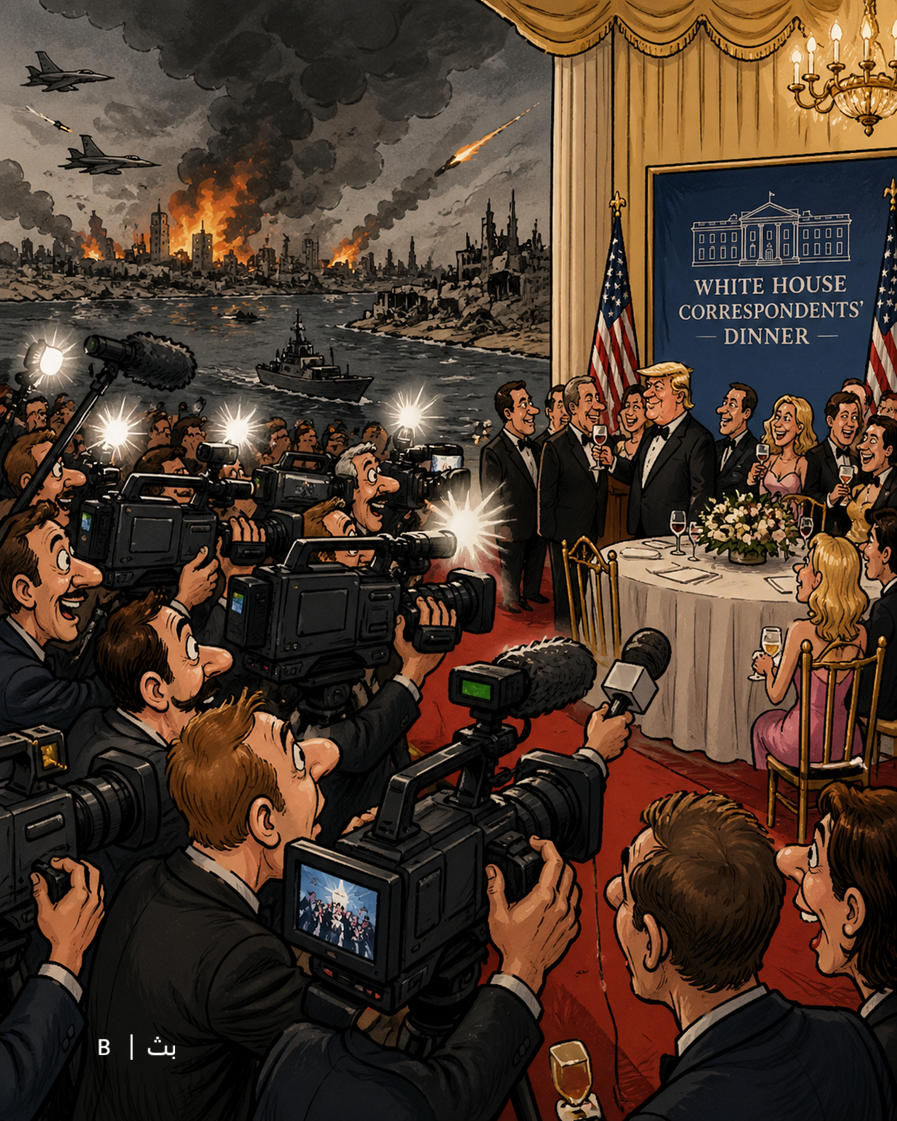
Despite the shooting incident that shook the White House Correspondents’ Dinner in Washington, attended by President Donald Trump, and despite global media shifting their focus to its details, the deeper picture has not changed.
The U.S.–Israeli war with Iran has not stopped… it has continued to expand in a more dangerous calm.
At a moment when attention turned to a sudden event inside Washington, the shadow continued to move elsewhere… where the real battle is being managed—between the battlefield and diplomacy, between the desire for resolution… and the fear of a larger explosion.
Day 56 is not merely a passage of time,
but a phase where three tracks intersect:
Media noise that distracts attention,
A faltering diplomacy,
And military pressure quietly escalating.
Between these tracks, something more dangerous than the war itself is taking shape:
A reordering of global priorities… without announcement.
Overview
Attention is turning to Islamabad, which is preparing to receive Iranian Foreign Minister Abbas Araghchi for a new visit—his second in days—as part of Pakistani efforts to revive a stalled negotiation track between Tehran and Washington.
The visit comes after the sudden cancellation of a planned trip by U.S. envoys Steve Witkoff and Jared Kushner, in a clear indication of the failure to achieve a real breakthrough to end the war that began on February 28.
Meanwhile, voices in Washington are rising in favor of abandoning diplomacy altogether. Senator Roger Wicker called for ending negotiations and shifting to a military solution, stating that “the time for diplomacy is over,” and that the only guarantee for long-term stability is the destruction of Iran’s military and nuclear capabilities.
On the ground, the United States Central Command (CENTCOM) announced tighter maritime enforcement, with 37 vessels rerouted since the blockade began, and the interception of the commercial vessel Sevan in the Arabian Sea—highlighting a systematically escalating economic and military pressure campaign.
Indicators suggest that targeting Iran’s so-called “shadow fleet” has moved beyond sanctions… into direct operational enforcement aimed at choking resources.
B Analysis
What is happening now does not reflect the failure of diplomacy… but a redefinition of its role.
Diplomacy is no longer a tool for resolution,
but a tool for managing time…
until military pressure is fully established.
The cancellation of the U.S. envoys’ visit does not signal withdrawal, but a message:
Negotiations will not continue without a higher cost.
Meanwhile, Iran’s movement through Pakistan reflects an attempt to avoid a forced-resolution scenario, yet it faces a reality where the balance of pressure is no longer equal.
As for the maritime blockade, it is not merely a tactical move,
but a transition into a phase of “state-level economic strangulation,” alongside military pressure.
What is striking is that all of this is happening… without noise.
And here lies the paradox:
The quieter the media landscape becomes… the higher the real level of risk.
What’s Next? | B Foresight
The coming phase is moving across three main scenarios:
1. Controlled Escalation (Most Likely)
Continuation of the maritime blockade and expansion of indirect targeting, while keeping diplomacy formally open.
Objective: Exhaust Iran without triggering full-scale war.
2. Limited Decisive Strike
A focused military operation targeting strategic (military or nuclear) facilities to create a breaking point forcing Tehran into new terms.
3. Uncontrolled Escalation (Most Dangerous)
Any miscalculation—at sea or in the air—could shift the conflict from managed escalation to open confrontation, especially with rising military friction.
B Conclusion
What appears as calm… is not calm.
What appears as media distraction… is not coincidence.
On Day 56,
the war does not stop…
it perfects the art of lowering its voice.
Between the noise in Washington and the silence of the fronts…
the next phase is being written.
Trump: Iran War Nears Its End
U.S. President Donald Trump said on Sunday that the war with Iran “will end very soon,” affirming that the United States “will win,” amid ongoing political and military movements related to the Iranian file.
Trump noted that some of the parties Washington is dealing with regarding Iran are “very rational,” while “others are not,” expressing hope that “the Iranians will act wisely” in handling the current phase.
In a separate context, Trump commented on the shooting incident that targeted the vicinity of the White House Correspondents’ Dinner, stating that the location of the attack was “difficult to secure,” and noting that the shooter did not manage to approach the event hall.
B Analysis
The statement carries two parallel tones:
sharp optimism about a near end…
and pressure messages directed within the negotiation track.
Describing some parties as “rational” opens the door to differentiation within the Iranian scene,
between those who can be engaged… and those who complicate the path.
Trump: Iran Knows What We Want… No Need for a New Round of Negotiations
The statement is clear… and direct.
No talk of a new negotiation track,
and no desire to “reopen the discussion.”
The message:
Our demands are known… and the ball is not on our side.
What Trump is saying here is not an invitation to dialogue,
but a declaration that the negotiation phase—in its traditional form—has ended.
This is a message of strength,
built on shortening the path:
No more rounds,
no more time to spare,
and no appetite for “going in circles.”
At the same time, it carries another dimension:
It is not a complete shutdown,
but intensified pressure to push the other side toward a swift decision.
More precisely:
Either compliance…
or facing a different path.