


When Wars Are Narrated .. ho Tells the Truth?
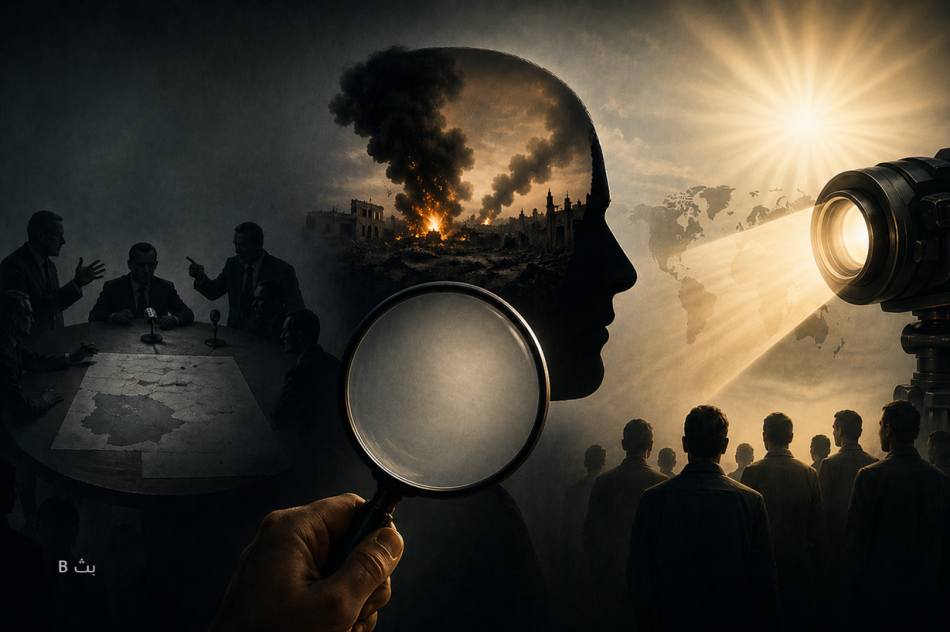
Prepared and Analyzed by | Strategic Media Department – BETH
Supervised by: Abdullah Al-Umairah
Introduction
Wars are not misleading through weapons alone…
but through narrative.
Each side presents its own version:
it amplifies what it has gained,
minimizes what it has lost,
and redefines “victory” to serve its position.
And here the problem begins…
not in the event itself,
but in how it is presented.
Between Politics and Media
Politics, by nature, is indirect.
It moves through implication,
uses ambiguity,
and conceals more than it reveals.
That is why the public tends to turn away from it.
True media, however, has a different role:
not to justify,
not to embellish,
not to repeat the narrative…
but to:
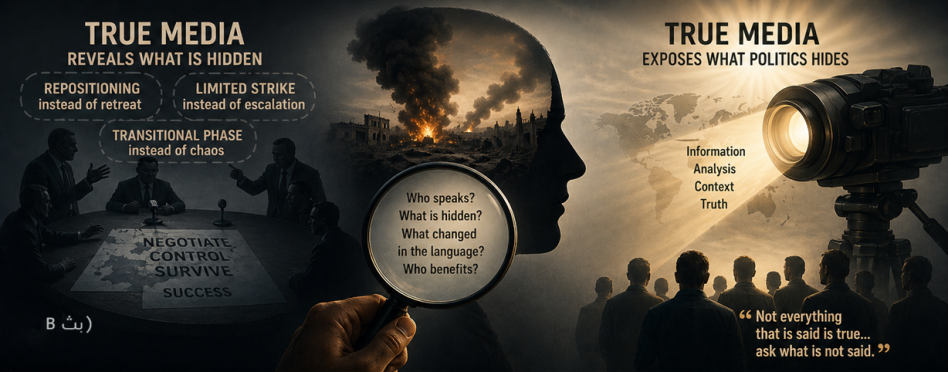
- reveal what is hidden
- present information as it is
- distinguish between reality… and what is made to appear as reality
Deconstructing the Narrative
In many wars,
no one declares defeat openly…
instead, it is reformulated:
“withdrawal” becomes “repositioning”
“chaos” is presented as a “transitional phase”
“loss” is concealed within diplomatic language
But changing the words…
does not change the reality.
Sometimes, wars are not only managed…
their image is managed as well.
How Do You Uncover the Narrative?
To understand what is really happening, it is not enough to hear what is said…
it must be deconstructed:
Who is speaking?
An official entity? A party to the conflict? A mediator?
What is being concealed?
What has not been mentioned despite its importance?
What has changed in the language?
Has a “strike” become a “message”?
A “withdrawal” become a “repositioning”?
Who benefits?
Who gains from this narrative… now or later?
Principle
Media is not driven by agendas…
it exposes them.
What remains hidden
is placed under scrutiny,
to be seen as it is…
not as it is intended to be seen.
Conclusion
Not every ending is a victory.
Not every narrative is truth.
The difference is not made by the loudest voice…
but by the eye that sees clearly.
Media is not merely a mirror…
it is a light that reveals what politics does not want seen.
Linking Context
In this context, BETH presented a report titled:
“War Negotiations… Who Decides?”
which examined what takes place behind negotiation tables,
under the pressure of military and political dynamics.
Applied Example (From Reality)
When reading military reinforcements in the region,
they may be presented as a “buildup for war”…
or as a “tool of pressure for negotiation.”
Here, the news alone is not enough…
questions must be asked:
Is the goal confrontation?
Or shortening the timeline of negotiations?
The narrative may say one thing…
but timing and context say something else.
Closing
In crises, truth does not disappear…
it becomes crowded by competing narratives.
Politics manages the scene with calculated silence,
and media—if aware—breaks that silence,
not with loudness…
but with the right question.
Wars do not hide their truth…
we simply choose which narrative to believe.
____________
BETH (بث B) – All rights reserved