


How Is Power Managed Today?

Prepared by: Strategic Media Department | Bبث
Supervised by: Abdullah Al-Umairah
When Donald Trum says that “the blockade is more dangerous than bombing,” and then threatens to destroy “Persian civilization,” he is not presenting a contradictory narrative, but rather revealing two levels of conflict:
targeting will from within… and shaping the image from the outside.
BETH Reading
The Blockade.. Targeting Survival, Not Geography
Ideological systems do not perceive danger in the scale of destruction, but in the threat to their continuity.
Bombing can be contained within a narrative of “resilience,”
but a blockade strikes what cannot be justified for long:
The daily economy
Loyalty networks
Elite cohesion
For this reason, the blockade becomes more dangerous:
because it pressures where ideology cannot shield itself.
“Persian Civilization”… A Constructed Narrative
Speaking of “civilization” does not describe military reality…
it builds the image of confrontation.
Trump does not present Iran merely as a state,
but as a “deep power,”
in a simplification that reshapes its image,
despite the fact that its civilizational depth—by this meaning—does not fundamentally differ from countries in the region such as Afghanistan and Iraq.
The goal here is not to describe reality…
but to amplify the scale of confrontation,
so that any victory is presented as a historical breakthrough, not merely a tactical achievement.
This rhetoric is also linked to an attempt to reshape the image of American power,
after controversial experiences in Afghanistan, Iraq, and Somalia.
From Loud Power… to Effective Power
The difference today is not in possessing power,
but in how it is used.
Loud power: fast, high in noise, short in impact
Effective power: slow, deep, changes behavior
The blockade belongs to the second type:
it raises costs,
creates internal pressure,
and opens the door for negotiations under different terms.
From a perhaps less visible angle:
lifting the blockade—within the calculations of the Iranian system, particularly the Islamic Revolutionary Guard Corps—appears to be a priority, surpassing the cost of military strikes.
Vital passages, foremost among them the Strait of Hormuz, affect the arteries of the economy and the capacity for financing,
while strikes are reframed within a mobilizing narrative that can be absorbed.
In this sense, the blockade becomes a matter of survival…
not merely a tool of pressure.
The Battle of Narratives
The conflict is not fought only in the field…
but in awareness.
Washington seeks to establish the image of a “tight blockade,”
while Tehran seeks to present a “managed resilience.”
Whoever succeeds in managing the narrative…
moves closer to determining the outcome.
Iraq… Chaos or Miscalculation?
The model of Iraq remains present in every reading of American power.
The world—especially in the region—continues to ask:
how did a massive military intervention end in a reality that allowed the expansion of Iran’s influence?
The fall of the regime was not the core issue…
but what followed:
Dismantling state institutions
Political and security vacuum
Rise of forces linked to Iran
Two interpretations emerge:
Managing chaos: maintaining a fragile balance controlled from outside
Miscalculation: rapid decisions without a post-war plan
In both cases, the result is the same:
a vacuum does not remain empty… it is filled by whoever is faster.
Between past and present,
the image of the United States remains at stake.
The Paradox of the Present
Forces that emerged during that phase
have now become part of a reality that Washington deals with.
This raises a critical question:
has the policy changed?
Has the United States moved from:
creating vacuum…
to managing balance?
And have some forces transformed into equations that are difficult to control?
The deeper question:
what does “Victor Frankenstein” do when what he created grows?
And can “Achilles” maintain his strength… or will his weakness be exposed?
What is certain is that power, when managed alone and with arrogance,
loses its balance…
even if the opponent appears weaker.
Toward a Different Policy?
Current indicators suggest a three-track approach:
Continuous economic pressure
Ready military deterrence
An open negotiation window
Resolution without full-scale war…
and change without total collapse.
Conclusion
The blockade today is not an alternative to war…
but an evolution in its tools.
Talking about “civilization” is not a description…
but the construction of an image of power.
Yet the lesson of Iraq remains present:
power that topples… but does not manage…
may produce a stronger adversary.
In the end,
power is not measured by the noise it creates…
but by the change it produces.
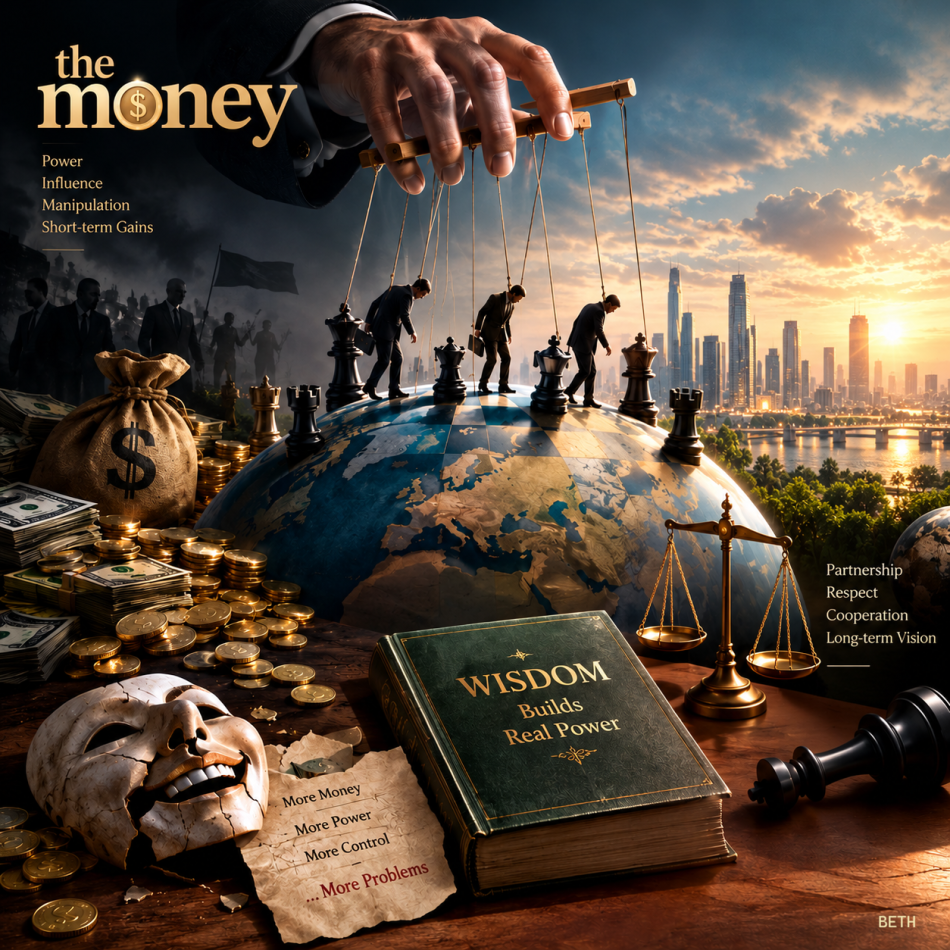
Image Meaning
“Real power is unseen… yet it controls.”
In other words:
real power is hidden… yet it governs.
Commentary on the Image
“Real power is unseen… yet it controls”
This statement does not necessarily imply the existence of a mythical force secretly governing the world, nor does it validate narratives such as “protocols” or a “hidden world government.”
Rather, it describes a more grounded reality:
a significant portion of modern power does not operate in front of cameras, but through quiet, cumulative, and influential tools.
Power today is not exercised only through missiles and tanks,
but through sanctions,
supply chains,
control of vital passages,
management of narratives,
and the timing of decisions.
Thus, ambiguity does not always mean conspiracy,
and invisibility does not mean illusion.
What has long circulated in books and stories about “who runs the world”
is a mixture of fiction and reality.
Reality suggests:
there is no single hand controlling everything,
but rather networks of interests, centers of influence, and pressure tools that often operate more effectively in silence than in noise.
Here, awareness becomes the key:
to read beyond the surface,
without falling into oversimplification…
or obsession.
Within this report’s context,
the blockade is a clear example of this kind of power:
it does not create a loud scene…
yet it changes calculations.
The battle of narratives is another example:
it does not bring down a wall…
but it can redirect decision-making.
Final Insight
Hidden power is not a mystical secret…
but a modern method of management.
It appears in outcomes more than in scenes,
and is measured by what it changes… not by what it declares.