



Did the war reveal the strength and importance of the Gulf states?
Written by: Abdullah Al-Umairah
B Vision | B
The crisis did not create importance for states that had none, nor did it reveal their strength by coincidence…
it uncovered what already existed.
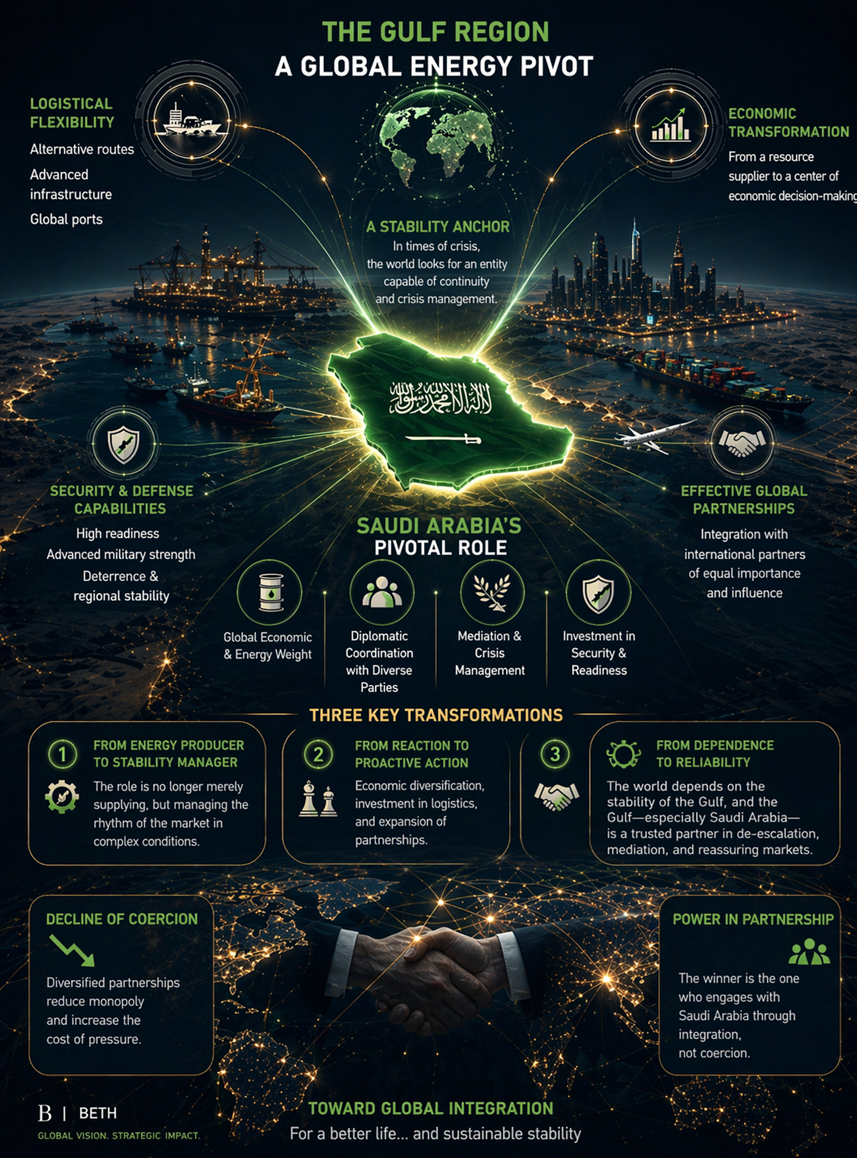
The Gulf is a global energy pivot: the stability or disruption of supplies is immediately reflected worldwide.
It possesses logistical flexibility (alternative routes, infrastructure, ports) that mitigates shocks.
Over the past decade, it has transformed from a source of resources into a center of economic decision-making.
In times of crisis, the world does not look for a producer only…
but for an entity capable of enduring under pressure and managing crises effectively.
Here, the Gulf states—at varying degrees—emerged as a factor of stability.
Saudi Arabia.. and global security
Saudi Arabia today plays a pivotal role.
Why pivotal?
Global economic and energy weight.
Ability to coordinate diplomatically with diverse parties.
A growing record in mediation and crisis management.
Continuous investment in security infrastructure and readiness, both domestically and regionally.
Deterrent military capabilities counted within advanced power balances.
It is true that:
Global security is not created by a single state…
but by a network of balances.
However, Saudi Arabia leads in key and sensitive files,
and integrates with international partners who hold comparable importance and influence.
What has actually changed?
Three notable shifts:
1) From “energy producer” to “stability manager”
The role is no longer merely supplying, but managing the rhythm of the market under complex conditions.
2) From reaction to proactive action
Economic diversification, investment in logistics, and expansion of partnerships.
3) From dependence to reliability
The world depends on the stability of the Gulf,
and the Gulf—especially Saudi Arabia—has become a partner relied upon in de-escalation, mediation, and reassuring global markets.
Has the era of challenges and coercion ended?
It has declined… but not ended.
Diversifying partnerships and integration (east and west) reduces monopolies.
Building defensive and economic capabilities raises the cost for those who attempt coercion.
The existence of alternatives (logistical and commercial) provides a wider margin of decision.
Attempts at pressure will remain part of traditional politics for some states,
particularly those still influenced by colonial thinking,
despite the contraction and erosion of that mindset amid the interweaving of interests.
With the expansion of this interdependence, integration policies impose themselves,
so the tools of coercion change, their intensity diminishes,
and their impact is no longer what it once was.
Power today is not measured only by the ability to exert pressure…
but by the ability to build partnerships.
The winner is the one who deals with Saudi Arabia through the logic of integration,
not the logic of coercion.
It is also necessary to consider the shift in power balances:
those who were strong yesterday are no longer so…
and the reverse is true.
Toward global integration
In a turbulent world, stability cannot be built in isolation.
Integration among states—economically, security-wise, and technologically—is no longer an option… but a necessity.
States capable of managing crises
are the same ones capable of building networks of cooperation that protect the global system from collapse.
Here, a new model takes shape:
Not merely a struggle of power centers…
but a balance through partnerships.
A balance that aims at:
a better life,
sustained stability,
and collective confrontation of any party that disrupts this system.
Conclusion
The crisis did not create the role…
it revealed who can manage it.
Saudi Arabia today is one of the most influential pillars of stability.
Between production… and management…
the true weight of states is determined.
With the expansion of thought and the interconnection of interests,
the world is moving toward a deeper transformation:
from managing destruction… to managing construction.
History is full of the wise and the reckless…
the wise write the history of life,
while the reckless push toward destruction and death,
with a mindset that sees the world only as perpetual conflict,
as if they were leaders of gangs… not states seeking a better life for their peoples and for humanity.
History has witnessed phases where the reckless took the lead,
but the end often tilts in favor of those who build and develop,
and preserve human security and the safety of the earth.
The law of life—or the cosmic order—is the organization of the universe according to wise principles,
with a just balance on earth.
When imbalance occurs, and humans grow accustomed to disorder until they accept it,
the process of correction begins… to restore balance and achieve justice.
Thus, whoever disrupts the balance of the universe
is confronted by one more capable of restoring it.
Returning to the beginning:
Saudi Arabia is not alone in carrying the balance of justice,
but it points to it and helps establish it—
through diplomacy at times, and through force when necessary.
Not only in this crisis,
but in every crisis that arises.
The pages of history tell us:
no evil rises to confront good…
without being met by a force that restores balance.
Events remain lessons.
The earth belongs to those who bring it to life,
to those who seek to live in peace…
not to those who seek to disrupt it.