



“Hatharology” of Trump
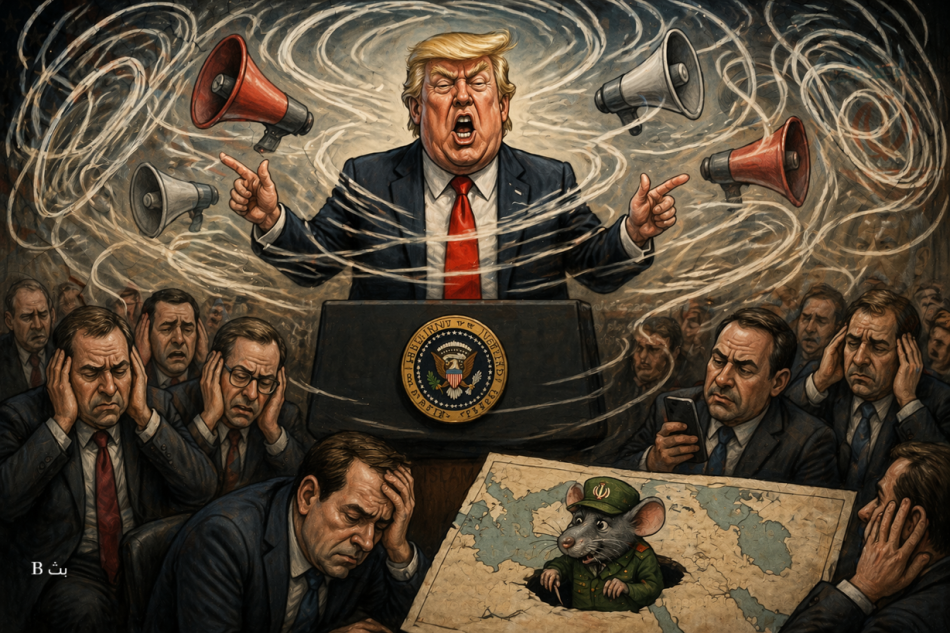
Trump’s Verbal Overload
Written by: Abdullah Al-Umairah
Introduction…
What does “Hatharology” mean?
According to the definitions:
“Hatharology” is a coined term, derived from “hathar” (useless talk) and “-logy” (study/science), referring to the “science of rambling” or unstructured speech. It can be described as a pattern of discourse based on repetition, contradiction, and excessive output without real added value.
But; are we facing mere “rambling”?
Or a phenomenon that deserves deeper reading?
The clearest example
U.S. President Donald Trump presents a striking model of this pattern.
Flowing, repetitive statements… in every direction…
High intensity, versus low value.
The recipient does not receive information..
but is subjected to a “verbal bombardment.”
Here, we move from linguistic description to the psychological dimension.
The psychological angle: why does this happen?
In media psychology, there is a concept known as “cognitive overload.”
When a person is exposed to a massive amount of repeated and contradictory messages, they lose the ability to analyze, and shift to one of two options:
either submission… or complete rejection.
Trump—consciously or not—uses this pattern.
Not to persuade you.. but to exhaust you.
Here, another concept emerges:
“Normalization of chaos.”
When contradiction becomes repetitive, the mind begins to accept it as normal, and stops questioning it.
Comparison with Iranian discourse
Some compare this pattern to the rhetoric of certain Iranian officials.
The similarity is not only in form.. but in the outcome.
Both discourses face a crisis of trust.
But the difference is fundamental:
Trump practices “political chatter”
while Iranian discourse often relies on an ideological structure built on ambiguity, maneuvering, and what is presented in media as a culture of concealment.
The result?
The recipient no longer believes either of them.
Or more precisely: they have grown tired of Trump’s repetition… and the contradictions within Iranian discourse.
Here a precise question arises:
Do both sides understand each other well?
And does Trump deliberately use repetition as a tool of excessive simplification; in the face of a discourse built on maneuvering?
The recipient is no longer naïve
Today’s audience is not what it once was.
It understands that:
American power is real; but it is not absolute.
And Iran is not a “tiger” as it portrays itself; but rather an entity capable of causing disturbance more than decisive outcomes.
Here, a mental image forms in the mind of the recipient specifically about Iran:
a “paper mouse”; it may cause harm, but it does not decide.
Here, I recall what some analysts suggest about the multiple “traps” that Trump sets.
In my view, the matter may not require this level of complexity.
In such cases, Iranian behavior is often read as responding more to the logic of clear force than to prolonged rhetoric or ambiguous messages.
As for excessive statements and chatter, they may be interpreted in the opposite way; increasing stubbornness and creating an exaggerated impression of deterrent capability.
Naturally, there remain broader political considerations and arrangements that govern the American position, imposing a different rhythm in managing the conflict.
But when calculated force appears clearly, it tends to impose prestige… without the need for excessive noise.
The most important psychological equation
When discourse loses its credibility, it loses its impact.. regardless of its source.
Here we move to a third concept:
“Perceived Authority Erosion”
Authority does not fall in a single blow..
but erodes with every inaccurate, exaggerated, or contradictory statement.
The problem is not the abundance of speech..
but the absence of meaning.
Not everyone who speaks a lot is influential,
and not everyone who threatens is powerful.
Sometimes..
measured silence
is stronger than a thousand statements.
Intelligence is not in filling the scene with words..
but in saying just enough.. for the rest to fall silent.
Note
There is a saying: “The best speech is what is brief and meaningful.”
In politics, excessive speech does not necessarily produce clarity… rather, it often leads to mistakes.
And the greatest of those mistakes is when an abundance of statements becomes a cover for a scarcity of action.
Among common expressions in societies:
“Repetition teaches the donkey”.. a sarcastic variation of the well-known saying “Repetition teaches the clever,”
indicating that excessive repetition may lose its meaning and turn from a tool of learning into a burden on perception.
Unless this repetition is intentional?
Here, the question remains open.
Addendum
Some may say: this is what journalism wants.. media loves chatter.
This is not accurate.
Real media does not chatter.. it chooses.
It respects the mind of the recipient, and presents information through clear journalistic forms:
news.. report… article… image… etc.
A professional analytical work, not a traditional impressionistic one.
In a fast-paced era, the value of concise information supported by focused analysis stands out.
Length does not mean chatter.
Deep analysis may be extended; but it is coherent, integrated, and not repetitive.
The difference is clear:
chatter that confuses..
and another that explains.