


Day 51: Disordered Negotiation
Follow-up & Analysis | بث B
22 Shawwal 1447 AH | April 21, 2026
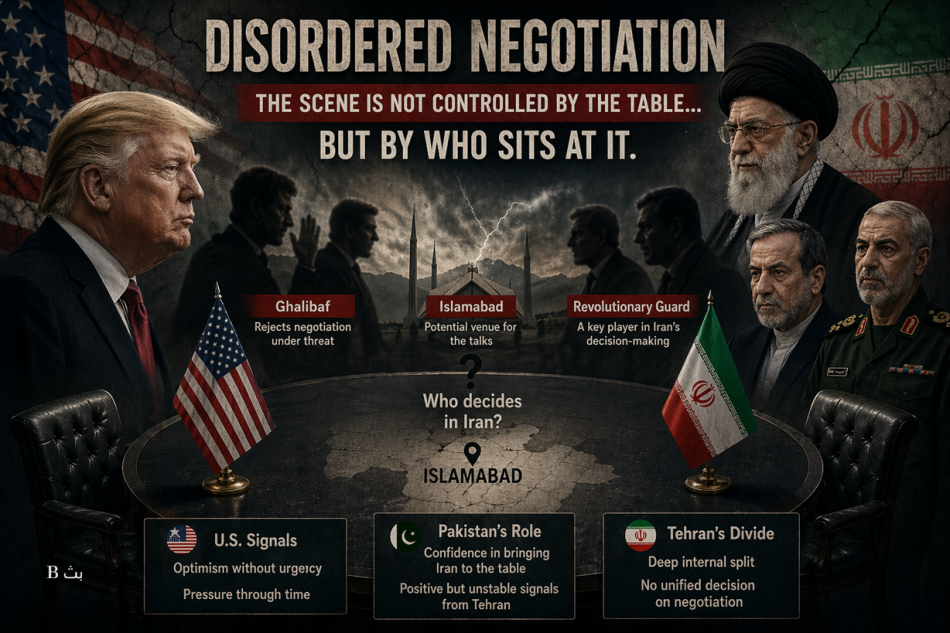
Ambiguity is intensifying around the trajectory of U.S.–Iran negotiations, amid overlapping political signals and internal divergences in Tehran, contrasted with accelerating diplomatic movement in Islamabad. The scene reflects not merely a stall, but a struggle over who controls the decision to negotiate.
Overview
Iranian Parliament Speaker Mohammad Bagher Ghalibaf declared Tehran’s refusal to negotiate under threat, emphasizing readiness to “reveal new cards on the battlefield,” a statement carrying more military than diplomatic weight.
Meanwhile, U.S. President Donald Trump delivered mixed signals—expressing optimism about a potential agreement, while stressing he is “in no rush” to end the conflict, indicating a strategic use of time as leverage.
Multiple sources pointed to the possibility of both delegations arriving simultaneously in Islamabad, with expectations of talks beginning Wednesday morning. However, the Iranian delegation’s participation remains uncertain amid what is described as an internal divide between Ghalibaf and Foreign Minister Hossein Amir-Abdollahian, alongside the influence of the Islamic Revolutionary Guard Corps.
CNN cited U.S. officials noting signs of this division, while White House spokesperson Caroline Leavitt stated that Washington is “closer than ever” to reaching an agreement, despite ongoing uncertainty.
In parallel, Pakistan expressed confidence in its ability to bring Tehran to the negotiating table, citing “positive yet unstable signals” from the Iranian side.
Analysis
The question is no longer whether negotiations will take place,
but who holds the authority to decide in Iran.
The contrast between political rhetoric and field-oriented statements reveals an internal power struggle, where decision-making appears fragmented between state and military institutions. This division not only obstructs negotiations but redefines them as an internal contest rather than a purely external process.
In contrast, Washington is managing the scene with calculated restraint—no urgency to conclude, yet maintaining sustained pressure. This balance between escalation and de-escalation provides broader maneuvering space, placing Tehran under a test of decision-making, not capability.
Outlook
If talks proceed, they will test Iran’s ability to unify its stance.
If they collapse, it will signal that internal conflict in Tehran outweighs its external confrontation with Washington.
The scene is not controlled by the table… but by who sits at it.
Escalating Interceptions of Iranian-Linked Vessels
U.S. maritime enforcement measures are intensifying around the Strait of Hormuz, with field operations targeting vessels linked to Iran, within an expanding scope of naval control.
Reports indicate that the U.S. Navy boarded the Iranian vessel “Tiffany,” in the second such operation following the interception of the vessel “Tosca,” signaling a rising pace of on-the-ground actions in the region.
In the same context, the United States Central Command (CENTCOM) announced the imposition of a naval blockade and maritime control in the Gulf of Oman and the Arabian Sea, east of the Strait of Hormuz, confirming that its forces are conducting boarding, interception, and rerouting operations against vessels attempting to violate this blockade to and from Iranian ports.
B BATH Analysis
The U.S. move should not be read as a limited tactical action, but as a reshaping of the rules of maritime engagement in one of the world’s most critical energy corridors.
The message goes beyond the targeted vessels… extending to the shipping lanes themselves.
Conflicting Statements.. Multiple Messages
U.S. President Donald Trump returned to Truth Social with a series of posts reflecting a recurring pattern of mixed messages—combining assertions of control, downplaying the role of time, and keeping the door open for a potential deal.
In one of his most notable posts, Trump said:
“I’m in no rush to make a deal with Iran.”
In another, he stated:
“I’m in charge!”
He also stressed that any potential agreement would be:
“Much better than the previous deal.”
At the same time, he hinted at the possibility of reaching a deal soon, without specifying a clear timeframe—adding further ambiguity to the negotiation track.
B بث Analysis
What stands out in these statements is not each quote on its own…
but the way they are delivered together at the same time.
- No urgency
- Full control
- Promise of a better outcome
- And a signal of a near deal
This overlap does not merely reflect apparent contradiction,
but points to a style based on managing pressure through rhetoric, rather than resolution.
Conclusion
When messages multiply… clarity diminishes.
Trump: Division Within Iranian Leadership… and Pakistani Request to Halt the Attack
Donald Trump pointed to a sharp division within the Iranian leadership, in a development that reflects the complexity of the political landscape in Tehran, alongside diplomatic moves to contain the escalation.
Trump said that Pakistan requested a temporary halt to the attack, to allow time to address the division within Iran’s leadership, indicating a regional role seeking to contain tensions and avoid further escalation.
These statements reflect the overlap between the military and political tracks, as escalation cannot be read in isolation from attempts to reorganize decision-making centers within Iran.
B بث
The statement goes beyond merely describing an internal situation…
to become a tool of political pressure.
Referring to an “internal division” weakens the image of cohesion,
and opens the door to leveraging this division in either negotiation or escalation.
Pakistan’s involvement reflects an attempt to create a time window,
not only to halt the attack…
but to rearrange the internal landscape.
The battle is no longer only on the ground…
but inside decision-making rooms.