



Day 50: A Fragile Ceasefire
Monitoring & Analysis | B | بث
—
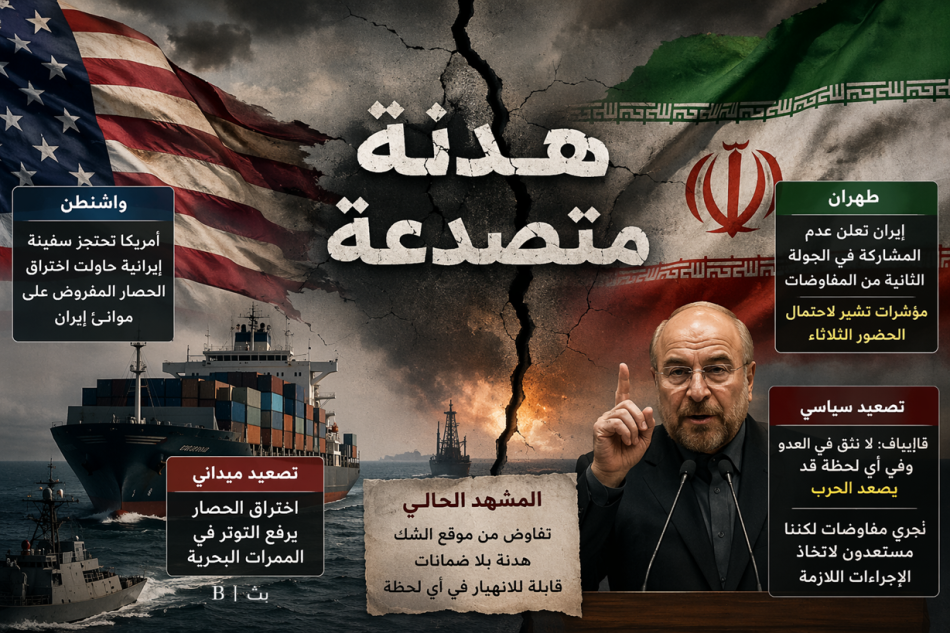
Fears increased today, Monday, of a potential collapse of the ceasefire between the United States and Iran, amid military and political developments reflecting the fragility of the truce, ahead of its expected expiration tomorrow, Tuesday.
The United States announced the detention of an Iranian cargo ship that attempted to breach the blockade imposed on Iranian ports, in a move Tehran described as an escalation that warrants a response, raising tensions in maritime routes.
On the political track, Iran announced it would not participate in the second round of negotiations, before later indications suggested the Iranian delegation may attend tomorrow, reflecting divergence in the negotiating decision.
Meanwhile, Iran’s Parliament Speaker and chief negotiator, Mohammad Bagher Ghalibaf, escalated his tone, stating that his country “does not trust the enemy,” and is prepared to take necessary measures at any moment, despite continuing negotiations.
B |
The situation is moving toward a ceasefire without guarantees:
- field escalation (ship detention)
- political hesitation (uncertain participation)
- hardline rhetoric (lack of trust)
These indicators mean that negotiations are continuing…
but from a position of doubt, not trust.
The ceasefire has not turned into stability,
but remains a temporary tool to manage escalation.
The ceasefire holds…
but it is vulnerable to collapse at any moment.
The Truce Is Eroding
Fears increased today, Monday, of a potential collapse of the ceasefire between the United States and Iran, after Washington detained an Iranian cargo ship it said had attempted to breach the blockade imposed on Iranian ports, in a new escalation that puts the path of de-escalation to a real test.
Amid this tension, Iranian President Masoud Pezeshkian affirmed that war “is not in anyone’s interest,” calling for the adoption of rational and diplomatic paths to reduce escalation with the United States.
However, he stressed at the same time that “lack of trust and vigilance in dealing with Washington are a necessity that cannot be debated,” reflecting continued Iranian caution despite the diplomatic tone.
In a notable development, Tehran officially settled its position by announcing it would not participate in the anticipated second round of negotiations, as Foreign Ministry spokesperson Esmail Baghaei confirmed that “there is currently no plan for a second round of talks with the United States.”
B |
The scene reveals a clear equation:
- diplomatic rhetoric rejecting war
- a political stance rejecting negotiations
- and field escalation raising the cost
This means that de-escalation has not turned into a stable path,
but remains a temporary condition vulnerable to collapse.
Calls for peace continue…
but the tools of conflict are advancing.
Shift Toward Targeting Proxies
The U.S. Embassy in Baghdad renewed its warnings about escalating activities by militias linked to Iran, in an indication that the scope of tension is expanding from direct confrontation to targeting regional proxies.
The embassy stated that militias allied with Iran continue to plan attacks against U.S. citizens and U.S.-related targets across Iraq, including the Kurdistan Region.
It also pointed to the presence of actors within Iraq providing political and financial cover to these militias, further complicating the security landscape and increasing the likelihood of escalation.
B |
The warning should not be read as a mere security alert…
but as a signal of a shift in the course of confrontation:
from pressure on the state… to targeting proxies.
This means:
- expanding the scope of response
- increasing the cost of indirect actions
- and attempting to dismantle Iranian influence beyond its borders
The confrontation does not stop at Iran…
but extends to its proxies.
Escalation via Truth Social
U.S. President Donald Trump escalated his tone on Monday through his platform “Truth Social,” in a series of statements reflecting a shift in U.S. messaging from negotiation pressure to direct warning, amid stalled talks and rising tensions in the Strait of Hormuz.
Trump accused Iran of a “complete violation” of the ceasefire agreement, referring to gunfire incidents in the Strait of Hormuz involving a French vessel and a British freighter, which he described as a serious escalation.
He confirmed that a U.S. delegation will head to Islamabad to continue negotiations despite the escalation, indicating that the diplomatic track is ongoing under pressure.
In a new press statement, Trump said he does not see it necessary to personally attend the Pakistan negotiations, emphasizing that talks can proceed at the delegation level.
He also stressed that the blockade will remain in place until an agreement is reached, signaling the continued use of economic pressure alongside diplomacy.
In his most forceful remarks, Trump warned of a broad military response, stating that the United States would target “every power plant and every bridge in Iran” if no agreement is reached, adding that Washington is offering a “fair deal” that Tehran should accept.
B |
Trump’s statements today are not a passing escalation…
but a shift in the structure of U.S. negotiations:
- negotiations led by delegations, not leaders
- sustained blockade as a constant pressure tool
- comprehensive threats as a direct alternative
This indicates that Washington is not treating negotiations as a conventional political process,
but as part of a broader pressure strategy.
Trump’s absence from the negotiation table carries a clear message:
the issue has not yet reached a stage of political resolution…
but remains in the phase of testing conditions.
Negotiations continue…
but under the logic of pressure, not compromise.
When leaders step back…
pressure steps forward.
Tehran Retreats
Iran has backed down and announced that it will send its negotiating delegation to Pakistan on Tuesday, headed by Mohammad Bagher Ghalibaf, after reversing an earlier position of non-participation, in a move reflecting a clear fluctuation in the negotiating decision.
The Iranian decision came after a series of contradictory positions over several days, between announcing a boycott, then retreating, then confirming attendance, reflecting a repeated pattern in the management of the negotiating file.
It is noteworthy that Tehran kept the same previous delegation, without any change in representation or approach, despite rising military and economic pressure, indicating that there is no real shift in the structure of the decision, but rather movement within the same framework.
B |
What is happening should not be read as a passing fluctuation…
but as a negotiating pattern based on:
- raising the ceiling
- creating confusion
- then returning without resolution
This is not “negotiating flexibility”…
but what can be described as negotiating chaos.
A pattern that relies on:
- wrangling
- provocation
- and prolonging time
It is an entrenched method in Iranian political behavior,
not aimed at resolution…
but at managing the conflict without ending it.
But on the other hand,
the equation has changed:
U.S. pressure today is not merely negotiational…
but a combined pressure (military + economic + field-level)
which means that Iran’s room for maneuver has become narrower.
Here, a decisive point emerges:
Not every Iranian retreat is “tactical”…
some of it is a response to pressure.
**Iran negotiates…
but in a style of chaos,
and pressure is what determines the limits of this chaos.**
When negotiations turn into chaos…
pressure becomes the only language of understanding.