



Day 49: Hormuz on the Edge
Riyadh | B | BETH
02 Dhu al-Qi'dah 1447 AH | 19 April 2026
The world is watching April 22, the scheduled end of the temporary ceasefire between the United States and Iran, while the Strait of Hormuz remains closed, amid renewed escalation placing the region at a decisive crossroads between de-escalation and potential conflict.
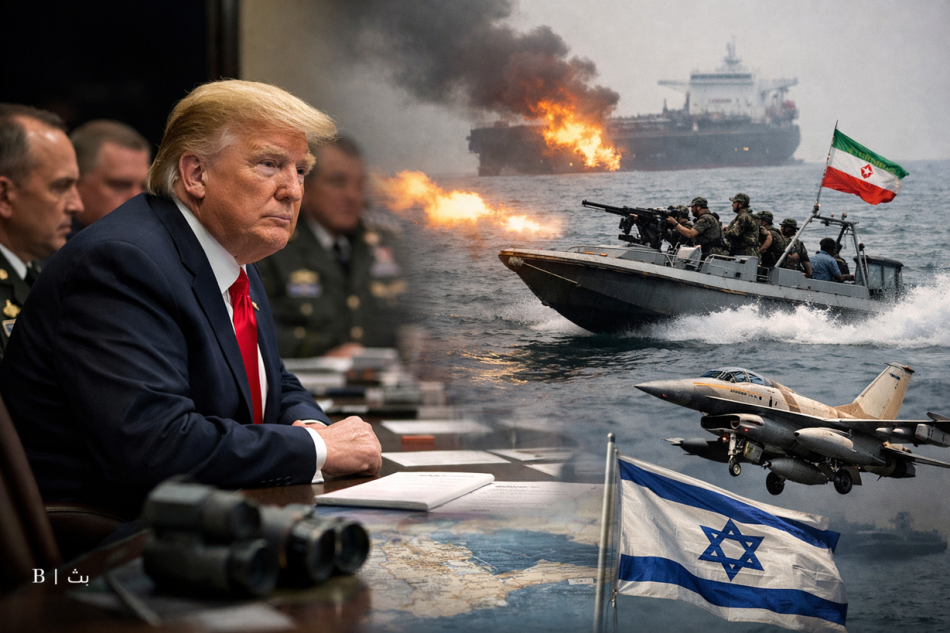
Tensions in the Strait of Hormuz escalated after Iran reversed its decision to reopen the waterway, with Iranian forces announcing its closure and reportedly firing on vessels attempting to pass, describing the move as a response to the continued U.S. blockade on Iranian ports.
The Islamic Revolutionary Guard Corps confirmed that the strait will remain closed until the blockade is lifted, warning that any vessel attempting to approach would be targeted, in a direct escalation threatening one of the world’s most critical energy routes.
In response, U.S. President Donald Trump convened an emergency meeting in the White House Situation Room to assess the renewed escalation and the future of ongoing negotiations with Iran via Pakistan, as anticipation builds over potential announcements in the coming hours.
Simultaneously, Israeli media, citing a military official, reported that Tel Aviv is awaiting a U.S. announcement to terminate communications with Tehran ahead of expected talks in Islamabad, amid growing expectations of a return to military confrontation.
The official added that the Israeli military and air force are on high alert in preparation for a possible sudden collapse of the ceasefire.
In parallel, Trump reiterated his support for Israel, describing it as a “great ally” of the United States, in remarks that coincide with heightened military readiness and reflect alignment between Washington and Tel Aviv at this stage.
B |
The situation is not a standalone escalation…
but a recalibration of pressure ahead of a decisive moment.
The closure of Hormuz is not a final decision…
but a high-stakes negotiating lever.
Meanwhile, Washington is operating on dual tracks—military and political—
balancing Situation Room deliberations with continued diplomatic engagement,
indicating a strategy of pressure without a full break in negotiations.
Israel, for its part, is acting on a doctrine of preemptive readiness,
where any political hesitation is viewed as a window to be closed militarily.
Conclusion
The ceasefire has not yet ended…
but it is no longer stable.
Hormuz is not merely closed…
it has become a testing ground for the wills of three actors:
Iran… the United States… and Israel.
B |
We are not yet at a decision for war…
but at a moment where its terms are being shaped.
A New Negotiation Toward the “Tent”
In Pakistan… A New Test of Intentions
The U.S. negotiating delegation has arrived in the Pakistani capital, Islamabad, at the start of an anticipated round with the Iranian side, which is expected to join within hours, at a sensitive moment ahead of the end of the ceasefire, amid renewed escalation in the Strait of Hormuz and global anticipation of the course of the talks.
This round comes amid a clear divergence between de-escalation and escalation, as Iran continues to impose restrictions on navigation in the Strait of Hormuz, after reversing its decision to reopen it in less than 24 hours, in a move that reflects the complexity of the situation and the overlap of political and military calculations.
In this context, the negotiations do not appear to be heading toward a final agreement, but rather toward recalibrating tensions, by establishing temporary lines, testing intentions, and managing escalation without reaching a decisive resolution.
A key question arises here: who guarantees compliance?
In reality, there is no traditional guarantor.
Guarantees do not come from signatures, but from the balance of power, the cost of violation, and field verification mechanisms, within a negotiating environment based more on continuous monitoring than on mutual trust.
Iranian behavior—such as the rapid reversal in the Hormuz file—is understood within the framework of tactical flexibility, used to raise the negotiation ceiling and improve positioning, without a fixed final commitment.
B |
The scene does not reflect conventional negotiations…
but the management of conflict through negotiating tools.
Iran negotiates and pressures at the same time,
while the United States observes and tests without declaring a final decision.
The result:
a fragile balance,
where everyone moves… without trusting anyone.
The outcome of this round will not be measured by what is signed…
but by what escalation stops.
In these negotiations…
no one guarantees anyone…
everyone watches everyone.
Will It End in “Safwan”?
The “Safwan tent” symbolizes a decisive ending under the conditions of one side after a clear field collapse.
What is happening now:
no complete collapse,
shifting balances of power,
and negotiations proceeding alongside pressure.
What is currently taking place is closer to managing a conflict…
not drafting a document of surrender.
In a notable statement, U.S. President Donald Trump affirmed that an agreement with Iran “will happen… whether amicably or by force,” a message that encapsulates the next phase between two options: negotiation… or imposition.
Contest for Control
Trump: Iran’s announcement of closing the Strait of Hormuz is surprising, as we are effectively blockading the strait.
When he says they are “effectively blockading the strait,”
he is seeking to strip the Iranian announcement of its negotiating value.
The meaning:
Iran does not hold full control…
but operates within a reality shaped by Washington.
The Final Opportunity
U.S. President Donald Trump stated that Iran faces a “final opportunity,”
a statement that—on the face of it—is not a call for negotiation as much as it is a raising of the pressure ceiling ahead of a decisive moment.
He is defining the framework of the next phase:
the door to negotiations remains open… but under conditions,
and the alternative is no longer ambiguous… but clearly implied.
This type of rhetoric serves three purposes:
- forcing the other side to make a rapid decision
- preparing public opinion for potential escalation
- shifting full responsibility onto Iran
In essence:
Trump is not offering an opportunity…
he is setting a deadline for choices.
Direction of the Agreement
U.S. President Donald Trump affirmed that the blockade on Iran will continue alongside the negotiations, indicating his readiness to travel to Pakistan if an agreement is reached.
This statement shifts the negotiations from a technical level… to a direct political announcement level.
The blockade is not new,
but the destination is the key message:
an indication that an agreement is taking shape.
Divergence within Tehran
Indicators of divergence within Iran’s decision-making centers are increasing,
with differing tones between the diplomatic track and field-level statements,
as these signals coincide with a sensitive round of negotiations.
This divergence reflects a lack of full alignment in managing the file…
or a deliberate management of two tracks:
negotiation… and pressure.
A Delayed Agreement
Despite unconfirmed reports suggesting a nearing U.S.–Iran agreement, current indicators show the process remains far from resolution, particularly as assessments point to the Islamic Revolutionary Guard Corps exerting decisive influence over Iran’s negotiating stance, while talks continue amid concerns over a rushed and incomplete framework deal.
Negotiations are ongoing under sustained field pressure, with no signs of a fully concluded agreement. What is currently being discussed appears closer to a potential political framework rather than a complete, implementable settlement, while European diplomats have expressed concern that rushing into a framework announcement could lead to technical and political complications later.
Meanwhile, Iranian actions—especially regarding the Strait of Hormuz—reflect a fluctuating pattern between de-escalation and escalation, following Tehran’s reversal on reopening the strait and the reimposition of control, which weakens the prospects for a stable and swift agreement.
Indicators also point to divergence within Iran’s decision-making centers, where the diplomatic track advances at times while the military track maintains a high level of pressure, making any political understanding vulnerable unless resolved within Iran’s internal structure.
New Development
The situation became more complex following a statement by U.S. President Donald Trump that “a framework for an agreement with Iran is now ready.”
This statement does not necessarily indicate that a final agreement has matured, but rather suggests that a preliminary political formula is under discussion, while key issues remain unresolved—particularly enrichment levels, verification mechanisms, and the nature of mutual commitments.
B |
Trump’s statement about a “ready framework” should not be read as a final breakthrough, but as an attempt to raise political momentum and signal progress in negotiations, even as critical technical and sovereign issues remain unresolved.
In simpler terms:
the framework may be ready…
but the agreement itself is not.
This distinction is crucial, as the real risk at this stage lies not only in the absence of a final deal, but in the premature announcement of an agreement whose implementation details remain unsettled.
In this context, the situation appears closer to managing a conflict rather than concluding one.
The United States negotiates under pressure,
while Iran maneuvers within complex internal balances,
with the Revolutionary Guard remaining a decisive factor in any obstruction or reinterpretation.
Should this “framework” falter, it cannot be ruled out that Washington—potentially with Israeli backing—may move to increase the cost of obstruction, in an effort to break the will of the more hardline factions within Iran.
The agreement is being discussed…
but its conditions have not yet matured.
What appears “ready” is a political framework suitable for announcement,
not a final agreement capable of lasting… at least for now.
A Strong Warning from Trump
In a notable escalation, a post by U.S. President Donald Trump on his platform “Truth Social” carried a direct indication of forcing Iran into submission, by combining the offer of a “fair deal” with an explicit threat to target infrastructure comprehensively, in a tone that goes beyond negotiation toward imposing will by force.
Trump accused Iran of violating the ceasefire by firing in the Strait of Hormuz, considering that Tehran “is losing daily” with the continued closure of the passage, while confirming that a negotiating delegation will still be sent to Pakistan, reflecting the continuation of the negotiation track despite escalation.
On the other hand, Iran’s official IRNA agency reported that Tehran refused to participate in the second round of talks, citing “unreasonable U.S. demands” and the continuation of what it described as a naval blockade.
However, other Iranian agencies reported that no final decision has been made yet, describing the atmosphere as “not very positive,” and linking participation to the lifting of the blockade on Iranian ports.
Meanwhile, Israeli Prime Minister Benjamin Netanyahu escalated his tone, affirming that the confrontation with Iran “has not ended,” hinting at possible developments at any moment.
B |
The American post was not a passing statement…
but a redefinition of the negotiation path:
- an offer of a deal… under conditions of power
- a comprehensive threat… as a direct alternative
- and continued negotiations… without easing pressure
This means that Washington is not negotiating to reach a middle ground,
but to reach a point of submission under its terms.
In contrast, the Iranian position appears hesitant:
- a declared rejection
- an implicit retreat
- and internal divergence in decision-making
which reflects the difficulty of reaching a final decision under external pressure and internal escalation.
We are not facing balanced negotiations…
but an attempt to impose an outcome.