



Hormuz: Negotiation with Two Faces
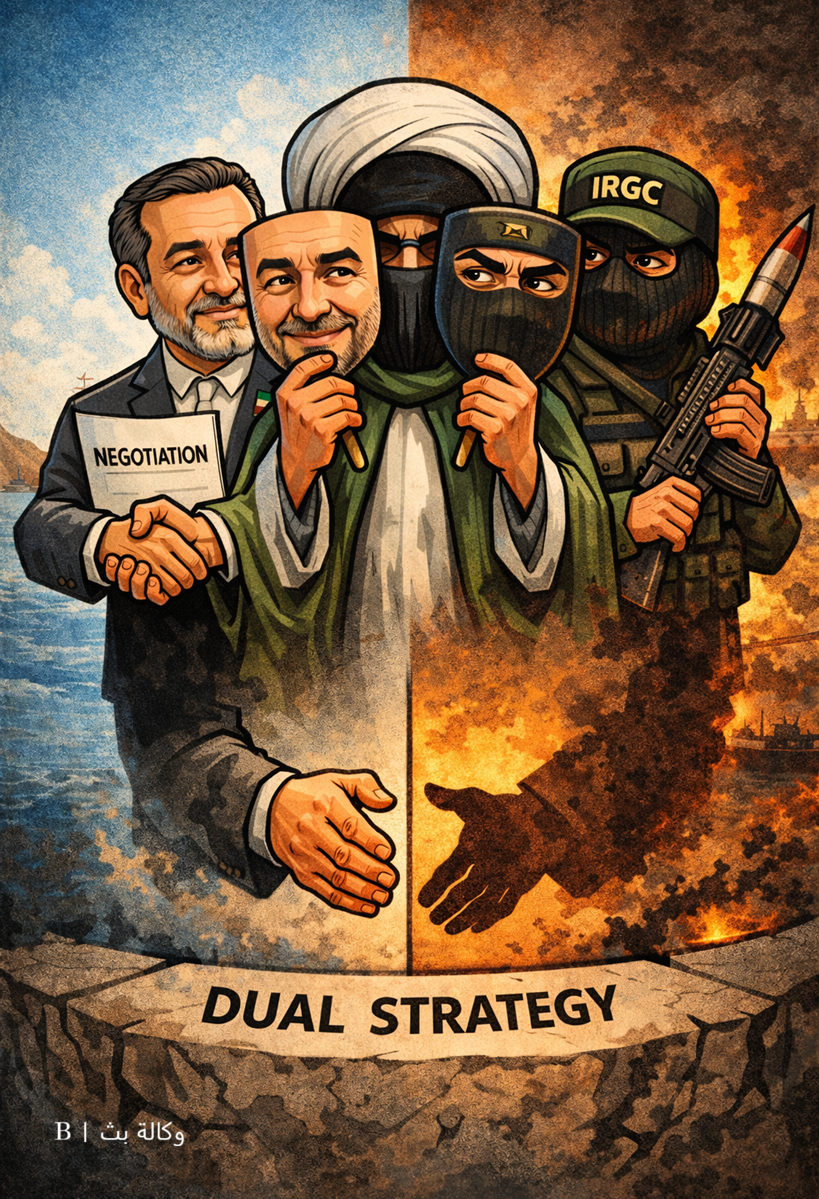
Prepared and Analyzed by | Strategic Media Department – BETH | B
The U.S. President Donald Trump held a press conference in which he announced the signing of several domestic executive orders, amid notable anticipation for a statement regarding developments with Iran, particularly following the Islamic Revolutionary Guard Corps’ announcement of reimposing restrictions on the Strait of Hormuz.
Earlier today, Saturday, the Islamic Revolutionary Guard Corps had announced the reimposition of restrictions on the strait, less than 24 hours after Tehran declared it open to commercial navigation, in a rapid shift that reflects the complexity of decision-making in Iran and raises a key question: is what is happening a contradiction… or coordination?
As the conference began, more than fifteen minutes passed without Trump addressing the Iran file or the Strait of Hormuz, before he spoke briefly, confirming that “things are going very well,” and that “we are still talking to the Iranians,” stressing that “Iran cannot blackmail the United States.”
He added that information regarding the situation in the Strait of Hormuz would be available by the end of the day, indicating that Tehran “may be looking to close the strait again,” before making a notable remark: “I don’t know why we waited 47 years to confront Iran.”
At the conclusion of his remarks, Trump shifted to domestic affairs, addressing the issue of drug prices, which took up the majority of the press conference, including medications approved for treating depression.
B | BETH Analysis
Breaking Down Trump’s Statement
- “Things are going very well”
A calculated reassurance message to markets, allies, and public opinion.
Implicit meaning: the situation is under control. - “We are still talking to the Iranians”
A clear affirmation of the negotiation track.
No full-scale escalation… the file remains politically open. - “Iran cannot blackmail the United States”
Raising the pressure ceiling.
A rejection of imposed conditions, with a potential prelude to a response if red lines are crossed. - “We will have information on Hormuz by the end of the day”
The most critical point in the conference.
Indicates that no decision has been announced yet… or that developments are still forming. - “It seems Iran wants to close the strait again”
Shifting responsibility to the other party.
A classic prelude to any potential next step. - “I don’t know why we waited 47 years”
The most dangerous statement in the speech.
Not spontaneous… but strategic mobilization justifying any potential escalation.
Deeper Reading
Trump did not announce escalation…
nor did he announce de-escalation…
Instead, he did the most calculated move:
he left all options open… and raised the psychological ceiling.
His shift to discussing drug pricing was not random,
but a deliberate separation between an open external file and a controlled domestic narrative,
reinforcing the message: “We are managing the situation.”
Conclusion
Trump did not remain silent…
he managed the silence.
He reassured…
he pressured…
he kept negotiations open…
and he postponed the decision…
all within minutes.
B | BETH Reading
He did not speak about Iran as much as he defined the framework for dealing with it.
He did not announce a decision…
he announced that a decision has not yet been made.
Key Indicator
“Information by the end of the day”
Only then will it become clear:
Are we heading toward escalation…
or a recalibration of negotiations?
Earlier today, Saturday, the Islamic Revolutionary Guard Corps had announced the reimposition of restrictions on the Strait of Hormuz, less than 24 hours after Tehran declared it open to commercial navigation, in a rapid shift that reflects the complexity of decision-making in Iran and raises a key question: is what is happening a contradiction… or coordination?
Body
The scene appears as if Foreign Minister Abbas Araghchi opens a window, while the Revolutionary Guard closes it.
However, a deeper reading suggests that this divergence is not necessarily an internal conflict, but may be a calculated distribution of roles.
Iran manages its decision through three overlapping circles:
a political circle that negotiates,
a military circle that applies pressure,
and an ideological circle that regulates the rhythm.
Within this framework, no actor moves in isolation, but rather within a unified system that allows for the creation of a “calculated duality”:
an open negotiation window…
and a high pressure ceiling at the same time.
Here, what appears to be contradiction transforms into a complex negotiation tool, allowing Iran to advance a step and retreat another without losing balance.
BETH | B Analysis
The question is not:
Is Araghchi carrying the flame… while the Guard extinguishes it?
But rather:
Is the flame itself part of the game?
Indicators suggest that what is happening is implicit coordination, where the diplomatic front is used to ease pressure, while the military institution maintains the level of threat.
This model is not managed by a single mind, yet it is not random either.
It is a system that negotiates with two faces:
a face that speaks…
and a face that signals.
Outcomes and Expectations
In this context, it does not appear that the United States is moving toward “eliminating” one side within the Iranian system, as the realistic approach to such a model is based on containing behavior, not restructuring the system at this stage.
As for Donald Trump’s response, it is likely to follow the same dual-pressure formula:
escalation in rhetoric…
while keeping the door to an agreement open.
We may hear a firm tone asserting that “Iran does not comply,”
alongside indications that the opportunity remains “if Tehran adheres to clear conditions.”
Conclusion
What is happening is not a conflict between two men…
but coordination between two tracks.
Negotiation continues…
and pressure continues…
Hormuz is no longer just a maritime passage,
but a stage on which a battle of wills is being managed.
Is trust built on individuals… or on the structure of decision-making, in such a system?
And does this affect negotiations… or has the decision already been made, making negotiation merely formal?
Trust is built on the structure of decision-making… not on individuals.
In a multi-centered system, trust remains partial and conditional, because decisions do not originate from a single authority.
This affects negotiations, slowing commitment and keeping doubt present,
but it does not make them purely formal… rather, it turns them into a parallel pressure tool to the battlefield, used to extract better terms without reaching a final resolution.
Ideological symbols are used to mobilize the domestic audience and raise the ceiling, while decisions on the ground are managed through calculations of cost and deterrence; therefore, escalation remains calibrated, not a rush toward total destruction.
On the Brink of Collapse
The outcome will not be a swift, decisive resolution…
but rather attrition and adaptation.
The ball is not in a single field…
but across overlapping arenas, and Trump is one of the key players, not the owner of the game.
Iran gains in endurance and maneuvering,
but is being economically drained under sustained pressure,
and the game remains open with no point of resolution.
The Strike
Iran has not lost… but victory is difficult,
and the path to victory runs through the decisions of others.
B | BETH Forecast
48 hours… enough to reveal most of the picture.