Saudi Land Bridge Design .. Rail Link Connecting the Red Sea to the Arabian Gulf

Riyadh | B
28 Shawwal 1447 AH | 16 April 2026
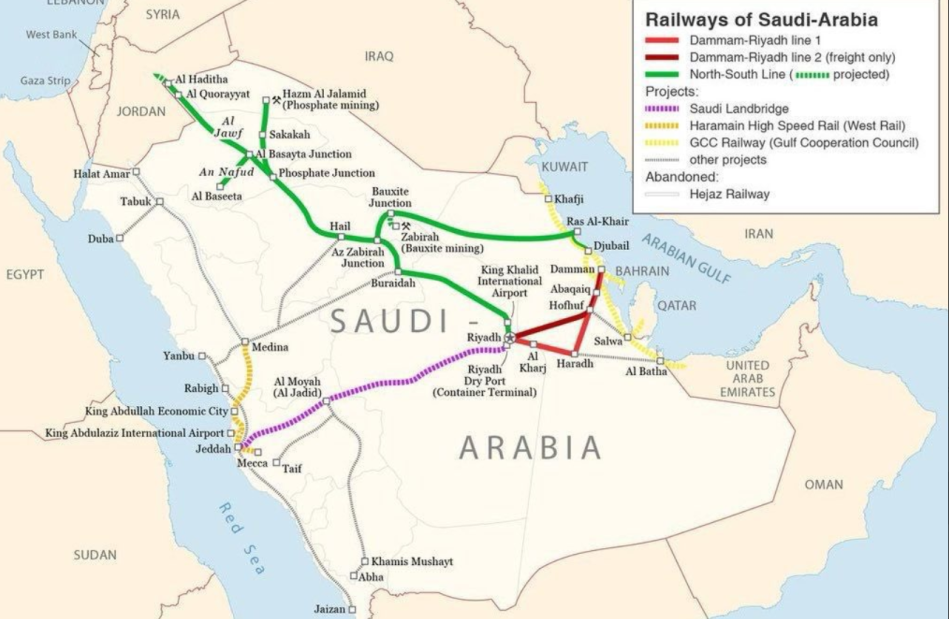
Spain’s Sener has won the design contract for the Saudi Land Bridge project, which connects the eastern and western regions of the Kingdom through a railway network exceeding 1,500 kilometers, with an estimated cost of around $7 billion. The move reflects accelerating progress on one of Saudi Arabia’s most prominent logistics projects under Vision 2030.
The Saudi Land Bridge project is witnessing notable progress following the award of the design contract, according to MEED magazine, signaling renewed momentum for the long-awaited project aimed at linking the Red Sea to the Arabian Gulf and enhancing transport and trade efficiency within the Kingdom.
The contract award follows a tender issued by the Saudi Railway Company (SAR) in 2025, with bids evaluated through the end of that year, before selecting Sener as a key technical contributor at this stage.
The project spans approximately 1,500 kilometers, connecting Jeddah on the Red Sea with Dammam and Jubail on the Arabian Gulf, contributing to reduced cargo transit times and improved efficiency across industrial corridors.
The project is now entering an advanced planning phase, with the new design contract supporting the development of engineering concepts and detailed designs. Authorities have adopted a phased execution model instead of a single large public-private partnership, aiming to enhance flexibility and accelerate implementation.
Project management remains under a consortium including Hill International, Italferr, and Sener, reflecting the integration of global expertise in engineering, program management, and execution strategies.
Current work builds on designs completed in 2017, with updates covering routes, operational systems, and the segmentation of construction packages, in preparation for multiple design-and-build tenders, including connections to Riyadh.
Passenger trains are expected to reach speeds of up to 250 km/h, while freight trains will operate at speeds of up to 160 km/h, significantly enhancing operational efficiency.
B Analysis
The Saudi Land Bridge represents a strategic transformation in the Kingdom’s transport infrastructure, effectively reshaping logistics by linking major seaports with inland industrial hubs, thereby reducing reliance on traditional maritime routes around the Arabian Peninsula.
The project also strengthens Saudi Arabia’s position as a trade corridor connecting Asia, Europe, and Africa, offering a faster and more efficient alternative for cargo transport, and boosting the competitiveness of the national economy.
Adopting a phased execution model reflects a practical approach to risk reduction and faster delivery, while leveraging international expertise in large-scale infrastructure development.
Conclusion
The award of the Saudi Land Bridge design contract confirms the project’s transition into a more advanced execution phase, as the Kingdom continues its transformation into a global logistics hub. Upon completion, the project is expected to play a key role in supporting trade and enhancing economic connectivity, in line with Vision 2030 objectives.