



Religious Symbolism in the War of Narratives: Between Freedom of Expression and the Instrumentalization of Ideology
Prepared, Monitored, and Analyzed by the Strategic Media Department – B News Agency (B)
Supervised by: Abdullah Al-Omairah
Introduction
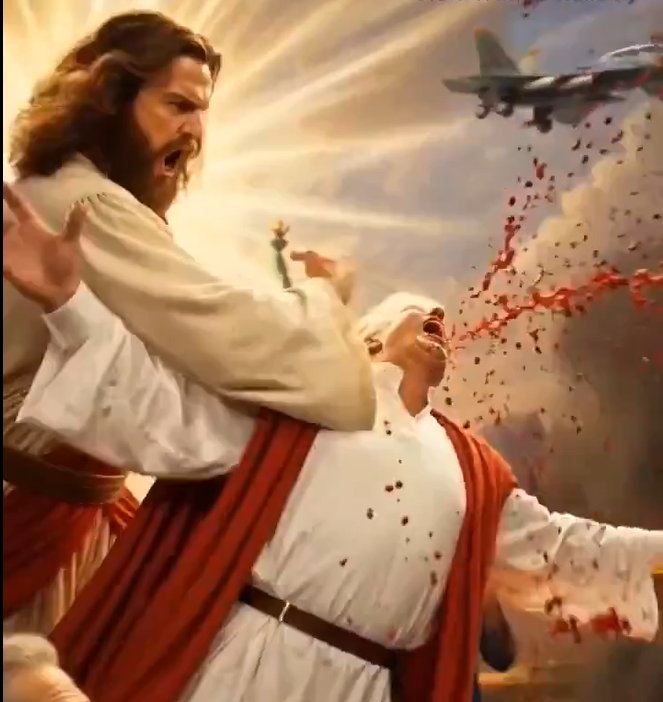
The circulation of a symbolic video depicting a religious figure in a violent scene targeting Donald Trump has sparked widespread debate, not only because of its shocking nature but also due to the profound political and ideological implications it carries beyond its artistic dimension. This event emerges within the context of the escalating war of narratives accompanying political conflicts, where religious symbolism intersects with freedom of expression. It raises fundamental questions about the influence of ideology on American society, the role of the media in shaping public awareness, and the boundaries of responsible freedom within democratic systems.
Description of the Video
The circulated video begins by portraying Trump in a religiously inspired role resembling a healer or savior. The symbolic narrative then shifts dramatically with the appearance of Jesus, who attacks and kills him before he is cast into a scene suggestive of hell. This transformation conveys a sharp symbolic message that does not aim to glorify the figure but rather presents him as an usurper of sanctity who deserves punishment.

Analytical Significance
This type of content transcends political satire, reaching the level of religious symbolic adjudication, where belief systems are employed to strip the opponent of moral and spiritual legitimacy. It represents one of the tools of media conflict that relies on emotional and symbolic influence to shape public opinion.
The Extent of American Society’s Belief in Ideology or “Myth”
American society is characterized by significant religious and intellectual diversity. Despite the presence of religion in public life, political and media institutions operate within a secular constitutional framework. Religious discourse is often used for symbolic or mobilizing purposes rather than forming the basis of governance, as is the case in theocratic systems. Consequently, the influence of such ideologies remains limited within the context of intellectual pluralism.
Potential Entities Behind the Production of the Video
The identity of the entity responsible for producing the video cannot be definitively established without reliable evidence. However, the analysis suggests several possibilities, including:
- Groups opposing Trump or his political movement.
- Organizations critical of the Republican Party.
- Satirical content creators operating within the framework of freedom of expression.
- Disinformation or foreign influence campaigns aimed at deepening political polarization.
Accordingly, the interpretation of such content remains within the realm of probabilistic analysis, avoiding direct accusations.
Impact of Such Content on Society and Political Leadership
American society is affected by such materials primarily within the boundaries of existing political polarization. These narratives tend to reinforce pre-existing beliefs rather than produce substantial shifts in public opinion. Political leaders may also capitalize on this type of content to strengthen their rhetoric, making its impact largely symbolic and political rather than structural.
Oversight and Accountability
Despite the broad scope of freedom of expression in the United States, a comprehensive system of oversight and accountability exists, including:
- A legal framework that criminalizes incitement to violence or hatred.
- Digital platform policies for content moderation.
- The role of media institutions and civil society in promoting accountability.
Thus, the landscape reflects a complex balance between freedom and responsibility.
Media Freedom as a Double-Edged Sword
Media freedom constitutes one of the most significant elements of the United States’ soft power. While it enhances transparency and pluralism, it can also be exploited to disseminate misinformation or manipulate religious beliefs to incite division. This underscores the importance of responsible freedom, grounded in professionalism and rigorous verification of information.
Differences and Similarities Between the United States and Iran
Key Differences
The political systems of the two countries differ fundamentally. The United States operates under a pluralistic democratic system characterized by the separation of powers and the peaceful transfer of authority through elections. In contrast, Iran is governed by a religious theocratic system based on the principle of Wilayat al-Faqih (Guardianship of the Jurist).
Media in the United States enjoy extensive freedom and diversity, whereas Iranian media are subject to strict restrictions and operate within a framework aligned with the ruling ideology. While ideology in the United States exerts limited political influence within a pluralistic environment, it forms the foundation of the political system in Iran. Additionally, accountability in the United States is institutional and legal, whereas mechanisms of accountability in Iran remain limited.
Points of Similarity
Despite these differences, both countries employ religious symbolism in political discourse, utilize media as tools in political conflicts, and experience the influence of ideology in shaping media narratives, albeit to varying degrees and through different mechanisms.
Is the Conflict a War Between “Two Myths”?
The conflict between the United States and Israel on one side and Iran on the other cannot be reduced to a confrontation between similar religious beliefs. Its primary drivers are geopolitical, security, economic, and strategic in nature. Nevertheless, religious and ideological discourse is sometimes employed by extremist factions as a means of mobilization and justification.
Despite these differences, a degree of similarity emerges in perceptions regarding the outcomes of war among certain groups in Iran and the West—particularly within religious Zionist circles—where eschatological narratives associated with salvation or ultimate resolution are invoked.
Politicization of Religious Beliefs
The Belief in the Mahdi in Iran
Belief in the appearance of the Mahdi forms part of Shiite doctrine, albeit with varying interpretations. Some political currents in Iran have politicized this belief to reinforce the legitimacy of the regime. It is important to emphasize that Iran does not represent Islam, and the politicization of belief differs from the authentic essence of Islamic doctrine.
Beliefs Related to the Second Coming of Christ in Zionist Thought
Certain Jewish and Christian Zionist movements hold eschatological views linking major wars to the appearance of the “Messiah.” However, these perspectives do not represent all Jews or decision-makers in Israel, as political decisions remain fundamentally strategic and security-oriented.
BETH Methodology: Promoting Awareness and Removing the Veil
In line with its media mission, B News Agency (BETH) adopts an approach centered on enhancing societal awareness and combating misinformation. Through balanced analytical content grounded in verification and contextual interpretation, this methodology seeks to remove the “veil” from audiences, enabling them to distinguish between truth and propaganda, professional analysis and misleading narratives, thereby contributing to the development of an informed society capable of understanding the complexities of the media and political landscape.
Conclusion
The circulated symbolic video represents a clear example of the use of religious symbolism within the war of narratives, highlighting the challenges associated with balancing freedom of expression and media responsibility. The comparison between the United States and Iran demonstrates that the ongoing conflict is not a war between myths but rather a geopolitical struggle in which religious symbolism is employed by certain extremist factions as a mobilization tool.
Professional media play a crucial role in uncovering truths and fostering awareness, thereby protecting societies from misinformation and misunderstanding.
Finally, no international power can be regarded as an absolute savior. Interpreting state actions solely through the lens of geopolitical interests may be insufficient to capture the full picture. History shows that some major transformations transcend declared calculations, contributing—intentionally or unintentionally—to restraining regimes or groups that have practiced violence and extremism. When injustice reaches its peak, forces capable of countering it emerge within the framework of historical laws governing the course of nations.