



Iran Between Mismanagement and Methodology: A Reading of Regional Outcomes
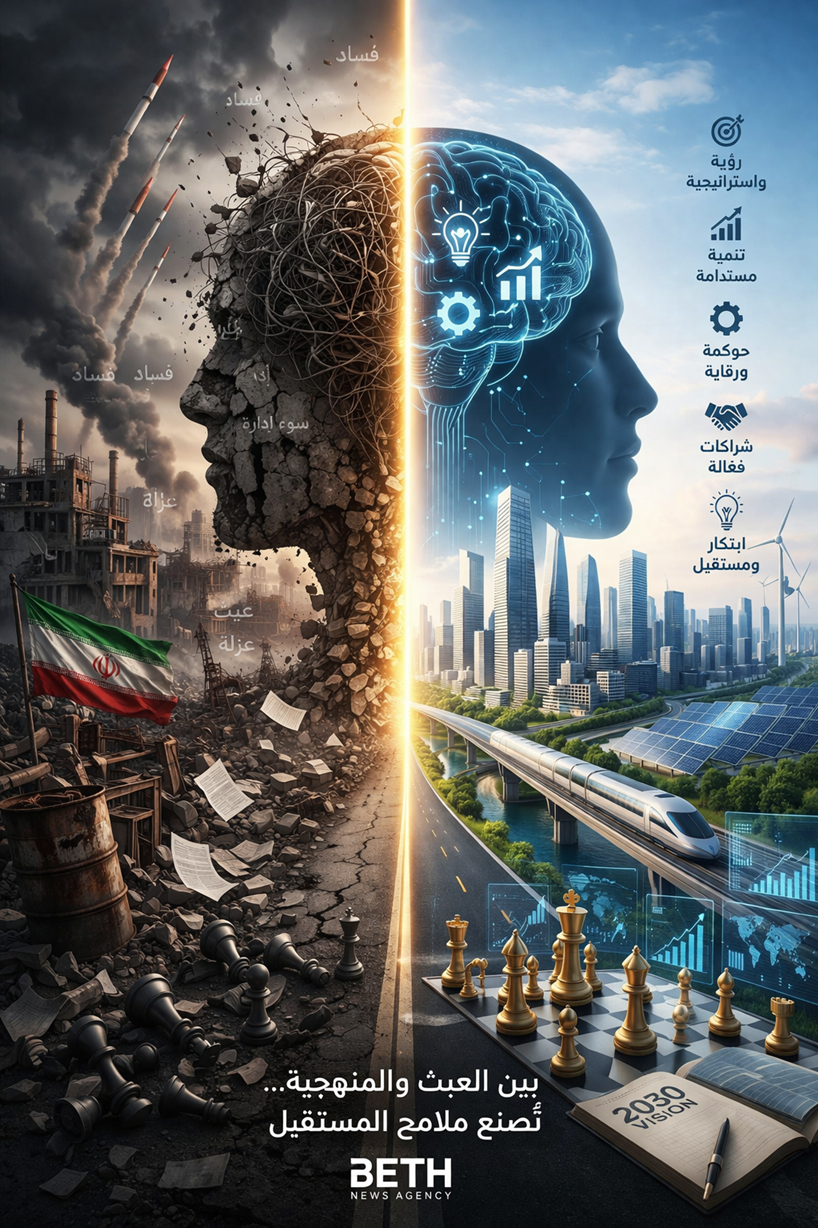
Prepared and Analyzed by | Strategic Media Department – BETH News Agency
Introduction
For nearly five decades, the Iranian regime has represented a model of state governance driven by an ideological perspective that prioritized military expansion and the building of regional influence, often at the expense of economic development and the well-being of its people. In contrast, the Gulf states—alongside the United States and Israel—have adopted more systematic models in resource management and power-building, based on strategic planning and sustainable development. This report aims to analyze the differences between these models and to explore the future of Iran and Gulf–U.S. relations in light of regional and international transformations.
First: The Difference Between Governance in the United States and Iran
1. Nature of the Institutional System
- United States: Relies on strong institutions, a clear separation of powers, and oversight and accountability mechanisms that ensure the sustainability and effectiveness of decision-making.
- Iran: Characterized by the concentration of power within narrow ideological circles and the dominance of religious and military institutions, limiting transparency and weakening administrative efficiency.
2. Allocation of Resources
- United States: Directs resources toward innovation, scientific research, and economic development while maintaining a balance between military strength and internal growth.
- Iran: Has heavily focused on developing military programs and regional influence, often at the expense of domestic development, infrastructure, and essential services.
3. Efficiency and Governance
- United States: Distinguished by advanced governance systems, clear performance indicators, and an environment that encourages talent and innovation.
- Iran: Faces significant challenges related to corruption, poor management, and weak institutional efficiency, which have negatively affected its economic and developmental performance.
4. Decision-Making Process
- United States: Decisions are based on strategic studies, think tanks, and specialized institutions.
- Iran: Decisions are often influenced by ideological or religious considerations, reducing flexibility and effectiveness.
Second: Did Washington and Tel Aviv Anticipate the Iranian Regime’s Downfall in This Manner?
Evidence suggests that the United States and Israel did not necessarily rely on a scenario of a “sudden collapse,” but rather on a gradual attrition strategy aimed at reducing Iran’s regional influence and weakening its economic and military capabilities.
Evidence on the Ground
- International economic sanctions that directly impacted the Iranian economy.
- Targeting of the nuclear program through political pressure and intelligence operations.
- Reduction of regional influence in certain arenas due to international and regional pressures.
- Increasing support for regional alliances that enhance the balance of power.
Conclusion
What is unfolding can be understood as the result of a long-term strategy to reshape regional balances rather than a sudden or unexpected event.
Third: Iran’s Gains and Future Prospects
1. Current Gains
- Possession of political influence in certain regional arenas.
- Development of military and missile capabilities.
- Maintenance of relative internal regime cohesion despite challenges.
2. Challenges
- Economic pressures resulting from sanctions.
- Decline in domestic development levels.
- Escalating social and political challenges.
- Relative international isolation.
3. Future Scenarios
A. Short-Term
- Continued economic and political pressures.
- Possibility of returning to the negotiating table.
- Repositioning of regional influence.
B. Long-Term
- Internal Reform Scenario: A gradual shift toward a more open and development-oriented model.
- Ideological Continuity Scenario: Persistence of the current approach with increasing pressures.
- Radical Transformation Scenario: Profound political changes that could reshape the structure of the regime.
Fourth: Gulf–U.S. Relations… Integration or Domination?
1. Evidence of Integration
- Long-term strategic partnerships in defense and energy.
- Growing economic and investment cooperation.
- Political and security coordination that enhances regional stability.
- Joint support for development and economic transformation projects in the Gulf states.
2. Indicators of a Changing Relationship
- Increasing strategic autonomy of Gulf states.
- Diversification of international partnerships (with China, Europe, and others).
- Strengthening of independent defense and economic capabilities.
Conclusion
Gulf–U.S. relations tend toward an integrative model based on mutual interests, rather than one of domination or control in the traditional sense.
Fifth: A Methodological Comparison Between Administrative Models
The comparison between the administrative models of the United States and the Gulf states on one hand, and Iran on the other, reveals fundamental differences in the philosophy of governance, resource allocation, and decision-making.
In terms of governance, the United States and the Gulf states rely on an institutional model grounded in strategic planning, clear distribution of authority, and well-defined roles, enhancing stability and sustainability. In contrast, the Iranian model is characterized by a centralized ideological nature, where political and doctrinal considerations intersect with decision-making, limiting flexibility and efficiency.
Regarding resource allocation, the United States and the Gulf states have focused on balancing military deterrence with economic development by investing in infrastructure, education, technology, and economic diversification. Conversely, Iran has prioritized enhancing its military capabilities and regional influence, often at the expense of domestic development and quality of life.
In governance and accountability, the United States and the Gulf states benefit from regulatory frameworks based on transparency, accountability, and performance indicators, which enhance institutional efficiency and public trust. Meanwhile, Iran faces significant challenges related to corruption and weak institutional performance, negatively affecting its economic and administrative outcomes.
With respect to economic stability, the United States and the Gulf states have achieved high levels of growth and economic diversification through well-planned financial and investment policies. Conversely, the Iranian economy continues to suffer from persistent pressures due to international sanctions and economic mismanagement, leading to declining growth rates and rising inflation.
Regarding future vision, the United States and the Gulf states are guided by clear long-term development strategies—such as Saudi Vision 2030—aimed at building diversified and sustainable economies. In contrast, Iran faces ambiguity in its future orientation due to continued reliance on ideological approaches and structural challenges that hinder reform.
Summary of the Comparison
This comparison demonstrates that the fundamental difference between the two models lies not merely in material capabilities but in the philosophy of governance itself. While one is based on institutional methodology and sustainable development, the other relies on ideological considerations—often focused on disruptive ambitions—which have limited Iran’s ability to achieve stability and prosperity.
It also reveals a clear divergence between a methodology centered on planning and development and an ideological approach that prioritized military expansion at the expense of societal welfare. These transformations are not sudden but rather the result of a long trajectory of strategic interactions.
Iran’s future will depend on its ability to redirect resources toward domestic development—an objective that does not fully align with the regime’s primary goals—while Gulf–U.S. relations are expected to continue within a framework of integrative partnership based on mutual interests, alongside increasing Gulf strategic autonomy.
Future Outlook
Short-Term
- Continued pressure on Iran with potential diplomatic de-escalation.
- Strengthening of security and economic cooperation between the Gulf states and the United States.
- Reconfiguration of certain regional balances.
Long-Term
- The possibility of Iran transitioning toward a more open and development-oriented model.
- Consolidation of the Gulf states’ position as global economic hubs.
- Evolution of Gulf–U.S. relations toward a multi-dimensional strategic integrative partnership.