



Day 44: U.S. Blockade of Iranian Ports and Escalating Tensions over the Strait of Hormuz
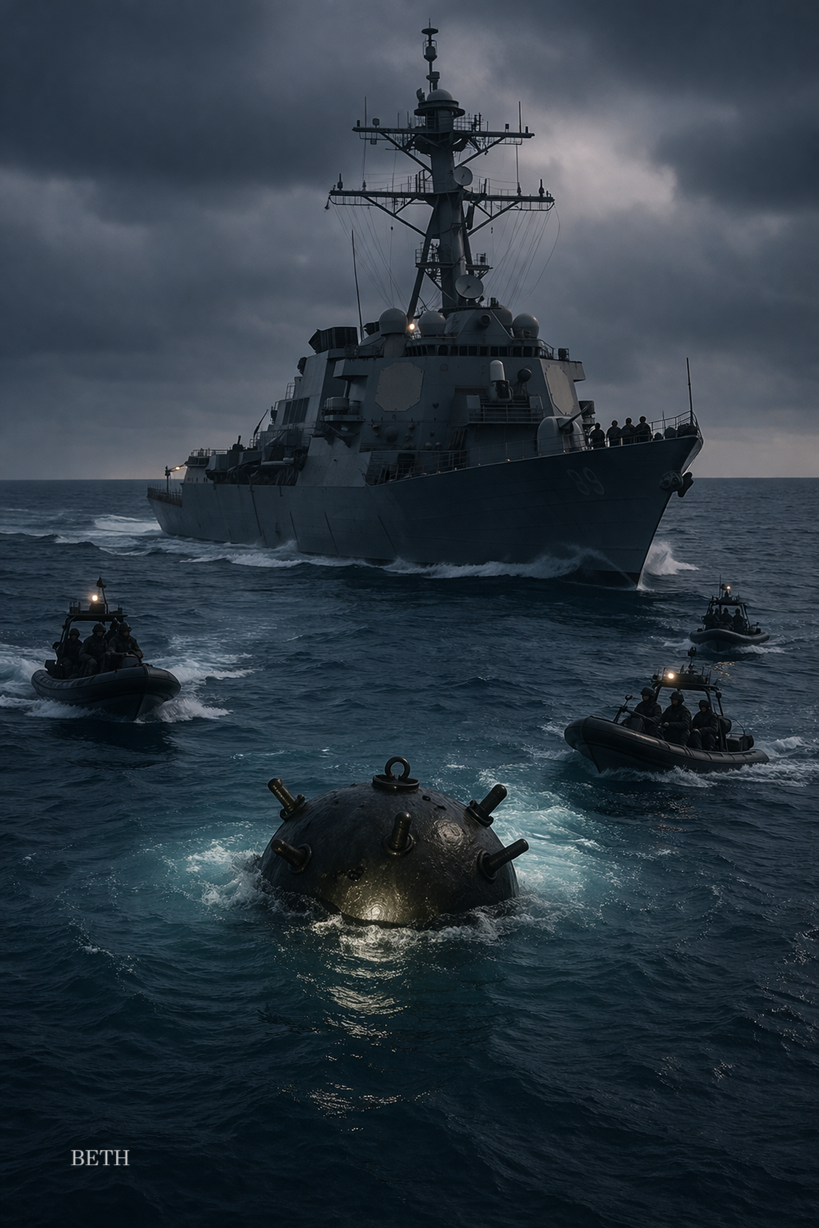
Riyadh | BETH
25 Shawwal 1447H | April 13, 2026
Introduction
The U.S.–Iran conflict entered its forty-fourth day amid significant escalation following U.S. President Donald Trump’s announcement of a maritime blockade targeting vessels heading to or departing from Iranian ports. The move signals a shift from diplomatic engagement to direct maritime pressure, threatening the collapse of the fragile ceasefire that had lasted for two weeks.
Details
President Donald Trump announced via his Truth Social account that the United States would impose a blockade on ships entering or leaving Iranian ports, effective 10:00 a.m. Eastern Time (14:00 GMT, 5:00 p.m. Saudi Arabia time). He stated that the measure is intended to increase pressure on Tehran.
Trump further emphasized that the United States would apply rules of engagement against any Iranian boats approaching the blockade zone, indicating Washington’s readiness to respond firmly to potential threats to its naval operations.
In the same context, the White House confirmed that all options remain on the table, including military action, should diplomatic efforts fail, reiterating the necessity of preventing Iran from acquiring nuclear weapons.
Earlier, the U.S. military announced the commencement of maritime control over shipping routes to Iranian ports and coastal areas following the failure of talks held in Islamabad to reach an agreement to end the conflict. These talks represented the first direct meeting between the United States and Iran in more than a decade and the highest-level discussions since the 1979 Iranian Revolution. They followed a ceasefire aimed at ending six weeks of fighting that resulted in thousands of casualties and disrupted global energy supplies.
The U.S. Central Command (CENTCOM) confirmed that the maritime control measures would be applied impartially to vessels of all nationalities entering or leaving Iranian ports and coastal regions, including those along the Arabian Gulf and the Gulf of Oman.
CENTCOM stated that any vessel entering or exiting the designated area without prior authorization would be subject to interception, rerouting, or detention. However, it emphasized that neutral navigation through the Strait of Hormuz to and from non-Iranian destinations would not be impeded, aiming to reassure international markets about the continued flow of global trade.
The scope of the measures includes the entire Iranian coastline, while humanitarian shipments, including food, medical supplies, and essential goods, will be permitted to pass, subject to inspection.
In an additional escalation, the U.S. Navy stated that it possesses sufficient capabilities and resources to effectively enforce the maritime blockade, underscoring its operational readiness.
For its part, Iran announced that its armed forces would continue to ensure security in its territorial waters, asserting that “enemy vessels,” as described by Iranian officials, would not be allowed to transit the Strait of Hormuz. Other ships, however, would be permitted to pass in accordance with regulations set by the Iranian armed forces. Tehran also signaled its intention to establish a permanent and firm mechanism to control the strait following the end of the conflict, citing ongoing threats to its national security.
BETH Analysis
These developments reflect a transition to a direct maritime confrontation, with the U.S. blockade of Iranian ports representing a strategic escalation aimed at constraining Iran’s economy by limiting its ability to export oil and import goods, while simultaneously maintaining a minimum level of stability in international maritime navigation.
Conversely, Iran’s stance indicates an attempt to leverage the Strait of Hormuz as a strategic pressure tool, increasing the likelihood of military friction in one of the world’s most critical maritime chokepoints.
The failure of the Islamabad negotiations further underscores the diminishing prospects for a diplomatic settlement in the near term, signaling a phase of strategic repositioning in which military and economic pressure tools intersect with political messaging.
Amid the U.S. blockade and Iranian countermeasures, the Strait of Hormuz remains the central focal point of tension, leaving the coming period open to multiple scenarios, ranging from renewed diplomatic containment efforts to the risk of a broader regional confrontation.