


Global Media Between War and Negotiation: A Strategic BETH Perspective
Prepared, Monitored, and Analyzed by | Strategic Media Department – BETH News Agency
Supervised by: Abdullah Al-Omairah
Riyadh – April 12, 2026
Introduction
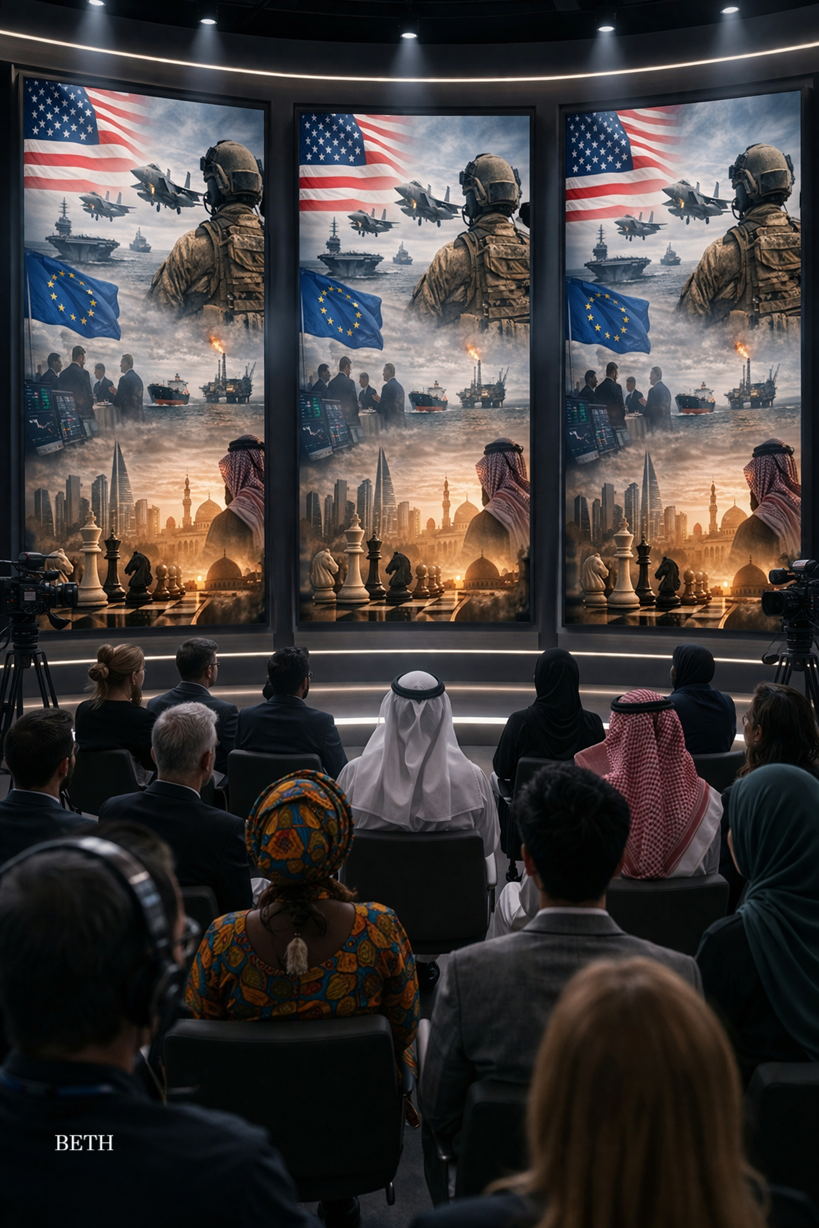
In times of major crises, wars are not fought solely on the battlefield, nor are settlements managed exclusively at negotiation tables. The confrontation extends into the media sphere, where narratives are crafted and public perception is reshaped. Within the context of war and negotiation, the media becomes a strategic actor that contributes to interpreting events, guiding public opinion, and even influencing political decision-making.
Through a comparative reading of the discourse of American, European, Arab and Gulf, and Iranian media, multiple dimensions of the same narrative emerge, reflecting the differing priorities and political references of each media environment.
First: American Media – Pragmatic Outcomes and the Logic of the Deal
Core Themes
American media focuses on the effectiveness of policies and their tangible outcomes, driven by a central question: Can military pressure be transformed into sustainable political gains? Key themes include:
- The fragility of temporary ceasefires.
- The Strait of Hormuz as a strategic chokepoint.
- Frozen Iranian assets as a bargaining tool.
- The role of regional mediators.
- Translating military superiority into political achievements.
Discourse Methodology
American media is characterized by a clear distinction between confirmed news, leaks, and analytical assessments, employing an institutional and pragmatic language centered on outcomes, such as:
- Ceasefire
- Leverage
- Fragile Truce
- Strategic Chokepoint
It also emphasizes attributing information to official or informed sources, enhancing the credibility of its coverage.
Expectations in American Media
- Continuation of negotiations: Viewed as necessary to convert military gains into political achievements.
- Continuation of U.S. strikes: Considered a potential means of maintaining leverage.
- Future of the war: Expectations lean toward managing the conflict rather than ending it immediately.
Second: European Media – Stability and Energy Security
Core Themes
European media adopts an approach centered on international stability and the economic implications of the conflict, particularly:
- Stability of global energy markets.
- Security of navigation in the Strait of Hormuz.
- Avoidance of military escalation.
- Preservation of the international order.
Language of Discourse
The tone is calm and objective, employing terms such as:
- Stability
- Crisis Management
- Energy Security
- International Concern
This reflects an institutional perspective that moves away from the binary logic of victory and defeat.
Expectations in European Media
- Continuation of negotiations: Essential to prevent broad economic and security repercussions.
- Continuation of military strikes: Seen as a threat to stability.
- Future of the war: Emphasis on containing the conflict and preventing regional escalation.
Third: Arab and Gulf Media – A Balanced Regional Perspective
Core Themes
Arab and Gulf media provide coverage that combines news reporting with political analysis, focusing on the regional implications of the conflict:
- Security of the Gulf region.
- Stability of energy markets.
- Frozen Iranian assets as a bargaining tool.
- The role of regional mediators.
- The impact of the conflict on regional power balances.
Language of Discourse
The discourse is balanced and analytical, relying on terms such as:
- Ceasefire
- Red Lines
- Mediation
- Regional Security
Expectations in Arab and Gulf Media
- Continuation of negotiations: A cautious hope for a sustainable de-escalation.
- Continuation of strikes: Possible if negotiations falter.
- Future of the war: Expectations of a gradual settlement while maintaining the regional balance of power.
Fourth: Iranian Media – Constructing the Narrative of Resilience
Core Themes
Iranian media, particularly agencies such as Fars and Tasnim, newspapers like Kayhan, and international platforms such as Press TV, emphasize:
- Negotiations as a result of military resilience.
- The Strait of Hormuz as a sovereign and deterrent tool.
- Reinforcement of legitimacy and victimhood narratives.
- Emphasis on internal unity.
Discourse Methodology
Iranian media relies on several mechanisms:
- Selection: Highlighting information that supports the official narrative.
- Repetition: Reinforcing concepts such as resilience and sovereignty.
- Tone Variation: Mobilizing rhetoric for domestic audiences and diplomatic language for international audiences.
- Perception Engineering: Guiding public understanding of events.
Language of Discourse
Commonly used terms include:
- Resilience
- Deterrence
- Sovereignty
- Imposing Conditions
Expectations in Iranian Media
- Continuation of negotiations: Presented as a political victory.
- Continuation of U.S. strikes: Utilized to reinforce the narrative of resistance and deterrence.
- Future of the war: Focus on imposing Iranian conditions in any future settlement.
BETH Insight
The comparison between these media schools reveals that the differences do not lie in the facts themselves, but rather in the angles of interpretation and prioritization. American media approaches events through the lens of outcomes and deal-making, while European media views them from the perspective of stability and the international order. Arab and Gulf media emphasize regional implications, whereas Iranian media seeks to reinforce a narrative of resilience and the imposition of conditions, presenting negotiations as a consequence of deterrence rather than a response to pressure.
Thus, the same event is interpreted in different ways according to the political and strategic priorities of each media environment, making the media an active participant in shaping public perception rather than merely a neutral transmitter of facts.
Commonalities
- Recognition of the conflict as a pivotal moment in shaping regional and global power balances.
- Emphasis on the centrality of the Strait of Hormuz in the security and economic equation.
- Acknowledgment of the fragility of any potential de-escalation.
- Linking negotiations to interconnected issues such as sanctions, frozen assets, and regional security.
Differences
- American Media: Focuses on transforming military power into political gains.
- European Media: Emphasizes stability and energy security.
- Arab and Gulf Media: Concentrates on regional implications.
- Iranian Media: Centers on reinforcing a narrative of resilience and imposing conditions.
Conclusion
The analysis of global media demonstrates that war and negotiation are not separate paths, but rather two facets of a single political process managed simultaneously on the battlefield, at the negotiation table, and within the media sphere. American media evaluates the outcomes of power, European media focuses on the implications for stability, Arab and Gulf media analyze regional repercussions, while Iranian media works to solidify a narrative of resilience and legitimize its political stance.
Consequently, the media emerges as a strategic partner in shaping the political landscape, not merely a conveyor of news. The convergence and divergence of narratives provide a deeper understanding of the trajectory of the conflict and its future, affirming that the war of narratives is no less influential than the war on the ground.
_________________________________
“BETH does not merely report the news; it provides strategic insight, analysis, and impact assessment, contributing to a deeper understanding of events