



U.S.–Iran Negotiations in Islamabad: A BETH Foresight Analysis
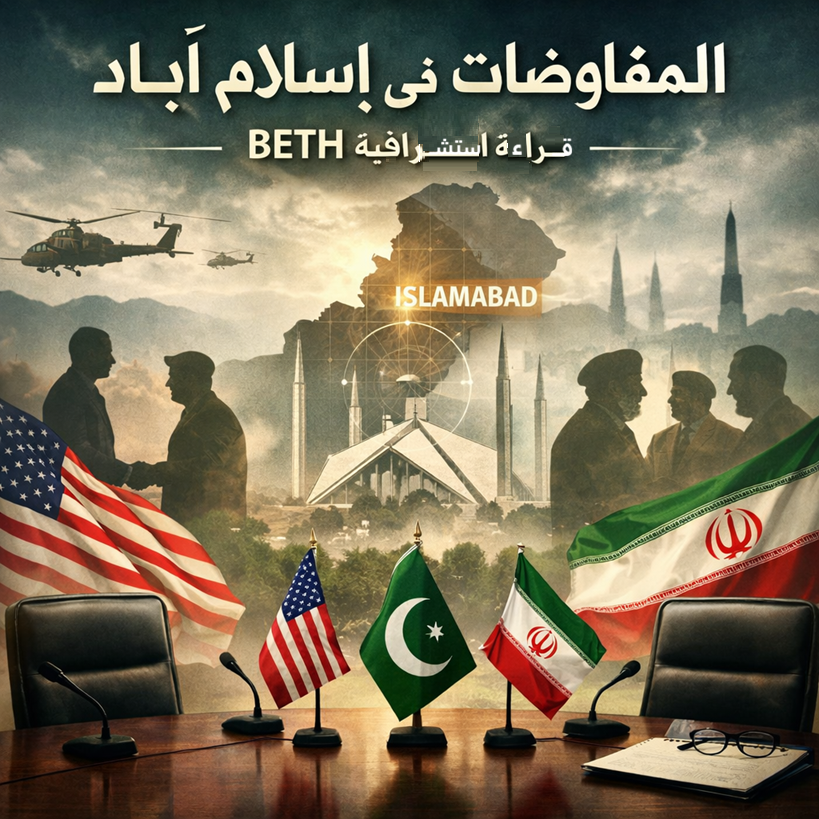
Islamabad | BETH
April 12, 2026
Global attention is turning to Pakistan’s capital, Islamabad, which has become the stage for a pivotal round of U.S.–Iran negotiations aimed at containing the repercussions of the recent war and opening a pathway toward sustainable regional de-escalation. These talks are not merely a traditional diplomatic engagement; rather, they represent a genuine test of both parties’ ability to shift from confrontation to conflict management as a prelude to a potential settlement.
What Is Happening Now?
U.S. Vice President JD Vance arrived in Islamabad leading the American delegation, signaling Washington’s seriousness regarding this round of negotiations. The delegation also includes U.S. Special Envoy Steve Witkoff, alongside Jared Kushner.
On the Iranian side, the delegation is headed by Parliament Speaker Mohammad Bagher Ghalibaf and includes Foreign Minister Abbas Araghchi, Central Bank Governor Abdolnasser Hemmati, and Secretary of the Supreme National Security Council Ali Akbar Ahmadian.
This high level of representation reflects both sides’ recognition of the importance of the moment, while also underscoring the complexity of the issues on the table. These extend beyond a ceasefire to include maritime security in the Strait of Hormuz, Iran’s missile program, the implications of economic sanctions, and broader regional security arrangements.
Strategic Motivations of the Parties
The United States seeks to consolidate the ceasefire and prevent Iran from exploiting the period of de-escalation to rebuild its military capabilities. Additionally, Washington aims to ensure the security of maritime navigation in the Strait of Hormuz and stabilize global energy markets, while translating its military leverage into long-term political gains.
Conversely, Iran is attempting to broaden the scope of negotiations to include sanctions relief and the release of frozen assets, while preserving its remaining military capabilities as a bargaining tool, thereby avoiding the perception of negotiating from a position of defeat.
Expectations and Possible Outcomes
1. Interim Agreement
The most likely scenario involves reaching a temporary agreement that solidifies the ceasefire and paves the way for subsequent negotiation rounds without comprehensively resolving all outstanding issues.
2. Extension of the Ceasefire
The ceasefire may be extended informally as a pragmatic option, granting both sides additional time to continue negotiations and avoid a return to military escalation.
3. Prolonged Negotiations
Given the complexity of the issues involved, this round is likely to mark the beginning of an extended negotiation process that could last for weeks or even months.
4. Stalemate
Although less probable, negotiations could stall if the parties fail to reconcile their respective demands, potentially leading to renewed tensions or military escalation.
BETH Insight
The Islamabad negotiations do not represent an immediate transition to peace; rather, they reflect an effort to manage the conflict and prevent its escalation. The current diplomatic landscape is shaped by a delicate balance between military pressure and the political necessity of de-escalation, with each party striving to maximize its gains without making substantial concessions.
Pakistan’s selection as the host underscores its role as a mediator maintaining balanced relations with both Washington and Tehran, positioning it as a potentially influential actor in shaping future understandings.
Conclusion
The U.S.–Iran negotiations in Islamabad represent a pivotal moment in the trajectory of the conflict. However, achieving a comprehensive settlement will require time and sustained diplomatic efforts. Amid cautious optimism and persistent strategic uncertainty, the ultimate outcome will depend on the ability of both parties to transform the ceasefire from a temporary pause into a durable agreement capable of restoring regional stability.
With Every Development.. Expectations That Precede and Follow
Shift in the Bargaining Equation
Some analytical readings indicate that the course of the U.S.–Iran negotiations is witnessing a notable shift in the nature of the proposed bargaining arrangements. After initial assessments linked de-escalation in Lebanon to guarantees related to the security of maritime navigation in the Strait of Hormuz, the scene now appears to be moving toward a different equation based on the release of approximately seven billion dollars of Iran’s frozen assets in exchange for facilitating the reopening of the strait and the resumption of maritime traffic.
Some observers believe that this potential bargaining arrangement reflects a transition from complex geopolitical understandings to direct economic incentives, granting each party a tangible gain. Tehran would obtain immediate economic relief, while Washington would secure stability in global energy markets and freedom of navigation in one of the world’s most vital maritime corridors.
However, this interpretation remains within the scope of analytical assessments, as no official confirmation has been issued directly linking the release of the assets to the reopening of the Strait of Hormuz, making it more an indicator of negotiation trends than a finalized agreement.
Comment: The Relationship Between Politics and Media
The course of these negotiations cannot be fully understood without considering the close relationship between politics and the media. Not everything that appears in the media necessarily reflects the reality of political interactions; rather, it may be part of the strategic messaging employed by decision-makers to influence public opinion or the trajectory of the negotiations themselves.
In many cases, the media is used as a tool to convey indirect messages to the opposing party or to prepare the political and public environment for the acceptance of certain settlements. Information may also be deliberately leaked to gauge reactions or to exert psychological pressure during the negotiation process.
Accordingly, media coverage of the talks does not always represent a complete picture of reality; instead, it often reflects a parallel arena of negotiation, where the battle is waged at the level of narratives as much as it is at the negotiation table.
BETH Insight
These developments demonstrate that the Islamabad negotiations are not limited to the exchange of political conditions but involve a precise engineering of interests, where economic tools are transformed into essential elements in building understandings. They also reveal the pivotal role of the media in shaping public perceptions and managing expectations, making it necessary to adopt a comprehensive reading that combines political realities with media messaging.