



Day 42: Anticipated Turning Point in Islamabad
Monitoring and Analysis | BETH
Islamabad – April 12, 2026
Global attention is turning to Pakistan’s capital, Islamabad, which is hosting a pivotal round of U.S.–Iran negotiations aimed at halting the war and reaching an agreement that could ease regional tensions.
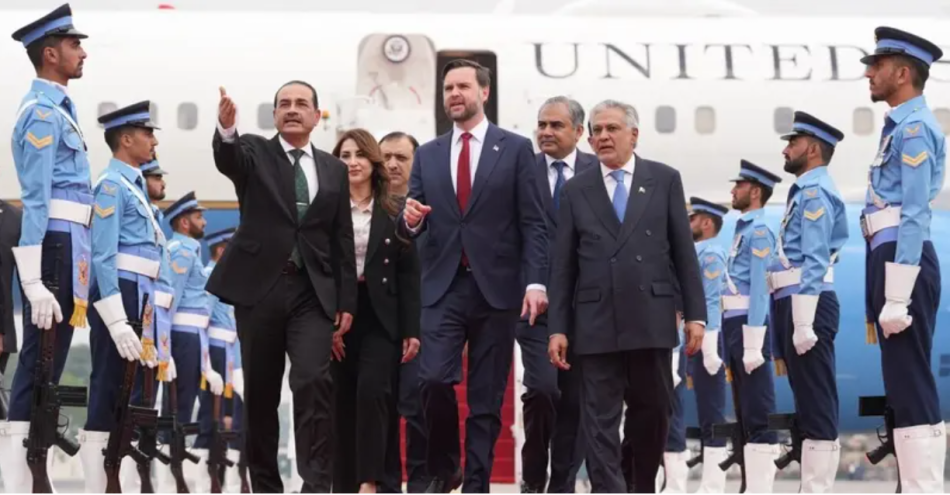
U.S. Vice President JD Vance, who is leading the American delegation, arrived at Nur Khan Airbase near Islamabad, where he was received by Pakistan’s Army Chief Asim Munir, signaling the strategic importance Pakistan places on these talks.
Also arriving in Pakistan were U.S. Special Envoy Steve Witkoff and Jared Kushner, according to Reuters.
On the Iranian side, the delegation is headed by Parliament Speaker Mohammad Bagher Ghalibaf and includes Foreign Minister Abbas Araghchi, Central Bank Governor Abdolnasser Hemmati, and Secretary of the Supreme National Security Council Ali Akbar Ahmadian, along with several other senior officials.
Prospects of the Negotiations
U.S. assessments suggest that achieving tangible progress during the first round of negotiations may be limited. However, Washington hopes the talks will go beyond a merely ceremonial meeting. Officials believe that reaching a final agreement could take weeks, if not months, with the possibility of extending the ceasefire for an additional two weeks—provided that the U.S. Vice President returns with concrete achievements from this round.
Iran’s Missile Capabilities
Despite statements by U.S. Secretary of Defense Pete Hegseth that Iran’s missile program has been “effectively destroyed,” U.S. intelligence assessments indicate that Tehran still possesses thousands of ballistic missiles and retains the ability to reactivate several launch platforms stored in underground complexes. Officials noted that more than half of these launchers have been destroyed, damaged, or forced underground, yet many of the remaining systems could be repaired or redeployed.
Strait of Hormuz and a More Complex Landscape
In a related development, U.S. officials stated that Iran is currently unable to fully reopen the Strait of Hormuz to maritime traffic. This is due to Tehran’s inability to locate all the naval mines it previously deployed, in addition to limited technical capabilities for their removal. This situation represents an additional pressure point ahead of the negotiations and helps explain the slow resumption of shipping through this vital waterway, according to The New York Times.
BETH Insight
The Islamabad negotiations should not be viewed as an immediate attempt to end the war, but rather as a phase of testing intentions and building mutual confidence. Pakistan’s selection as the host reflects a shared desire for a mediator maintaining balanced relations with both Washington and Tehran. Moreover, the high-level political and security representation suggests that the agenda extends beyond a ceasefire to include regional security, Iran’s missile program, and maritime safety in the Strait of Hormuz.
The divergence between political statements and intelligence assessments regarding Iran’s missile capabilities also highlights a state of “strategic ambiguity,” providing Tehran with a significant bargaining chip and leaving the door open for prolonged and complex negotiation rounds.
Conclusion
The Islamabad negotiations represent a potential turning point in the trajectory of the conflict. Nevertheless, the path toward a comprehensive agreement remains long. Amid cautious optimism and persistent strategic doubts, the outcome ultimately depends on the ability of both parties to transform the ceasefire from a temporary pause into a sustainable settlement that restores stability to the region.
Frozen Iranian Assets: Economic Relief or Financing Influence?
According to an Iranian official, the United States has agreed to release a portion of Iran’s frozen assets in Qatar and other foreign banks—estimated at around $7 billion. This move is seen as a potential indicator of progress in the ongoing U.S.–Iran negotiations taking place in Islamabad, Pakistan, and forms part of confidence-building measures aimed at consolidating the ceasefire and paving the way for broader understandings.
Analysis
The release of frozen assets represents both an economic incentive for Tehran and a political signal from Washington in support of the de-escalation process. However, the true significance of this step lies not in the release itself, but in who ultimately controls these funds and how they are utilized.
Who Will Receive These Assets?
Officially, the funds are expected to be transferred to the Iranian government, represented by the Central Bank of Iran, with the objective of supporting the national economy and covering humanitarian needs such as food and medicine. Such arrangements are typically accompanied by international monitoring mechanisms designed to regulate spending and prevent their use in military activities.
Concerns Over Potential Military Use
Despite these safeguards, international concerns persist regarding the possibility that these resources could be indirectly redirected to support the activities of the Islamic Revolutionary Guard Corps (IRGC) or to finance allied groups in the region. Even when funds are earmarked for civilian purposes, easing economic pressure may allow Tehran to reallocate its internal resources toward military or regional objectives.
Leverage or Concession?
This step is not widely viewed as a U.S. concession; rather, it serves as a negotiating leverage. The release of funds can be linked to specific conditions, such as adherence to the ceasefire, ensuring maritime security in the Strait of Hormuz, or limiting missile-related activities. Consequently, the continuation of such financial relief is likely to remain contingent upon Iran’s compliance with its commitments.
BETH Insight
The release of Iran’s frozen assets can be understood as part of a delicate balance between incentive and containment. While it provides the Iranian government with an opportunity for economic relief, it simultaneously serves as a test of Tehran’s willingness to direct these resources toward domestic stability rather than expanding regional influence or rebuilding military capabilities.
The ultimate fate of these funds will determine whether the negotiations are paving the way for genuine de-escalation or merely enabling a strategic repositioning that grants Iran additional time to reorganize its resources.
Conclusion
The release of frozen Iranian assets represents a cautiously positive indicator in the trajectory of U.S.–Iran negotiations. However, its real impact will depend on the effectiveness of monitoring and transparency mechanisms, as well as the ultimate beneficiaries of these funds. Between supporting Iran’s economy and financing regional influence, this issue remains one of the most critical tests of the seriousness and sustainability of any forthcoming agreement.
U.S. Naval Transit Through the Strait of Hormuz Without Coordination
U.S. media outlets, citing an American official, reported that vessels of the United States Navy transited the Strait of Hormuz today, emphasizing that the passage occurred without any coordination with Iran.
The official stated that the transit of U.S. warships was conducted as part of efforts to ensure freedom of international navigation in one of the world’s most critical maritime chokepoints. He affirmed that the United States retains the right to operate in international waters in accordance with international law, without requiring approval from any party.
The Strait of Hormuz is considered a vital artery for global energy trade, with a significant share of the world’s oil and liquefied natural gas shipments passing through it. Consequently, any military movement in the area attracts substantial international attention, particularly amid ongoing regional tensions and the current negotiations between Washington and Tehran.
BETH Insight
This uncoordinated transit carries strategic implications that extend beyond its military dimension. It underscores Washington’s commitment to the principle of freedom of navigation and its rejection of any Iranian claim to sovereignty over the strait. At the same time, it sends a message of deterrence, reaffirming the continued U.S. military presence in the region despite the parallel diplomatic track.
Moreover, the move may be interpreted as a negotiating leverage, intended to strengthen the U.S. position at the bargaining table, particularly concerning maritime security and the reopening of the strait to global commerce.
Conclusion
The transit of U.S. warships through the Strait of Hormuz without coordination with Iran represents a clear political and security message: diplomacy and military power are proceeding in parallel as part of a broader strategy to manage the conflict and maintain strategic balance in the region.
Talks
A White House official stated on Saturday that the trilateral talks between the United States, Iran, and Pakistan are ongoing and continuous, confirming that they are being held face-to-face in the Pakistani capital, Islamabad, in a step that reflects the negotiation track entering a more serious phase.
In the same context, an Iranian official stated that the discussions have entered a more serious stage, noting that the Strait of Hormuz remains one of the أبرز الرئيسية points of disagreement on the negotiation table, given its strategic importance and its direct impact on maritime security and global energy markets.
For his part, U.S. President Donald Trump announced on Saturday the official start of talks with Iran in Islamabad, affirming the seriousness of diplomatic efforts aimed at containing the escalation and opening a path toward potential understandings between the two sides.
BETH Insight
These simultaneous statements from both the American and Iranian sides reflect the transition of the negotiations from the preparatory phase to the stage of actual negotiations, with the Strait of Hormuz remaining at the forefront of contentious issues, as a strategic leverage affecting regional security and the stability of global energy markets.
The face-to-face nature of the talks also indicates an advanced level of political seriousness and enhances the prospects of reaching interim understandings, even though the path toward a comprehensive agreement remains fraught with challenges due to the interconnection of military, economic, and security files.
The Islamabad talks represent a pivotal milestone in the trajectory of U.S.–Iran relations, reflecting increasing seriousness by both parties in exploring opportunities for de-escalation, while strategic issues—foremost among them the Strait of Hormuz—remain a decisive factor in determining the outcomes of these negotiations.
A White House official stated on Saturday that the trilateral talks between the United States, Iran, and Pakistan are ongoing and continuous, confirming that they are being held face-to-face in the Pakistani capital, Islamabad, in a step that reflects the negotiation track entering a more serious phase.
In the same context, an Iranian official stated that the discussions have entered a more serious stage, noting that the Strait of Hormuz remains one of the أبرز الرئيسية points of disagreement on the negotiation table, given its strategic importance and its direct impact on maritime security and global energy markets.
For his part, U.S. President Donald Trump announced on Saturday the official start of talks with Iran in Islamabad, affirming the seriousness of diplomatic efforts aimed at containing the escalation and opening a path toward potential understandings between the two sides.
BETH Insight
These simultaneous statements from both the American and Iranian sides reflect the transition of the negotiations from the preparatory phase to the stage of actual negotiations, with the Strait of Hormuz remaining at the forefront of contentious issues, as a strategic leverage affecting regional security and the stability of global energy markets.
The face-to-face nature of the talks also indicates an advanced level of political seriousness and enhances the prospects of reaching interim understandings, even though the path toward a comprehensive agreement remains fraught with challenges due to the interconnection of military, economic, and security files.
The Islamabad talks represent a pivotal milestone in the trajectory of U.S.–Iran relations, reflecting increasing seriousness by both parties in exploring opportunities for de-escalation, while strategic issues—foremost among them the Strait of Hormuz—remain a decisive factor in determining the outcomes of these negotiations.