


Day 41: Lebanon Escalates .. Pakistan Talks Amid Denial and Anticipation
Coverage & Analysis | BETH
News Introduction
Military escalation in Lebanon continues on the forty-first day of the U.S.–Israeli war against Iran, as intensive Israeli airstrikes target multiple areas in southern Lebanon. This comes alongside conflicting reports regarding the possible resumption of U.S.–Iran negotiations in the Pakistani capital, Islamabad. Between battlefield developments and political maneuvering, the region appears to be at a critical crossroads that may shape the next phase of the conflict.
Overview
Southern Lebanon witnessed a series of Israeli airstrikes targeting the towns of Tyre, Nabatieh, and Zahrani, as well as the villages of Kfarreman, Kfartebnit, Habboush, and the surroundings of Rashaya al-Foukhar and Dibbin. Israeli forces also demolished homes in the towns of Khiam and Aita al-Shaab, as part of operations aimed at encircling Hezbollah, according to an Israeli security source cited by the Walla news website.
In response, Hezbollah announced that it had carried out rocket and drone attacks targeting Israeli military positions and settlements in northern Israel. The Israeli Home Front Command reported the activation of sirens in Kiryat Shmona and surrounding areas following the detection of rocket launches from Lebanon. Israeli Chief of Staff Eyal Zamir stated that the Israeli army is “at war” and continues to fight with significant force against Hezbollah, emphasizing that Lebanon constitutes the primary battlefield.
On another front, the U.S.–Israeli war against Iran has reportedly inflicted significant military and material losses on Tehran. The strikes were said to have eliminated several senior military and political leaders, most notably the former Supreme Leader Ali Khamenei, while his son and successor, Mojtaba Khamenei, has not appeared publicly so far. Nevertheless, the regime remains intact.
According to assessments by the Foundation for Defense of Democracies (FDD), the Iranian regime relies on two fundamental pillars: the armed forces, which continue to wage war, and the internal security apparatus responsible for maintaining domestic control. The regime’s survival is now closely tied to five key figures representing the country’s main power centers:
- Mohammad Bagher Ghalibaf – Speaker of Parliament, with strong ties to the Islamic Revolutionary Guard Corps (IRGC), currently leading talks with Washington.
- Mohammad Bagher Zolghadr – Head of the Supreme National Security Council, coordinating military, intelligence, and foreign policies.
- Ahmad Vahidi – Senior IRGC commander and a central figure in both military operations and internal stability.
- Gholam-Hossein Mohseni-Ejei – Head of the Judiciary and former member of the transitional leadership council.
- Ahmad Reza Radan – Commander of Iran’s Law Enforcement Forces, responsible for maintaining internal security.
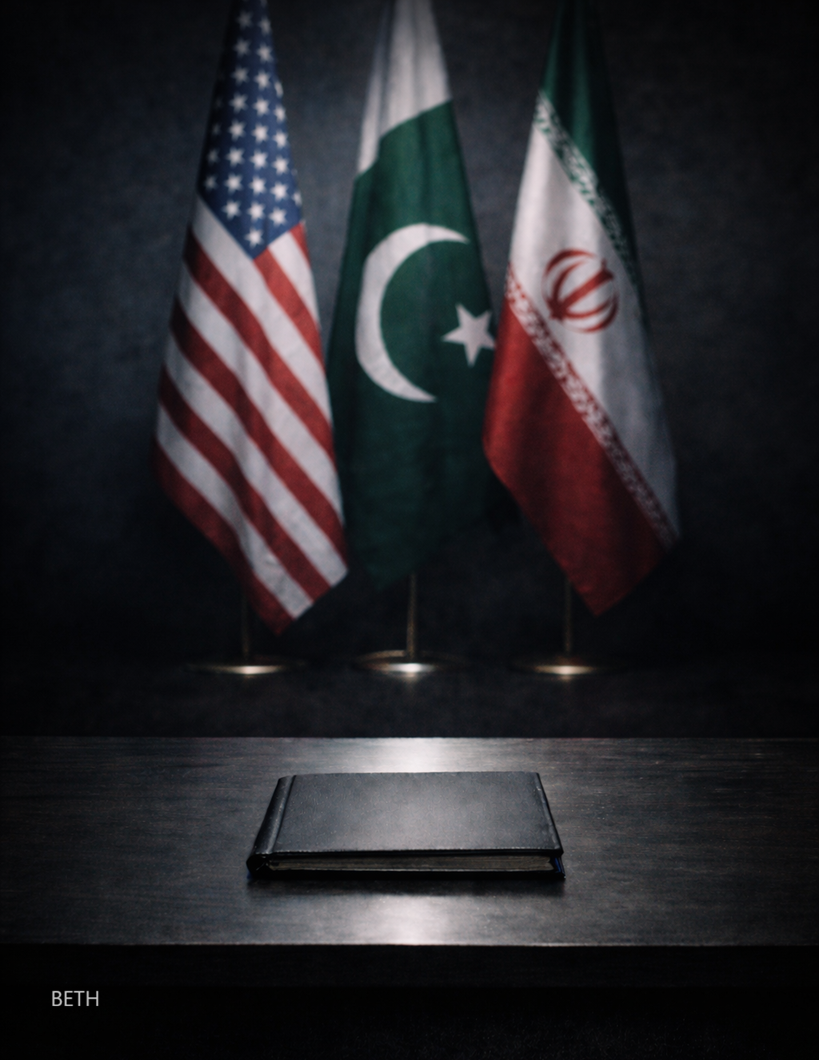
Meanwhile, reports regarding potential U.S.–Iran negotiations in Pakistan remain contradictory. An informed Iranian source denied claims that a negotiating delegation had arrived in Islamabad, describing such reports as entirely unfounded and emphasizing that talks remain suspended. The source added that any resumption of negotiations is contingent upon the United States fulfilling commitments related to a ceasefire in Lebanon and halting Israeli military operations.
Conversely, The Wall Street Journal reported that an Iranian delegation headed by Foreign Minister Abbas Araghchi and Parliament Speaker Mohammad Bagher Ghalibaf had arrived in Islamabad to begin negotiations with Washington, highlighting the ambiguity and divergence in narratives.
BETH Analysis
The escalation in Lebanon reflects Israel’s attempt to shift the military center of gravity to the northern front in order to weaken Hezbollah’s capabilities and impose new deterrence dynamics. Simultaneously, Iran appears to be leveraging its regional influence to strengthen its negotiating position.
The conflicting reports surrounding the Pakistan talks suggest the presence of “shadow diplomacy,” where media leaks serve as tools of mutual pressure. The Iranian denial may represent an effort to raise the negotiating ceiling, particularly by linking the resumption of talks to a cessation of military operations in Lebanon.
The future trajectory of the conflict remains open to two primary scenarios: either the United States resumes its military strikes, potentially leading to an Iranian surrender under harsh conditions, or unexpected diplomatic breakthroughs emerge through backchannel negotiations, reshaping the regional balance of power.
Conclusion
Between the fires of southern Lebanon and the ambiguity surrounding negotiations in Pakistan, a highly sensitive regional landscape is taking shape—one where military calculations intertwine with diplomatic maneuvering. As each party seeks to negotiate from a position of strength, the central question remains: will escalation pave the way for a comprehensive settlement, or for another round of confrontation?
Trump: Negotiation or the Strongest Weapons
U.S. President Donald Trump stated that the only path for Iran’s survival at the present time is through negotiation, warning that the United States would resort to using “the strongest weapons” if the ongoing talks fail.
Trump emphasized that the next 24 hours would be decisive in determining the prospects for the success of the negotiations. He noted that the U.S. military has begun resupplying warships with ammunition in preparation for the possibility of a breakdown in diplomatic efforts.
He added that Iran “cannot blackmail the world except in the short term,” asserting that the Iranian leadership “does not realize that it holds no winning cards” in light of the current balance of power.
BETH Analysis
Trump’s statements reflect a clear combination of military deterrence and psychological pressure, a strategy designed to push Iran toward the negotiating table from a position of weakness. The reference to the use of “the strongest weapons” should not necessarily be interpreted as an imminent declaration of war, but rather as a deterrent message intended to strengthen the U.S. negotiating position.
Moreover, the mention of resupplying U.S. warships with ammunition serves as an operational signal of military seriousness, enhancing the credibility of the threat and increasing pressure on Tehran during a critical phase of the negotiations.
Trump’s assertion that Iran “holds no winning cards” reflects a U.S. assessment of the balance of power and aims to undermine the Iranian narrative, which often relies on leverage such as:
- Threats to close the Strait of Hormuz
- The use of regional proxy networks
- Influence over global energy markets
Strategic Reading
These statements can be understood through three primary dimensions:
- Negotiation Pressure – The use of firm rhetoric to compel Iran to make concessions before reaching an agreement.
- Military Deterrence – Demonstrating operational readiness to reduce the likelihood of miscalculation by the Iranian side.
- Psychological and Media Influence – Sending messages to the international community and the Iranian domestic audience that the United States holds the strategic initiative.
Potential Scenarios
- Successful Negotiations: A phased agreement that reduces tensions and contributes to the stability of global energy markets.
- Failure of Negotiations: Limited military escalation aimed at restoring deterrence without sliding into a full-scale war.
- Continued Stalemate: The persistence of a state of “controlled tension,” with ongoing political and military pressures.
Final Assessment
Trump’s statements indicate that the United States seeks a negotiated settlement from a position of strength, where military threats are employed to reinforce the diplomatic track rather than replace it. Between the language of escalation and signals of negotiation, the coming hours remain crucial in shaping the next phase of U.S.–Iran relations.