



Narratives Clash Across the World
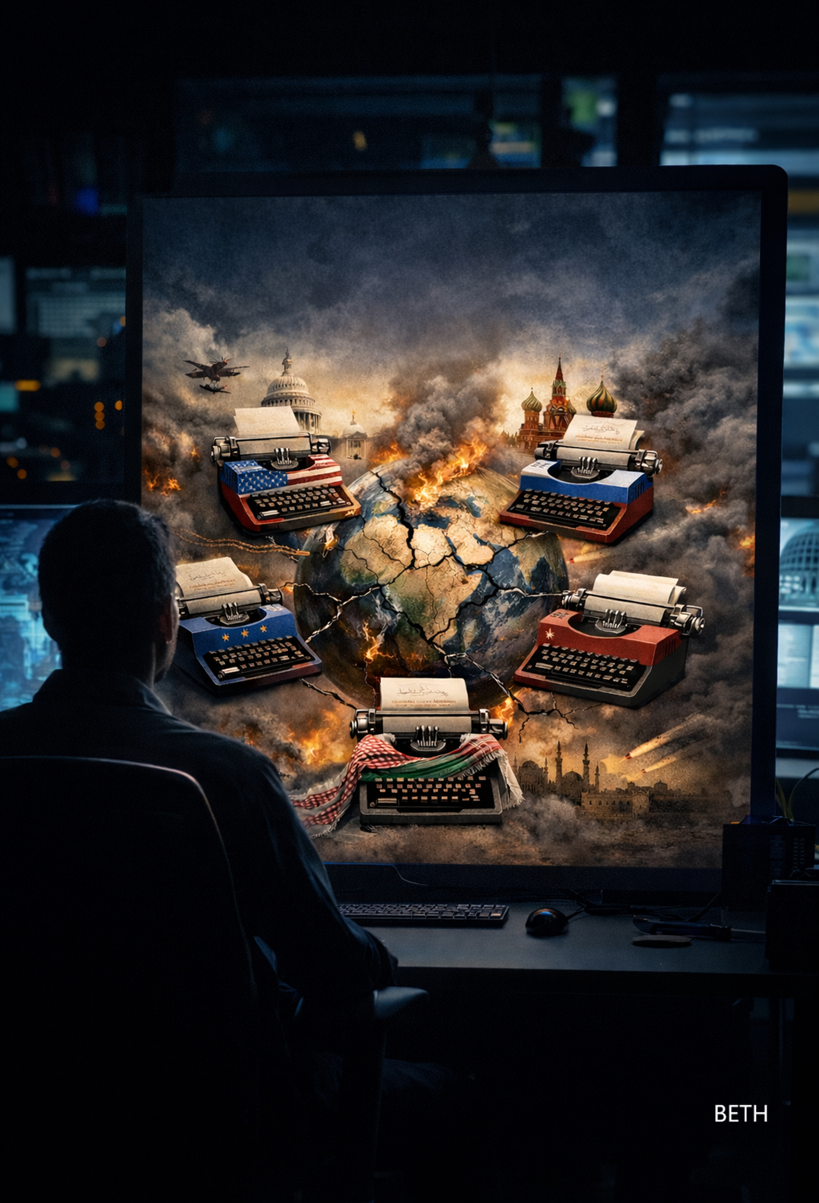
A Comparative Reading of Global Press Coverage of Escalation in the Region
Coverage & Analysis | Strategic Media Department – BETH News Agency
In modern wars, events are not measured only by what happens…
but by how they are told.
With the fragile ceasefire between the United States and Iran entering its first day, a multi-angled media landscape has emerged—one that reflects not merely differences in information, but differences in the minds interpreting it.
Here, we are not following a single event…
but five narratives being written at the same time.
In the American press, the event appears as a test of the agreement itself:
Is the ceasefire real or unstable?
Has Washington achieved its objectives, or has it entered a phase of reassessment?
The focus here is on contradictions:
Does the ceasefire include Lebanon?
Has the nuclear program been contained?
Is the Strait of Hormuz actually open, or merely declared so?
In the European press, the angle shifts:
The concern is not “who won,” but “how to prevent escalation.”
There is clear anxiety about the expansion of conflict, with calls to include Lebanon in any agreement, ensure freedom of navigation in the Strait of Hormuz, and contain the energy and economic consequences.
The Chinese press approaches the event with a calmer tone:
De-escalation, market stability, and the need to treat the ceasefire as an opportunity.
It does not search for a winner…
but seeks to prevent the collapse of the global economic system.
In contrast, the Russian press reads the scene differently:
The ceasefire is not an end, but evidence that no decisive outcome has been achieved.
The focus is on the fragility of the agreement, continued tensions in Lebanon, and the idea that Iran still holds effective pressure tools and has not exited the equation as Washington intended.
The Arab press stands closer to the field itself:
The ceasefire is read as a “pause above a volcano.”
Questions revolve around Lebanon, Hormuz, and the impact of escalation on the region, with a clear linkage between the humanitarian dimension and the strategic dimension, in a reading that blends concern with realism.
Comparative Reading
The American press asks: Is the agreement genuine?
The European press asks: How do we prevent chaos?
The Chinese press asks: How do we preserve stability?
The Russian press asks: Has decisive victory failed?
The Arab press asks: Has the war actually ended?
These are not just different questions…
but different mental maps of the world.
BETH Analysis
What we are seeing is not a difference in coverage…
but a difference in defining the “event” itself.
Each media environment reads the war from its own position:
One seeks achievement,
another fears chaos,
another protects the economy,
another monitors influence,
and another lives within the danger.
Here lies the deeper truth:
The narrative is not merely a reflection of reality…
but a reflection of the interests of those who tell it.
Conclusion
War is no longer only a conflict on the ground…
but a conflict over meaning.
And whoever owns the narrative
does not only change what happened…
but determines how the world will remember it.
Extended Comparison: From World War to Today’s Wars
If we recall major historical examples such as World War II, and compare them with what is happening today in the Middle East or in the Russia-Ukraine War, a striking paradox emerges:
In the past, the tools were limited… but the minds that managed them were more disciplined and clearer in purpose.
Today, the tools are advanced… but the minds using them appear more fragmented and less in control of meaning.
During World War II, media was not merely transmission or reaction…
it was part of a comprehensive strategy built with precision:
carefully crafted messages, coherent narratives, and propaganda designed to address both mind and emotion within a consistent vision.
Today, despite the massive technological leap—from digital platforms to artificial intelligence—the media landscape is characterized by:
uncontrolled acceleration,
multiple conflicting narratives,
and a decline in centralized editorial direction.
The result is not weakness in reach… but fragmentation in impact.
Further Analysis
The core difference is not technology… but the “mind” managing it.
In the past:
the mind led the tool.
Today:
the tool sometimes precedes the mind.
Thus, although media influence today is broader in reach, it is less capable of forming stable conviction, and more inclined to create a state of informational ambiguity.
In other words:
Media during World War II produced narratives that were believed.
Today, much of the media produces narratives that are consumed… then forgotten.
Extended Conclusion
The power of media has not declined…
but the nature of its influence has changed.
From deep, directed impact…
to wide, but unstable influence.
And here the central question returns:
Is the problem the evolution of tools…
or the decline of those who manage them?