

Beyond Reason
Written by: Abdullah Al-Omairah
Not all wars are driven by reason.
Some wars are driven by fear,
some by interests,
some by arrogance,
but the most dangerous of all are those driven by superstition.
When superstition enters the battlefield, war is no longer merely a conflict over land, influence, or borders.
It turns into an open festival of death, where illusion merges with belief, politics with myth, and destruction with a pathological anticipation of an imagined unseen salvation.
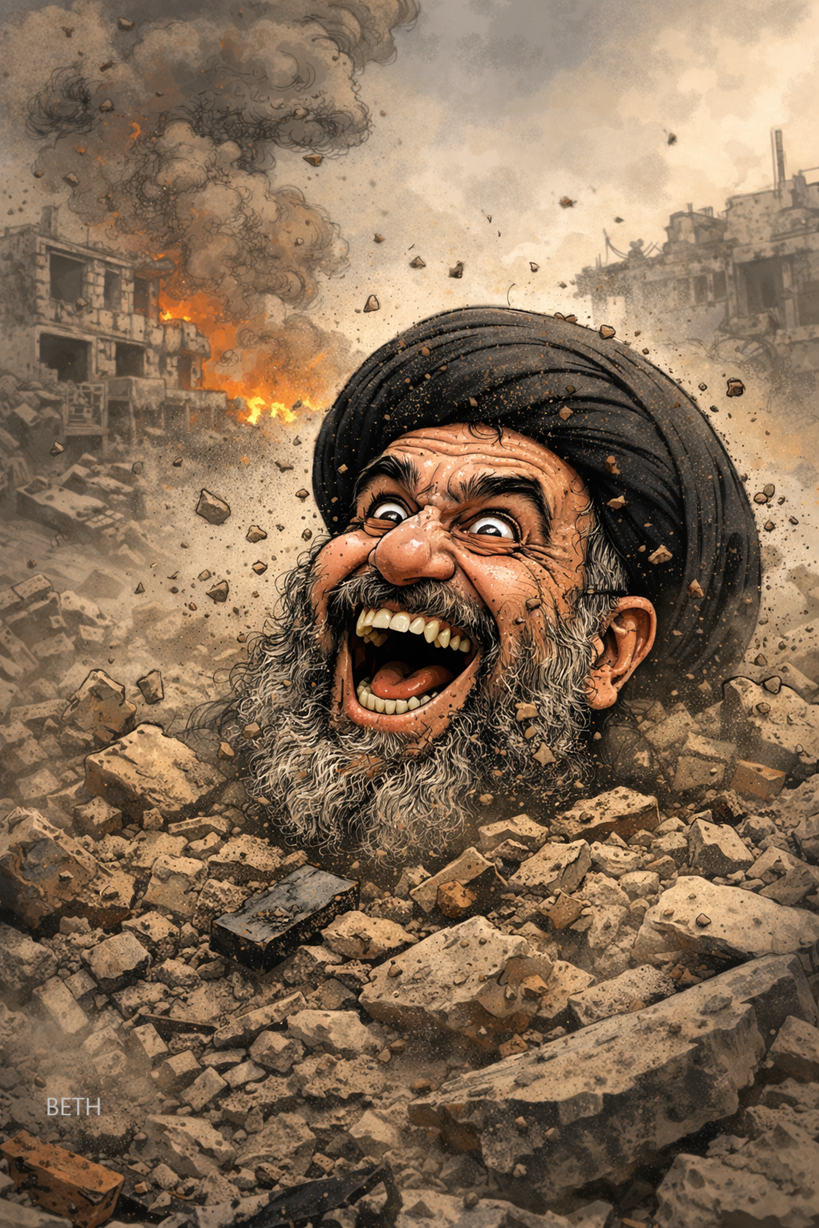
There are minds that do not see rubble as defeat, but as preparation.
They do not read destruction as catastrophe, but as a sign of imminence.
They do not see blood as a heavy cost, but as a passage toward a desired prophecy.
Here, we move beyond politics… into something more dangerous:
into a realm beyond reason.
What has happened—and continues to happen—in Lebanon, and the role of Hezbollah in pushing the country to the edge, is not merely a miscalculation or a military gamble.
It is, in one of its dimensions, an expression of a troubled mental structure—one that does not deal with reality as it is, but as it imagines it within a long tunnel of the unseen, interpretation, and anticipation.
Minds of this kind do not operate within known military calculations, nor the logic of the state, nor the interests of peoples, nor the meaning of stability and development.
They are bound to a narrative that sees chaos as preparation, destruction as a sign, and collapse as a necessary station on the path to “the emergence.”
When destruction becomes part of a redemptive imagination, the simplest functions of reason collapse.
The question then is no longer: How do we prevent war?
But rather: How do we convince those who see war as a path to meaning?
This is the dilemma.
A military strategist confronting an ideologically driven militia may calculate missiles, stockpiles, supply lines, and command centers.
But what is often underestimated is that mythical reservoir that fuels the fighter, allowing him to interpret every strike as a step forward, not backward.
Some regimes and militias do not rely solely on armed power, but on the management of illusion.
They construct their followers upon a grand narrative, then trap them within it, until doubt becomes betrayal, revision becomes weakness, and reality itself becomes a minor detail before the “greater story.”
This is how an exhausted mind comes to see destruction as victory,
retreat as heroism,
the loss of the state as preservation of the “project,”
and the ruin of nations as an acceptable price for keeping the superstition alive.
This is not merely a military reading.
It is a psychological, social, and intellectual one.
When superstition becomes power, it does not only corrupt politics—
it damages the human being himself.
It makes him capable of living in contradiction:
he loses and says he has won,
he collapses and says he has advanced,
he is exploited and says he owns a cause,
he is led like a herd and believes he moves by his own will.
Here lies the depth of manipulation in ideological systems:
they do not want followers to understand, but to believe.
Not to question, but to repeat.
Not to think critically, but to feel collectively—and to see only what they are allowed to see.
For this reason, confronting such projects is not achieved merely by striking positions, destroying platforms, or eliminating arms.
The deeper battle is not only against weapons…
but against the mental structure that produces them and grants them emotional and symbolic legitimacy.
It is a battle to liberate the mind from captivity.
What is even more dangerous is that many observers outside this world fail to grasp the nature of this dilemma.
Some still reduce it to a conventional political conflict.
Others see it as a mere geopolitical dispute.
And some remain trapped in outdated perceptions of a conflict between religions—while the problem, at its core, is not religion itself, but its hijacking, distortion, and transformation into a tool for marketing superstition and justifying dominance.
Religions, in their essence, are calls to guidance, mercy, and human dignity.
But when true religion withdraws and deception advances, sanctity becomes a mobilization tool, symbols turn into whips, and the human being shifts from a rational entity into a controlled subject.
This is what makes the Iranian system, in one of its deeper dimensions, not merely a state-level threat, but a system of falsification that has cloaked itself in religion—while in reality being far removed from its essence, its purposes, and its ethics.
The issue is not belief in God,
but the exploitation of the unseen against reason.
Not the anticipation of relief,
but the manufacturing of a culture that feeds on destruction to justify that anticipation.
Not sectarian identity as historical diversity,
but its transformation into a machine of mobilization—above the state, above the human being, above the nation.
When societies reach this stage, they do not only need political reconciliation—
they need a civilizational rescue.
A rescue that restores value to reason,
to science,
to the concept of the state,
to the ability to distinguish between faith and superstition,
between sanctity and charlatanism,
between genuine resistance and a false one that produces nothing but graves and ruins.
The question, then, is not only: When will the war end?
But: When will the era that allows superstition to produce war come to an end?
Wars may stop through agreements,
may subside through deterrence,
or be frozen by international balances.
But true peace begins only when the illusion loses its halo—
when people realize that tunnels do not deliver salvation,
that graves do not build nations,
that myths do not create civilizations,
and that those who train their followers to suspend reason do not lead them to victory—but to nothingness.
Yes, this is a dark phase.
But it is not eternal.
Every project built against human nature,
against reason,
against the laws of civilization,
is destined, eventually, to erode.
Destruction may last,
blindness may intensify,
awakening may be delayed—
but truth does not die.
A day will come when windows are opened—
not tunnels.
When societies return to the right questions:
How do we build?
Not how do we wait?
How do we revive the human being?
Not how do we convince him that destruction is sacred destiny?
How do we create a peace that protects reason and dignity?
Not a temporary truce that leaves superstition operating underground?
Only then…
will the battle have ended not just militarily,
but humanly as well.
That is the difference between those who seek victory for life,
and those who seek destruction to prove that their prophecy is near.
The real danger is not in weapons alone,
but in the mind that reconciles with destruction…
and then calls it a promise.
False Civilization
Civilization is not about invoking history,
but about creating the present.
Value is not in saying: “We were”…
but in standing with confidence and saying: “We are.”
Civilization is not inherited; it is practiced.
True civilization refines minds and contributes to building the present.
It is not preserved in books, but proven in behavior.
It is not measured by its age, but by its ability to produce a rational, free, and responsible human being.
Be the son of whomever you wish, and acquire manners…
Their virtue will enrich you beyond lineage.A true young man says: “Here I am”…
Not: “My father was.”
When the present fails,
the past inflates.
When reason fades,
superstition rises.
And here, a harsh truth reveals itself:
Most societies that retreat into a distant past to convince themselves they alone possess civilization…
are the very societies where magic, superstition, and backwardness prevail today.