



Day 39: A Truce Under Test
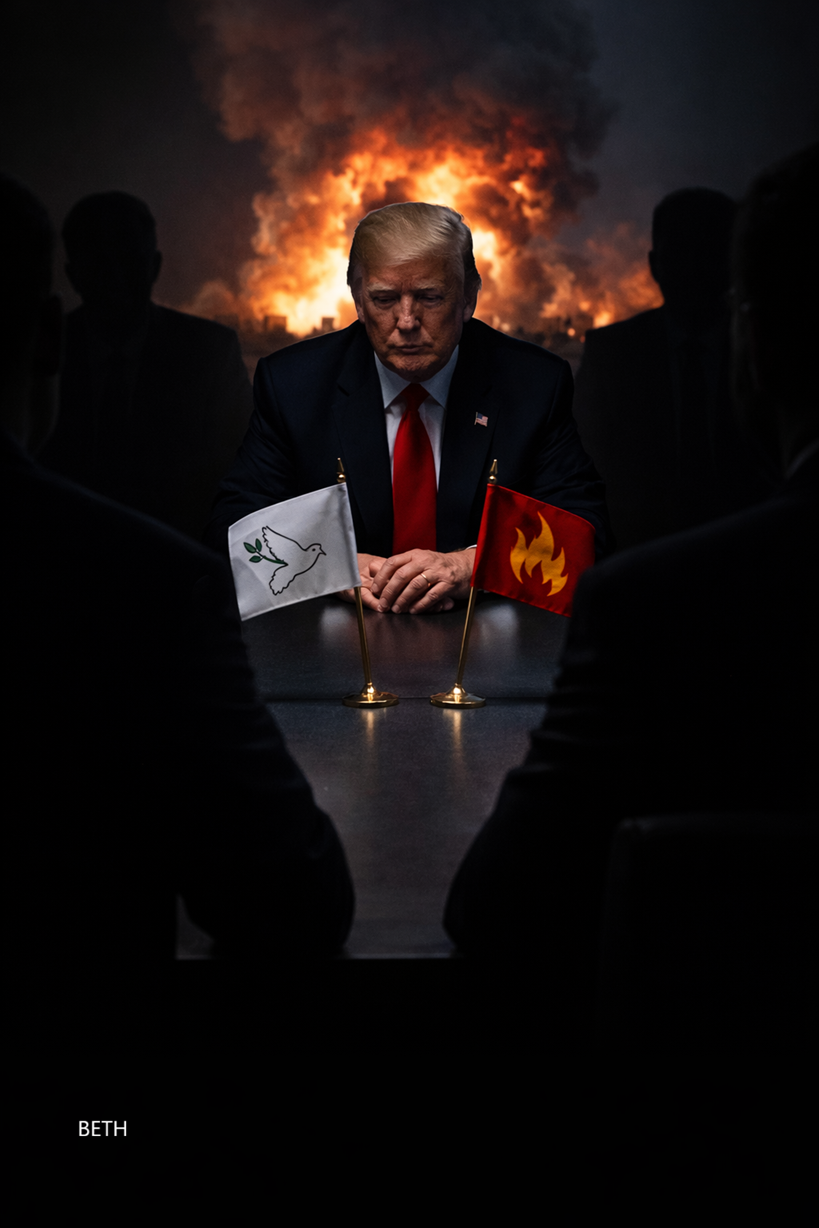
Before the Calm ..Who Wins the Moment?
Analysis and Coverage | BETH
Prepared and Analyzed by the Strategic Media Department – BETH News Agency
Supervised by: Abdullah Al-Omairah
After 39 days of war, the deadline announced by U.S. President Donald Trump did not end with a strike .. it ended with a two-week ceasefire.
The shift was not a retreat,
nor a complete victory,
but a recalibration of the moment of decision.
From “an entire civilization will perish tonight”
to “a great day for world peace,”
the tone changed… but the tool remained the same: power.
The U.S. President announced, less than two hours before the deadline expired, a two-week ceasefire, conditional on reopening the Strait of Hormuz and continuing the negotiation track.
He stated that:
The United States will help ease maritime congestion in the strait
U.S. forces will remain nearby to ensure stability
The agreement opens the door to a “positive phase” and reconstruction
In parallel:
The Iranian ten-point plan was considered a basis for negotiations
Tehran announced halting counterattacks and securing passage through the strait
The agreement was presented domestically as a “victory”
On the mediation track:
Pakistan emerged as an effective channel for delay
It called for a U.S.–Iran meeting in Islamabad on Friday
On the Israeli side:
The decision to suspend attacks was supported
With emphasis that the ceasefire does not include Lebanon
And continued adherence to core objectives (nuclear, missiles, regional threat)
On the ground:
Strikes intensified before the deadline
Infrastructure and strategic sites were targeted
Shipping movement in Hormuz remained limited… awaiting credible guarantees
BETH Analysis
Victory or management of the moment?
Trump achieved control over the moment:
He raised the سقف of threat
He secured a ceasefire before zero
He presented it as an achievement
But:
Strategic objectives have not yet been achieved
Core files (nuclear, missiles) remain open
The outcome:
A tactical gain… not a strategic resolution
Iran’s narrative .. resilience or avoidance of collapse?
Iran:
Avoided a wider strike
Accepted a ceasefire without declaring surrender
Maintained a narrative of “victory”
But:
The timing was critical
Pressure was at its peak
The more accurate reading:
Avoiding the worst… not achieving the best
Is it a ceasefire… or repositioning?
The indicators suggest:
Continuation of U.S.–Israeli objectives
Exclusion of some arenas from de-escalation
Sustained pressure
Which means:
The ceasefire is not the end of the war…
but a phase of repositioning before the next move
What comes next? (Outcomes)
A sustained truce… under conditions
Partial and continued reopening of Hormuz
Reduced direct operations
Success of the Islamabad meeting
Possible… but fragile
A truce that erodes quietly
Continued tension through proxies
Some fronts remain active (Lebanon – others)
Partial disruption in shipping
The most likely scenario
Using the truce for a later strike
Assessing remaining Iranian capabilities
Reordering target priorities
Returning with a more precise or broader strike
A strategic possibility
A rapid collapse of the truce
A major field incident
Disruption in Hormuz
Uncontrolled escalation
Less likely… but possible
A deeper scenario
If Iran has:
Pre-distributed its capabilities
Activated decentralized networks
Relied on multiple proxy structures
Then the next phase may become:
A slow dismantling war…
instead of a single decisive strike
And in contrast:
If Washington and Tel Aviv assess that:
Central capabilities have been significantly weakened
Responses have become fragmented
Then the objective may shift toward:
Eliminating what remains… under the cover of de-escalation
We are not living a moment of peace…
but a moment of reordering power.
Trump has not resolved it…
Iran has not prevailed…
Both have entered a phase of:
Post-pressure testing
The real question now:
Will the truce be used to build an agreement?
Or to prepare the next strike?
Before the sound fades…
the rhythm is rearranged.
Iran: Conditional and Limited Opening of the Strait of Hormuz
Iran announced that it may reopen the Strait of Hormuz on Thursday or Friday, if an agreement is reached, noting that the reopening would be limited.
BETH Analysis
The language reflects negotiation more than a firm decision.
Linking the reopening of the strait to an agreement turns it from a shipping route into a leverage tool.
The non-specific timing suggests calculated flexibility,
while the notion of a “limited opening” confirms that pressure will continue even under de-escalation.
The strait is not simply opened…
it is managed as an instrument of power.
The question:
Is this statement:
A maneuver:
A calculated move, involving a degree of power or capability, aimed at improving position or buying time within a relatively balanced game.
A provocation:
An action closer to argument or provocation, often issued under pressure, without possessing sufficient tools to impose a real outcome.
U.S. Secretary of Defense Statements
Washington | BETH
U.S. Secretary of Defense Pete Hegseth stated that the United States will remain present in the Strait of Hormuz to ensure it stays open and to secure maritime traffic.
He indicated that the Iranian regime understands it will not be able to develop a nuclear weapon, noting a shift in Tehran’s behavior in its dealings with Washington.
He added that Iran “says a lot and claims a lot,” but that developments on the ground point to the resumption of commercial activity.
He stressed that it would be wise for Iran to refrain from launching missiles, expressing hope that it will adhere to this.
Israeli Strikes Intensify in Lebanon
Israeli strikes in Lebanon continue, targeting Hezbollah positions.
Around 100 strikes were carried out within 10 minutes, marking the most intense attack since the start of the war.
Evening Updates
“Trump Throws Iran’s Plan in the Trash”
The White House said that Donald Trump “threw Iran’s initial plan in the trash,” in a sharp characterization reflecting an early breakdown in the negotiation track between Washington and Tehran.
Such plans are rarely disclosed in full. However, based on Iran’s negotiation patterns and past behavior, their likely features can be inferred:
A partial freeze in exchange for partial sanctions relief, easing pressure without offering a fundamental concession.
Reordering priorities without altering the core, while preserving the basic structure of the nuclear program or regional influence.
Buying time by opening the door to negotiations and repositioning politically or on the ground.
Multi-directional messaging, aimed at Washington, the Iranian domestic audience, and allies simultaneously.
BETH Reading
Rejecting the plan in such a public manner does not merely signal dissatisfaction; it carries three key implications:
Raising the ceiling of negotiations and rejecting partial or temporary solutions.
Breaking the traditional Iranian tactic of buying time through half-measures.
Managing perception ahead of outcome, as the statement itself becomes part of the media battle.
Iranian Response
In contrast, Mohammad Bagher Ghalibaf stated that the United States had violated three provisions of Iran’s plan, in an attempt to reframe the situation as an American breach rather than a negotiation setback.
BETH Comment
The Iranian response reflects a recurring pattern:
Shifting the focus of fault from the nature of the proposal to the behavior of the opposing party, in order to preserve internal narrative cohesion and keep the negotiation track open without offering real concessions.
The Iranian plan—if accurately described—was not an agreement, but the beginning of negotiations under low-threshold conditions.
Washington’s response was not merely a rejection of a plan, but a rejection of the method of engagement itself.
In this context, the tension is not read as a temporary setback, but as an extension of a negotiation pattern based on provocation and boundary-testing… where every opportunity is interpreted as a new space for maneuver, rather than a path toward resolution.