


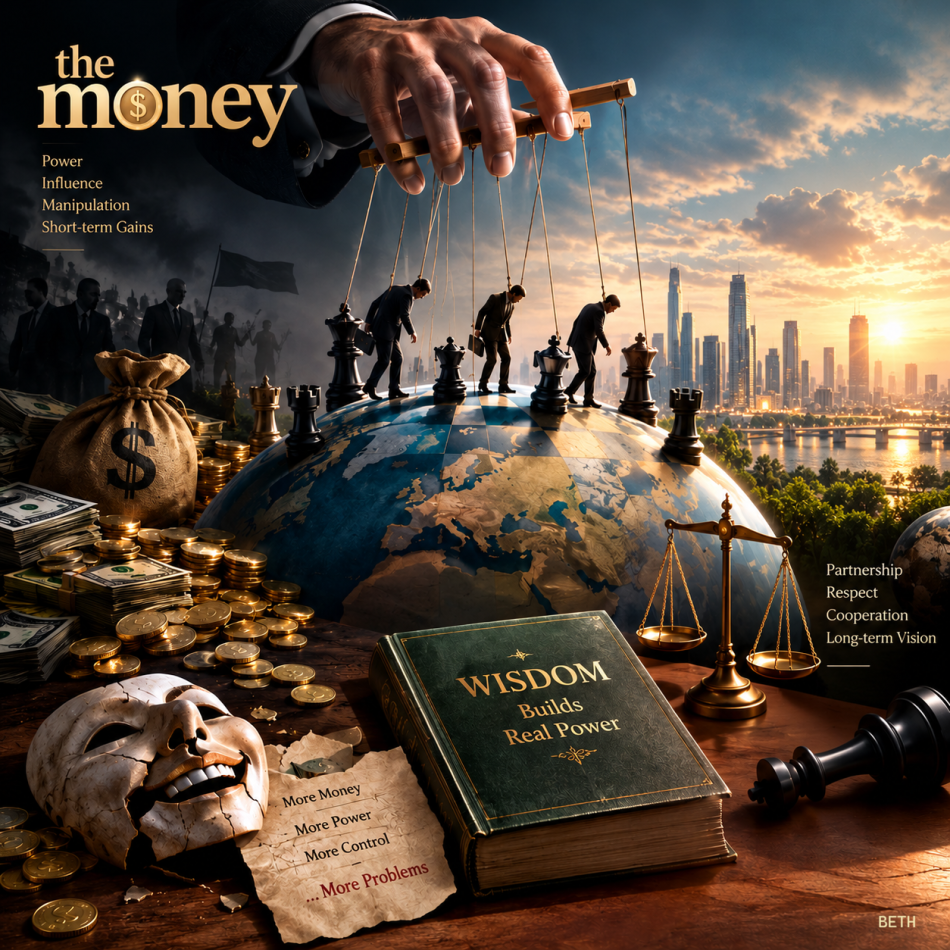
Engineering Survival.. A BETH Reading

Coverage & Analysis | BETH
Introduction
The article titled “Engineering Survival: Between the Traps of Politics and the Promises of Algorithms” is written by Dr. Fadi Daqnash, an academic and researcher in sociology at the Arab Thought Foundation.
The author presents a profound intellectual reading of the relationship between humans and nature, amid the intersection of politics and economics with scientific innovation, with a particular focus on artificial intelligence as a new force that may reshape global balances—either toward saving humanity or deepening its crises.
Text
Engineering Survival… Between the Traps of Politics and the Promises of Algorithms
The dialectical relationship between humans and nature is as old as humanity’s existence on Earth. Historically, it has taken various forms—sometimes balance, at other times domination by one side. Today, however, it assumes one of its most extreme and polarized forms, caught between the worlds of politics and economics on one side, and innovation and scientific research on the other.
Anthropological studies indicate that early humans (L’Homme Primitif) relied on nature only to the minimum extent necessary to meet their immediate needs. During that stage, human awareness was tied to overpowering hidden forces that lacked rational explanation due to ignorance of natural laws. As a result, people turned to sorcerers and fortune-tellers as a form of knowledge aligned with their reality, offering answers to existential questions.
Over time, the first cognitive revolutions—namely the agricultural revolution—introduced a new reality. Stability necessitated the exploitation of natural resources according to available knowledge, human capacity, and need. Yet nature and its laws continued to dominate human thought, manifesting in the worship of nature-related deities and the offering of sacrifices in gratitude—such as Ra (the sun god), Osiris (god of fertility and agriculture), and Hapi, the god of the Nile.
The true turning point, however, did not begin until the industrial revolution. Scientific advancement—initiated by Arab scholars and later expanded by Western civilization—led to the interpretation of many natural laws through scientific methodology based on observation and experimentation. From that moment, the relationship between humans and nature became hierarchical, shifting toward large-scale exploitation without regard for consequences.
What we have witnessed, past and present—wars, domination, and subjugation of societies—is merely a manifestation of control over natural resources. Contemporary examples are evident in what are commonly referred to as “wars of oil, gas, and minerals.” This is clearly reflected in statements by U.S. President Donald Trump, who repeatedly refers to “resource deals” or “mineral deals” as justifications for ending or preventing conflicts.
Sustainable Development… Unsustainable
Since the beginning of this century, growing attention has been given to climate change and resource depletion. Numerous environmental concepts have entered the global discourse: sustainable development, global warming, ozone depletion, pollution in its various forms, and its impact on both environment and humanity.
In 2015, UN member states convened to address climate change seriously, resulting in a comprehensive “roadmap” for a better future. Seventeen non-binding goals were established, spanning social, economic, and environmental pillars, with a target horizon set for 2030.
Yet the key question remains:
Have these goals been achieved?
A 2025 report by the World Economic Forum indicates that only 18% of the goals are on track, while nearly half are progressing too slowly and about one-fifth are regressing—described as a “global development emergency.”
Climate Change… A Deception?
When economic and political interests intersect with profit and dominance, nature becomes the primary victim. Scientific consensus warns of severe ecological imbalance, yet political narratives often diverge.
For example, Donald Trump described climate change as “the greatest hoax in history,” justifying continued exploitation of resources. His withdrawal from international climate agreements reflects a prioritization of economic interests over environmental commitments.
From Technological Privilege to Developmental Right
Billionaire Bill Gates advocates a technological optimism, arguing that innovation is the only path to saving the planet without harming economies. However, he also stresses the need to balance environmental efforts with improving the lives of the poor.
Here, generative artificial intelligence emerges as a transformative force. It does not merely analyze data—it creates entirely new content, mimicking human creativity. It offers unprecedented capabilities in modeling climate systems, optimizing energy use, and advancing sustainable agriculture.
Yet it also introduces new pressures:
- Massive energy consumption
- Intensive water usage for data center cooling
- Increased demand for raw materials
Thus, the challenge shifts from technological capability to equitable access.
If AI remains a privilege of wealthy nations, the world risks entering a new era of:
Digital feudalism.
Conclusion of the Text
If science holds the solution, and artificial intelligence provides the speed,
then politics alone determines the outcome:
Will the future be inclusive and democratic,
or reserved for a privileged few?
BETH Analysis
The text thinks deeply…
but opens a more critical question:
Is the problem a lack of solutions…
or the way they are used?
Core Insight
Artificial intelligence is not a solution in itself—
it is a tool whose impact depends on who controls it.
The Real Crisis
The issue is not technological, but structural:
- A gap between nations
- A gap in access
- A gap in decision-making
In essence:
Technology advances…
but justice does not.
What Lies Beneath
If AI serves only:
- Major powers
- Advanced economies
then we are heading toward:
A new global order—defined by digital inequality.
BETH Conclusion
Artificial intelligence will not shape the future on its own…
but those who control it—and how they choose to use it.
The question is no longer:
Do we have the technology?
But:
Who decides—and for whose benefit?