



U.S : Iran Talks Reach Deadlock
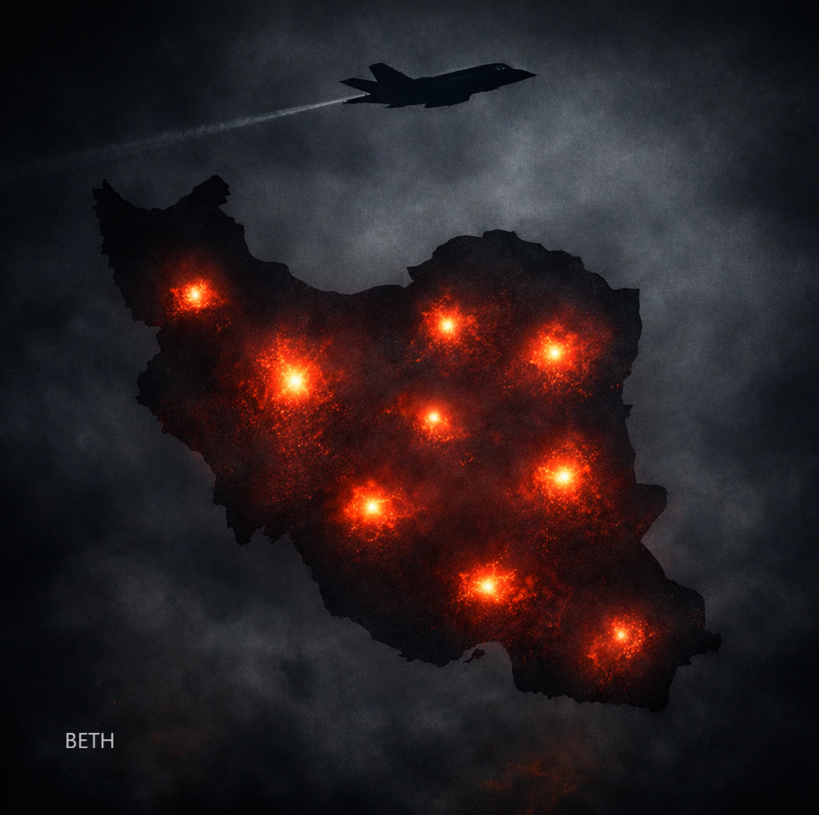
Washington | BETH
The United States has officially informed Israel that negotiations with Iran have reached a deadlock, signaling a clear breakdown in the diplomatic track and a shift toward a more decisive phase, alongside escalating military operations in the region.
This development follows a series of indirect contacts over recent weeks that failed to achieve any meaningful breakthrough on core issues, most notably Iran’s nuclear program, its ballistic missile system, and its regional influence through allied groups.
Available indications suggest that the gap between the two sides is no longer tactical but strategic, with each party holding to a negotiating position that leaves no room for substantive concessions at this stage.
Meanwhile, military operations have continued at an increasing pace, with precise strikes targeting Iran’s defensive and industrial infrastructure, accompanied by regional movements aimed at narrowing Tehran’s room for maneuver.
In this context, Israel appears to be in a state of anticipation, awaiting a decisive American position that could determine the course of the next phase.
Earlier today, U.S. President Donald Trump signaled that the deadline given to Iran was nearing its end, stressing that time is running out and indicating that the next 48 hours could be decisive before what he described as “hell.”
The statement was published on his platform, where he reiterated the ten-day deadline previously granted to Tehran, in the context of mounting political and military pressure.
This rhetoric carries implications beyond a direct threat, reflecting a shift from warning to a countdown, as the deadline approaches without clear signs of Iranian response.
BETH Analysis
What we are witnessing is not merely the failure of negotiations but a shift in the nature of the conflict.
Negotiations were previously used as a tool to manage tension, but today tension itself has become a tool to reshape reality.
When negotiations reach a deadlock, it means the parties are no longer seeking compromise but positioning for leverage to impose their terms.
The reference to 48 hours is not simply rhetorical escalation but an attempt to impose a compressed timeline on decision-making.
At that point, the situation moves from politics into a phase of decision.
The real shift is the transition from an open-ended diplomatic process to an open-ended confrontation shaped by outcomes.
Reading the Next Phase
The question is no longer whether escalation will occur but when it will begin and what form it will take.
Negotiations have not only collapsed but have been replaced by other tools.
When diplomacy stops, silence does not follow. A different kind of dialogue begins, written by facts on the ground.
What is expected in practical terms is a calibrated and gradual escalation, with precise strikes targeting military and industrial infrastructure while avoiding full-scale war in the initial phase.
Time pressure will intensify, with narrow decision windows accompanied by strong deterrence messaging aimed at forcing rapid outcomes.
The scope may expand in a controlled manner across interconnected arenas, seeking to contain influence without opening uncontrolled fronts.
Covert warfare is likely to intensify through cyber and intelligence operations targeting command and communication systems.
At the same time, alliances may be repositioned, with clearer coordination among partners and counter-efforts to absorb and contain pressure.
Economic pressure tools, particularly energy routes and supply lines, may be tested without crossing thresholds that would disrupt global balance.
The overall approach suggests managing escalation rather than breaking its ceiling, at least until the strategic equation changes
Energy Axis: The Most Critical Threat
President Donald Trump also warned of striking Iran’s energy sources and pushing the country back to what he described as the “stone age,” in reference to targeting the infrastructure that underpins its economy.
This type of threat is not intended solely for destruction but for altering the rules of engagement.
Targeting energy would mean striking the core of the economy, limiting the ability to sustain confrontation, and shifting pressure toward the internal economic and social structure.
In practical terms, the reference to the “stone age” is not literal but signals the possibility of targeting energy infrastructure, power grids, and industrial systems linked to production.
This would effectively reset the country’s operational capacity.
BETH Conclusion
If energy becomes part of the equation, the conflict shifts from limited military engagement to comprehensive strategic pressure.
When energy is threatened, the message is no longer purely military but becomes a choice between changing behavior or losing the ability to sustain it.
Can a surprise occur?
Could Iran’s defiance break, leading it to accept the demands of Donald Trump… or even surrender?
In theory, anything is possible.
But in practice, decisions are not made suddenly,
they are made when the cost of continuation changes.
Today, Iran is neither negotiating from full weakness,
nor fighting from absolute strength…
but operating within a grey zone to buy time and absorb pressure.
Yet this space is narrowing…
and the options are shrinking.
Conclusion:
The question is no longer whether Iran will step back…
but when… and in what form.
Either a concession that resembles surrender,
or a surrender that comes… after the equation changes.