



The Chaos of Narratives
By: Abdullah Al-Omairah
In times of crisis, it is not only events that race…
but narratives as well.
What reaches the public is not always the truth,
but what arrives first—
even if it is less accurate.
Contradictions in news are not new.
What is new is the speed at which they amplify.
In a turbulent environment, incomplete information spreads, sources multiply, and leaks diverge. This is natural.
What is not natural…
is when the media shifts from reporting this confusion to manufacturing it.
Some outlets no longer ask: Is this true?
But rather: Is this ready to be broadcast now?
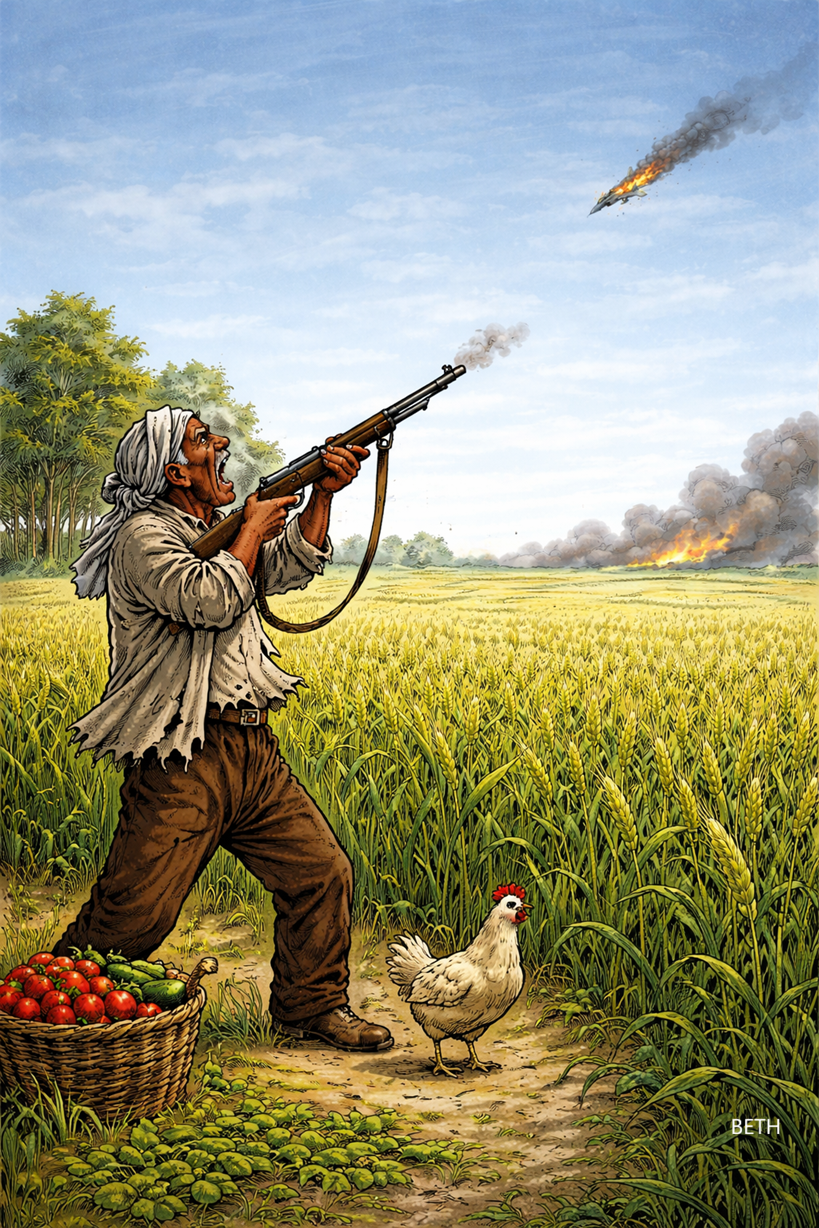
During the 2003 U.S. invasion of Iraq, a name emerged that lingered in memory: Ali Obeid Manqash. A simple Iraqi farmer who suddenly became a “national hero” after a story circulated claiming he had shot down a U.S. helicopter with an old hunting rifle.
The story had all the perfect elements:
a humble hero, a primitive weapon, and a massive achievement.
It spread quickly, was picked up by media outlets, and turned into a widely told narrative.
But reality was different.
There was no military logic behind it, no technical evidence to support it, and not even the man himself maintained the claim.
With the fall of the regime, the story disappeared—and the truth surfaced.
But the idea never did.
Today, the same scene reappears in a new form.
A narrative is being promoted that an Iranian farmer shot down an American aircraft.
Times have changed…
but the template has not.
A simple man, a basic tool, and an implausible outcome.
The goal here is not to report an event…
but to manufacture a feeling.
The real question is:
Why do some media outlets repeat narratives that defy logic?
And why do weak stories become broadcast material?
The danger is not in the emergence of such narratives…
but in how they are handled by the media.
Headlines appear on screens such as:
“It is unclear whether the U.S. fighter jet crashed or was shot down.”
And here, the simplest professional question arises:
Where is the news?
If the cause is unclear,
what makes this “breaking news”?
Why does a vague statement dominate the scene while deeper information and more solid analysis are available?
This is not reporting the news…
it is filling media space with anything.
What we are witnessing is not just conflicting information,
but a conflict in the very methodology of handling news.
There is a difference between media that reports what happens,
and media that searches for what can be aired.
In the first case, the news is understood.
In the second, it is consumed.
The “Ali Manqash narrative” never truly dies.
It simply returns under different names—
because it serves emotion, speed, and weak verification.
But in doing so,
it weakens public awareness
and distorts reality.
The problem is not conflicting narratives…
but those who give them a platform before questioning them.
In times of crisis,
not every story told…
deserves to be believed.
This is not about a fallen aircraft…
but about a war producing competing narratives—
between a truth that is told,
and a rumor that is manufactured.