



Iran’s Keys.. and the Battle Beyond
Riyadh | BETH
14 Shawwal 1447H | April 2, 2026
Prepared & Analyzed by | Strategic Media Department – BETH News Agency
Supervised by: Abdullah Al-Omairah
Introduction
Amid the escalation of military tensions, the ongoing war no longer appears as a conventional confrontation,
but rather as a precise search for the “keys” that reshape the balance of power in the region.
Between U.S. statements, field movements, and political ambiguity,
a strategy is forming that targets not geography itself,
but the nodes that control it.
Coverage
Attention is focused on a set of locations whose importance goes beyond their geographic boundaries:
Strait of Hormuz: the artery of global energy… and a test of maritime prestige
Recent developments have proven that Gulf states represent a fundamental pillar in global stability,
not only as a source of energy,
but as a decisive factor in economic security, the continuity of nations, and the advancement of societies.
Gulf states are no longer perceived as merely oil wells…
but as a stabilizing force that holds the rhythm of the global economy.
Kharg Island: the center of Iranian oil flow, and the shortest path to pressure revenue sources.
Bandar Abbas: the operational gateway controlling maritime movement.
Bushehr: a sensitive point linked to the nuclear file and its international balances.
Ahvaz (Khuzestan): the inland oil depth, and the geopolitical link with Iraq and the Gulf.
These locations, collectively, do not represent traditional military targets,
but rather an interconnected network of “keys of influence”
through which the behavior of an entire state can be altered without the need to bring it down.
BETH Analysis
First: The logic of “keys” instead of “occupation”
The closest reading of current movements indicates a clear shift in strategic thinking:
the objective is not to control Iran as a territory…
but to control its most influential points.
This approach reflects a mindset that sees:
securing the stability of Gulf states,
pressuring revenue sources,
recalibrating vital corridors,
and limiting maritime capability,
as priorities—tools that are more effective and faster in impact than engaging in a prolonged comprehensive war,
and more capable of reshaping the behavior of the opponent.
Second: Hormuz.. the symbolic battle
Discussion about Hormuz goes beyond oil to a deeper idea:
whoever ensures the flow of energy… determines the rhythm of the global economy.
Therefore, any attempt to reshape control over the strait is not merely a military move,
but a redefinition of the concept of maritime dominance in the region.
Third: Kharg.. the silent target
Amid political noise, Kharg Island emerges as a direct operational target:
it is not a military center as much as it represents a vital economic artery.
Pressuring it means:
reducing Iran’s ability to finance itself,
and pushing it toward negotiation options under the pressure of time and resources.
Fourth: Bandar Abbas and Bushehr… the limits of escalation
These locations represent a sensitive ceiling for the conflict:
Bandar Abbas: a point of tactical control
Bushehr: a line of contact with nuclear and international complexity
Any move toward them is not merely escalation…
but a transition into a more sensitive phase in managing the conflict.
Fifth: Ahvaz.. the deferred concept
Ahvaz remains, within this scene, a different kind of strategic possibility:
it is not merely a location,
but a proposition related to reshaping internal balances within the state.
However, if this path is opened,
it would not lead to tactical pressure,
but to a full geopolitical restructuring,
with costs and complexities that exceed the limits of the current phase.
Sixth: Between maneuver and distribution
U.S. movements do not follow a single line,
but are distributed between:
calculated escalation,
distribution of roles with allies,
and keeping options open without full commitment.
Here, Washington’s maneuvering with Europe and others appears
not as contradiction…
but as management of burdens and expansion of execution channels without restricting decision-making.
Seventh: The Gulf after the Iranian constraint
If Iran’s role in Hormuz and its surroundings declines,
the Gulf moves toward a new reality:
a more stable region in the flow of energy,
and more interconnected within a regional system that tends toward coordination with major powers.
But this transformation does not mean the end of complexity,
rather a shift from a “direct threat”… to a “new balance.”
Eighth: Peace.. between opportunity and risk
Weakening Iran opens the door to reintroducing peace in the region,
not as a political slogan,
but as a broad security and economic arrangement.
This shift does not come as an extension of a previous idea,
but as a direct result of new realities imposed by the balance of power on the ground,
where Gulf states—especially Saudi Arabia—have emerged as a decisive stabilizing force,
bringing them back into the equation of change as active contributors, not merely affected parties.
Within this context, it is no longer possible to imagine any new regional arrangement
without an active presence of Gulf states,
and with a role that goes beyond traditional expectations toward a more influential shaping of the coming phase.
The benefits are clear:
energy stability,
expansion of investments,
and a decline in the likelihood of open escalation.
But the cost is not simple:
redefining alliances,
bearing the cost of political transformation,
and entering a phase governed not by slogans, but by interests.
The risk does not lie in peace itself,
but in its impact on systems that have long operated within a climate of sustained tension.
BETH Conclusion
The war is not moving toward occupying Iran…
but toward limiting its ability to influence.
What is happening is not a race over land…
but a race over keys:
the key of oil,
the key of passage,
and the key of decision.
The most likely outcome is not the fall of a state…
but the recalibration of its role in a different form than before.
At this very moment, the question is no longer: who wins?
But:
who will shape the region once the war subsides?
And here begins the broader question… beyond the battlefield itself.
Regional Transformation.. and the Shift in Global Positions
With the emergence of a more cohesive regional system based on stability and balance,
a deeper question is raised:
how will global powers read this transformation?
The United States may see stability in the region as an opportunity to strengthen its strategic partnerships,
Europe will deal with it as a decisive factor in energy security and market stability,
while China tends to read the scene from a long-term economic perspective based on continuity of supply and expansion of investments.
Russia, on the other hand, may seek to maintain its role as a balanced actor,
while regional powers such as Turkey, and influential states like India and Pakistan, move according to their interests linked to regional stability and the flow of trade and energy.
A New Balance.. and Different Behavior
Within this context, the key question becomes:
does regional stability impose a different pattern of interaction among states?
A stable environment often leads to reducing the logic of confrontation,
enhancing cooperation pathways,
and redefining priorities in a way that serves development and prosperity.
In this framework, the focus may shift from managing conflict
to managing interests,
and from military balances
to economic influence and regional integration.
The scene does not point toward sudden change,
but toward a gradual recalibration in international and regional behavior.
The more the region is able to produce stability,
the more attractive it becomes as an economic and strategic partner,
and the less relevant traditional models of tension become.
At this stage, the question is not: who changes first?
But:
who succeeds in adapting to a new environment… defined by stability and shared interests.
Final Line
The battle is not over Iran…
but over who holds the keys to the world after it.
___________
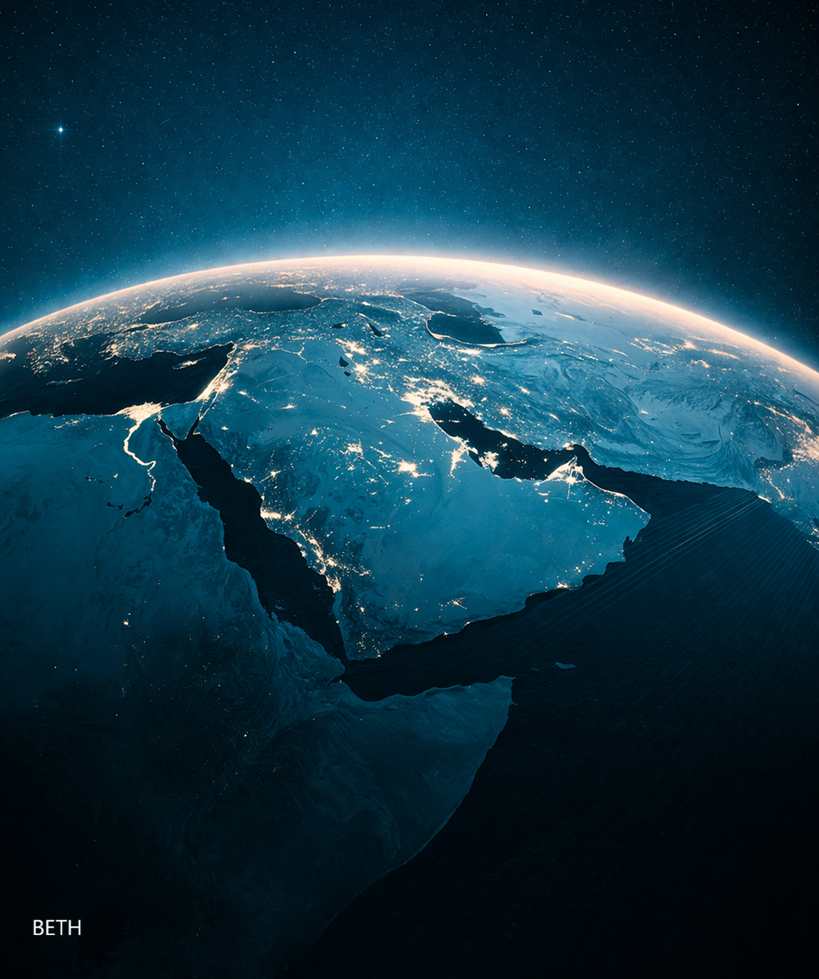
Caption (for the image):
Not geography…
but a center of decision.