



Saudi Saffron Moves Toward Global Markets
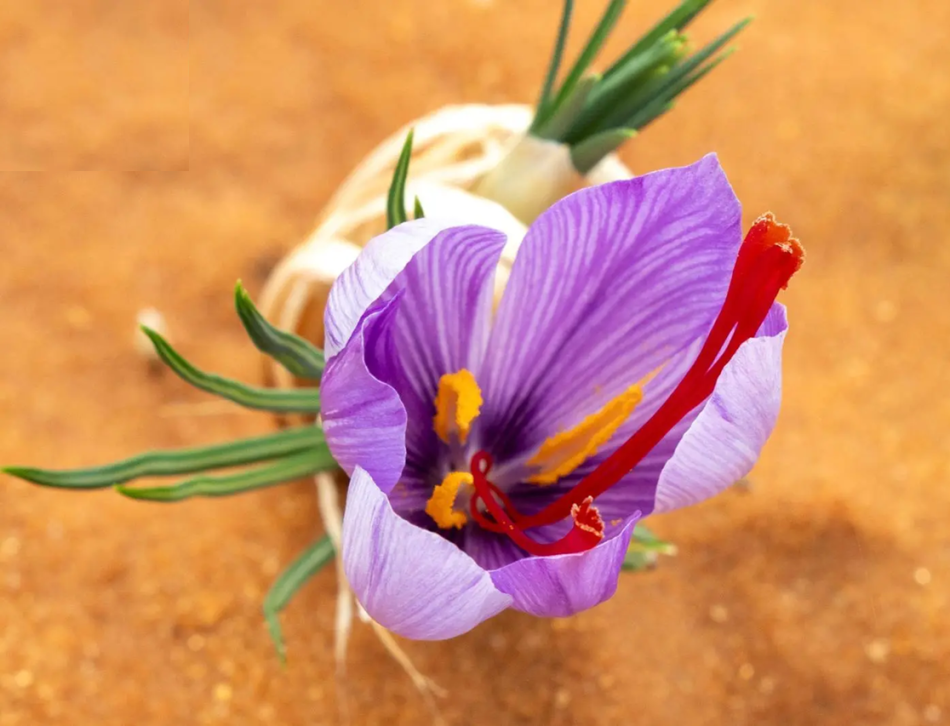
Riyadh | BETH
12 Shawwal 1447 AH | March 31, 2026
The National Center for Sustainable Agriculture Research and Development (Estidamah) has achieved a qualitative milestone in advancing Saudi saffron production, after confirming its compliance with international standards—marking a step that strengthens the presence of the local product in global markets.
Laboratory analyses conducted in accredited international labs showed that first-grade Saudi saffron threads comply with the ISO 3632 standard, confirming product quality and its global competitiveness.
This achievement comes as part of the saffron cultivation localization project launched by the center in 2024, in collaboration with the Ministry of Environment, Water and Agriculture and King Saud University, within efforts to support applied research and develop high-value agricultural crops.
The project included research and field trials across 10 regions in the Kingdom, focusing on evaluating environmental suitability, selecting optimal varieties, and applying best agricultural practices based on field study outcomes.
More than 500,000 saffron corms were distributed to over 43 farmers, with research outputs applied across more than 40 farms covering over 364,000 square meters—enhancing local production and achieving advanced quality levels.
The center adopted an integrated methodology combining scientific research with field application, through training and qualifying farmers across all stages of saffron production—from cultivation and crop management to harvesting, drying, and storage—ensuring preservation of the product’s premium characteristics.
BETH
This achievement is not measured by product quality alone, but by a shift in agricultural philosophy:
from limited traditional production… to a scalable, science-driven model ready for export.
Saudi saffron’s entry into a recognized global standard signals that the Kingdom is not aiming for self-sufficiency alone, but for competition in one of the world’s highest-value crops.
More importantly, the project reflects a new equation:
Scientific research + field application + farmer empowerment = a global product.
When agriculture becomes science… products become ambassadors.