



Netanyahu’s Speech Under the Microscope
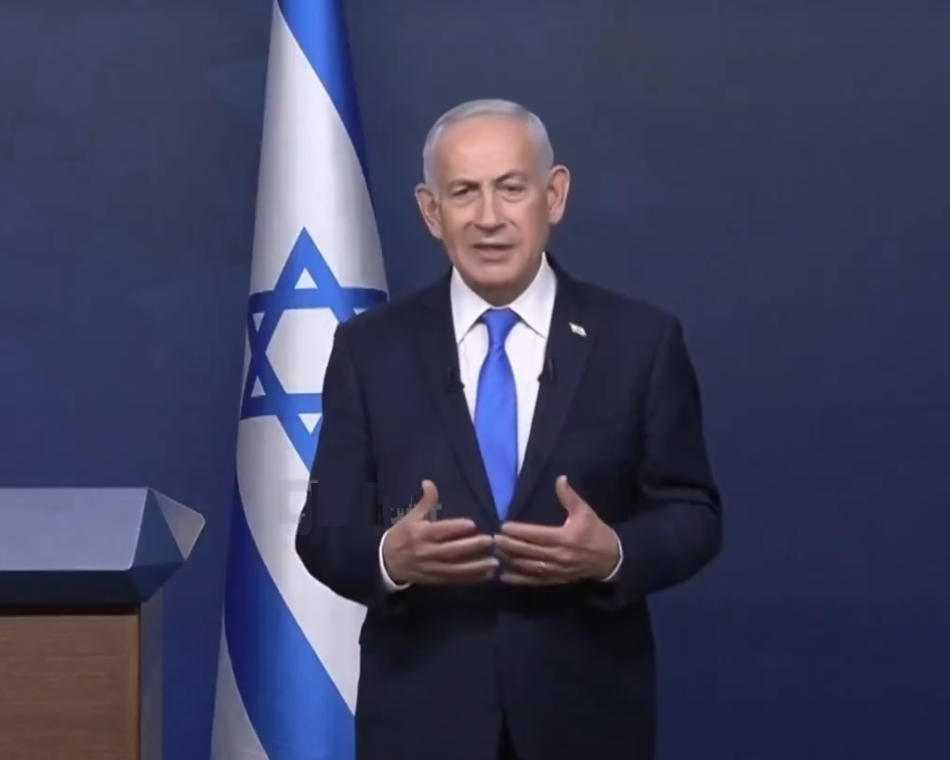
Examining what lies behind the words and the persona… where power claims meet anxiety
Analysis & Coverage | BETH
Prepared by | Strategic Media Department
Supervised by: Abdullah Al-Omairah
Introduction
At a moment of unprecedented escalation, Israeli Prime Minister Benjamin Netanyahu delivered a speech on Tuesday evening that appeared, on the surface, decisive and confident. Yet, at a deeper level, it reveals a concentrated attempt to redefine the war—not merely as a military operation, but as an entry point to reshaping the region.
This speech cannot be read as a political text alone, but rather as a structured model combining narrative management, internal consolidation, and the expansion of expectations.
The Presentation
Netanyahu opened his speech by denying rumors regarding his health—an act that may seem simple, yet carries a clear indication of the importance of maintaining the image of leadership during wartime.
He then moved to define the war, stating that the military operations against Iran—under the name “Roaring Lion”—aim to eliminate what he described as an “existential threat,” through targeting the nuclear program, destroying missile capabilities, and weakening the associated military infrastructure.
Netanyahu broadened the scope of the conflict, presenting Iran as an international threat, particularly in relation to the Strait of Hormuz, in an effort to shift the confrontation from a regional context to a global one.
He also emphasized coordination with the United States, while carefully rejecting the notion of dependency, asserting that the partnership is based on intersecting interests.
On the northern front, he announced the expansion of the “buffer zone” in southern Lebanon, reflecting a shift from containment toward imposing a new field reality.
He concluded with a central statement:
that Israel is working to reshape the Middle East.
Dissection | BETH
The Speech: Constructing a Narrative, Not Presenting Reality
Netanyahu did not present information as much as he presented a framework through which information is to be understood.
The core elements of this framework:
- Escalating military success
- An adversary framed as existential
- A strong international alliance
- A war with global legitimacy
These are not merely facts, but a coherent narrative structure
aimed at shaping public perception before shaping the battlefield.
Confidence: A Tool, Not a Measure
The language of decisiveness (“we destroy,” “we change”) does not necessarily indicate actual resolution, but reflects the speech’s need for certainty.
The contradiction appears here:
“Iran is being crushed”
“and there is still much work to be done”
This is not an accidental contradiction.
It may allow—in the eyes of the observer—for:
- Declaring success
- While justifying the continuation of the war at the same time
Arrogance: A Driver—and a Distorter
Netanyahu’s arrogance does not appear as display, but as a deeply held conviction—one of the known traits of his personality.
He sees himself:
as being in a historical moment,
and as the one shaping it.
This type of arrogance:
- provides decisiveness in decision-making
- but expands objectives beyond realistic limits
The risk lies not in arrogance itself,
but in its transformation into a standard for decision-making.
Strategic Dimension: Thinking Without a Clear Ceiling
The speech does not focus on:
reducing a threat
but on:
reshaping the region
This is evident in:
- linking Iran with Lebanon
- introducing the Iranian people into the equation
- connecting the war to global trade routes
This is not a limited war,
but an open-ended project.
Language: From Managing Conflict to Attempting to End It
The absence of terms such as:
- de-escalation
- containment
- settlement
and the presence of:
- decisiveness
- change
- superiority
reflect a psychological shift from:
managing conflict → to attempting to end it by force
This represents a high-risk leap in a complex environment,
with no clear indication that all its calculations have been fully accounted for.
Religious Dimension: From Mobilization to Constraint
The use of the religious dimension here is not incidental, but instrumental:
- to mobilize internally
- to raise the ceiling of the conflict
- and to grant legitimacy among religious constituencies
This political use of religion may, in some interpretations, conflict with the concept of a just peace—particularly when the conflict is framed as an extension of a religious narrative that does not accept compromise.
The problem emerges when:
war becomes a matter of “meaning” rather than “interest”
In such a case, it becomes:
- less likely to stop
- and more prone to uncontrolled escalation
Reading the Surrounding Environment | BETH
The Region Is No Longer What It Was
The regional environment has fundamentally changed:
The war has revealed that Saudi Arabia and the Gulf states have become real centers of power—a shift that has corrected many previous assumptions.
- The economy and stability have become tools of influence
- International relations have become complex and interwoven
Power is no longer purely military,
but composite.
Israel Faces a Clear Gap
It recognizes the transformation,
but has not yet adapted to it.
A mind that understands change…
and a behavior still operating within an old framework.
Why the Old Model Will Not Succeed
Because the new environment imposes different rules:
- Strong states are not managed through threat
- Development requires stability, not continuous conflict
- Shared interests have become broader than traditional disputes
Force alone is no longer sufficient to impose an equation.
Will Israel Change?
Yes… but:
- slowly
- under pressure
The driver will be:
reality, not rhetoric.
Conclusion
Netanyahu’s speech does not reflect stability as much as it reflects an attempt to control a complex reality.
It is a speech that is:
- strong in language
- broad in ambition
yet marked by an anxiety whose boundaries are not clearly defined—an anxiety that appears in parts of the narrative and in the way it is interpreted.
Most importantly:
it does not fully align with the nature of the new regional environment.