


When the Image Is Absent .. Who Owns the Narrative?
Analysis & Coverage | BETH
Supervised by: Abdullah Al-Omairah
In one of the most striking paradoxes of this war, a clear contradiction emerges between what is said… and what is seen.
The discourse speaks of near-complete air dominance and precise, deep strikes.
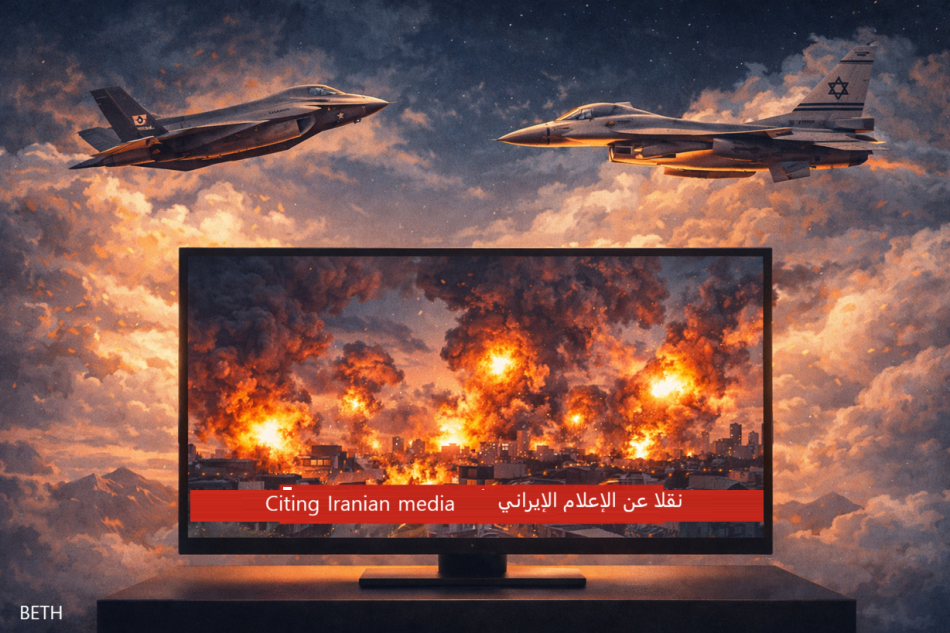
Yet the image that reaches the public does not come from the side executing these strikes, but from the side being targeted.
Explosions are broadcast from داخل إيران, footage sourced from its own media, and Arab channels rebroadcast the same material—without any visual presence from the opposing side.
This absence does not appear to be a flaw, but rather reflects a different nature in the management of war.
States that carry out precise strikes do not show everything. They avoid revealing operational details—not only to protect their capabilities, but because part of their success depends on what is not shown.
Moreover, in this type of warfare, strikes are conducted from the air or remotely, without direct ground presence. This means the camera is absent on the attacker’s side, while fully present on the side being struck—the side that possesses both the land and the event.
In contrast, the side under attack understands that the image is a weapon no less powerful than the missile.
So it broadcasts immediately—even if the footage is partial, limited, or open to interpretation—because it appeals to emotion before analysis, and demonstrates that it remains present and resilient despite the strikes.
Here, the paradox takes shape:
The strike is executed by one side… but seen from the perspective of the other.
With the absence of independent sources, media outlets that lack direct access become carriers of what is available.
The same scene is rebroadcast, and the same narrative is repeated—even if incomplete.
Except through leaked videos or approximate AI-generated visuals at this stage.
What is happening is not direct falsification of the image in most cases, but its management.
The image may be real, but the choice of angle, timing of release, and repetition give it a weight that exceeds its actual scale.
In this landscape, not only armies compete—narratives do as well.
The side focused on outcomes may delay the image, while the side seeking impact presents it immediately.
The real risk, however, lies not in who broadcasts—but in the absence of balance.
When the counter-image is missing, the public sees only half the scene, and its awareness is shaped by a single narrative.
Air superiority does not mean control of the screen.
And whoever owns the image… owns part of the truth.
In modern wars, the battle may be decided on the ground—
but it is understood… through what is shown.
What is the solution? And how does the side that owns the battle manage its narrative?
Managing the battle in the media does not mean revealing everything—
but it does mean not leaving a vacuum.
In modern wars, the problem is not a lack of information,
but its delay—or its absence at the moment when perception is formed.
The side that holds field superiority needs a minimum level of controlled visual presence—
one that shows indicators of outcome without revealing operational details.
A carefully crafted general image,
selective partial footage,
and visual confirmation of results—not methods.
With this balance, operations are protected, and the narrative is not left to the opponent.
Timing is no less important than content.
Delaying the image—even if accurate—creates space for another image, less precise… but more influential because it came first.
In this context, the role of media accompanying military operations is not mere transmission,
but framing the overall understanding—
so that events are not read from a single angle.
The equation is not between silence and exposure,
but between smart disclosure… and calculated silence.
In the end, the side that owns the battle
does not need to narrate all its details…
but it must prevent others from narrating it alone.