



Day 32: Explosions in Iran.. and Shrapnel Over Israel
Analysis & Coverage | BETH
On the thirty-second day of the war, Iranian cities—most notably Isfahan—witnessed a series of intense attacks. U.S. sources reported the targeting of a large ammunition depot using bunker-busting munitions, in what was described as one of the most powerful strikes in recent days.
Explosions also extended to the vicinity of Shiraz Airport and the Ahvaz region, while Tehran experienced partial power outages following multiple blasts across parts of the capital, with efforts underway to restore electricity.
On the other side, Israeli air defenses intercepted a missile heading toward Jerusalem, while another fell in an open area. Sirens were activated in Tel Aviv and central Israel, with falling shrapnel causing fires and injuring six people.
Politically, U.S. Secretary of State Marco Rubio اشاره إلى “positive informal messages” from داخل إيران, alongside reports of internal divisions and communication difficulties among Iranian officials, amid fears of surveillance and infiltration.
In the same context, Western intelligence reports confirmed a decline in the ability of Iranian military leadership to plan operations, due to weakened internal coordination.
Meanwhile, Israeli sources stressed that ending the war without dismantling Iran’s nuclear program would be considered a failure, emphasizing that the objective remains achieving a “complete victory” that includes both missile and nuclear capabilities, while the final decision on this file remains in Washington’s hands.
BETH Analysis:
What is unfolding on Day 32 reflects a shift from an exchange of strikes to targeting the “ability to sustain.”
Striking ammunition depots and critical infrastructure indicates a gradual effort to dismantle military depth,
while power outages signal pressure extending beyond the military sphere into the domestic front.
At the same time, the continued missile launches—despite their limited impact—confirm that Iranian capability has not been fully broken, but is operating within a narrower and more unstable scope.
More important than the battlefield developments is what is emerging politically:
Washington’s references to “elements within the system,”
reports of internal divisions,
and difficulties in communication among leadership
—all point to a shift where the confrontation is no longer purely external,
but is beginning to penetrate the structure of decision-making داخل إيران.
As for the Israeli position, it indicates that the ceiling of the war has not lowered, but is rising toward a more complex objective:
the complete elimination of capabilities, rather than merely weakening them.
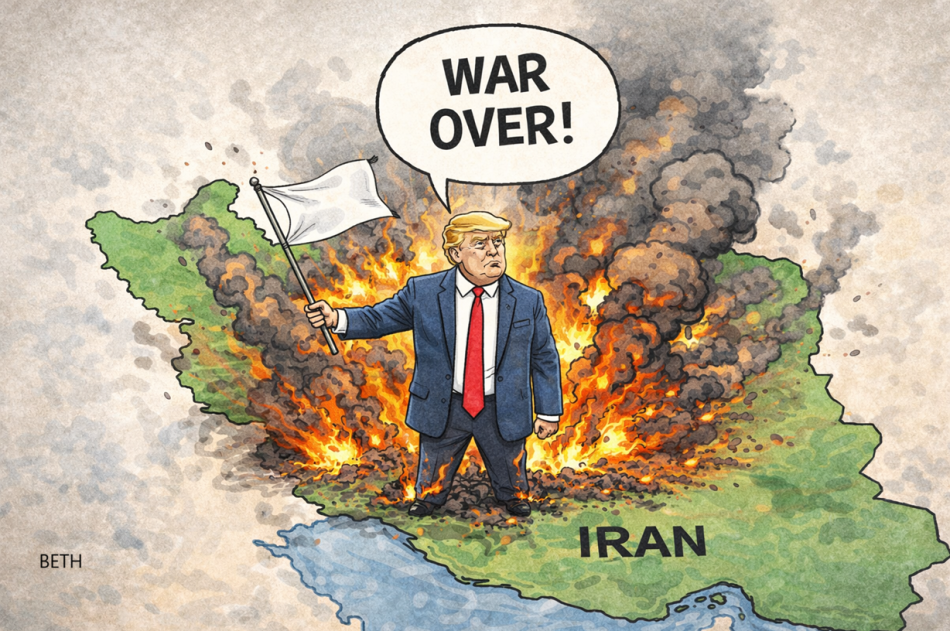
Trump Signals Ending the War Despite Hormuz
Riyadh | BETH
Media sources reported that U.S. President Donald Trump informed his aides of his readiness to end the military campaign against Iran, even if the Strait of Hormuz remains largely closed, with the reopening process postponed to a later stage due to its complexity.
BETH Analysis:
The statement reflects a reordering of priorities, where reopening the Strait of Hormuz is not part of the immediate objective of decisive military action, but rather a separate and more complex issue.
The delay does not appear to indicate hesitation, but rather an approach combining a military tactic focused on core objectives with a political pattern seen in some U.S. administrations, which involves signaling the end of wars before their full resolution, in order to secure additional gains in a shorter timeframe.
Ending the war does not mean resolving all its consequences…
but choosing what must be settled first.Update – 4 PM (Saudi Time)
The tone of U.S. statements continues to escalate, alongside ongoing reciprocal strikes and an expanding scope of operations, signaling a more sensitive phase in the course of the conflict.
Hegseth: The coming days will be decisive
U.S. Secretary of Defense Pete Hegseth stressed that the coming days will be decisive in the war with Iran, asserting that Tehran “cannot do much” in the face of available U.S. options.
He noted that the United States holds broader options, while Iran’s options are narrowing, adding that the past 24 hours have witnessed a decline in the number of missiles launched by Iran.
He further stated that “wisdom dictates that Iran should reach an agreement,” emphasizing that the new Iranian leadership must be more pragmatic than its predecessor.
In the same context, he confirmed that President Donald Trump is ready to reach an agreement with Tehran, warning that failure to do so would lead to a sharper escalation.
Hormuz: Stripping the pressure card
Meanwhile, Trump urged countries affected by threats to close the Strait of Hormuz to move and take control of this vital passage, asserting that there is “no real threat” to the strait.
This reflects an attempt to neutralize one of Iran’s most significant leverage tools on the global stage.
Field developments
Military operations continued across multiple fronts:
- Renewed Israeli strikes on Beirut’s southern suburb following evacuation warnings
- Intensive low-altitude drone flights over the Lebanese capital
- Explosions reported in Tehran and Karaj
- 10 injuries recorded inside Israel amid ongoing exchanges
BETH Analysis
U.S. statements are no longer mere political messaging… they are signals of timing.
When it is said that “the coming days will be decisive,” it does not necessarily indicate an imminent end, but rather the entry into a phase of maximum pressure—where options are narrowed to force a single decision:
Agreement… or deeper escalation.
The reported “decline in missile launches” should not be interpreted as de-escalation, but rather as a potential indicator of:
- Gradual depletion of capabilities
- Tactical repositioning
- Or preparation for a different phase of response
As for the Strait of Hormuz, redefining it as “not under real threat” is less a field assessment and more an effort to undermine Iran’s most critical deterrence card globally.
Meanwhile, continued strikes in Beirut and Tehran confirm that the battlefield is no longer confined… but has evolved into a multi-front, open-ended conflict.
Evening Report
Iran Under Strikes
Multiple explosions were heard across different parts of Iran, targeting locations in the north, center, and south of the country, in a notable escalation reflecting the widening scope of the strikes.
The attacks included the city of Qazvin in the north and Isfahan in central Iran, where reports indicated heavy bombardment targeting a steel plant, in addition to explosions in Bushehr and Bandar Abbas in the south.
Reports also indicated that the Natanz nuclear facility in central Iran was subjected to what was described as a “heavy strike,” with no official confirmation yet regarding the extent of the damage or the nature of the targeting.
In a related development, the Israeli army announced carrying out approximately 230 strikes within 24 hours, primarily targeting ballistic missile launch platforms, along with weapons production and development sites in Tehran.
The statement added that the strikes included facilities for casting and filling warheads with explosives, research and development centers, and sites for manufacturing ballistic missile components, anti-tank missiles, and short-range surface-to-air systems.
BETH Analysis
What stands out in these strikes is not their number… but their pattern.
The targeting is no longer focused on isolated sites,
but is shifting toward disabling the entire military production system:
From launch platforms
to manufacturing lines
to research and development centers
This indicates that the objective is no longer merely reducing capability…
but resetting it from the ground up.
At the same time, the geographic spread (Qazvin – Isfahan – Bushehr – Bandar Abbas – Natanz) points to:
High reach capability
Broad operational coordination
And a message that Iran’s strategic depth is no longer beyond reach.
Synchronized strikes… targeting the industrial core before the weapons