


The War of Narratives.. Iranian Discourse vs Western Media
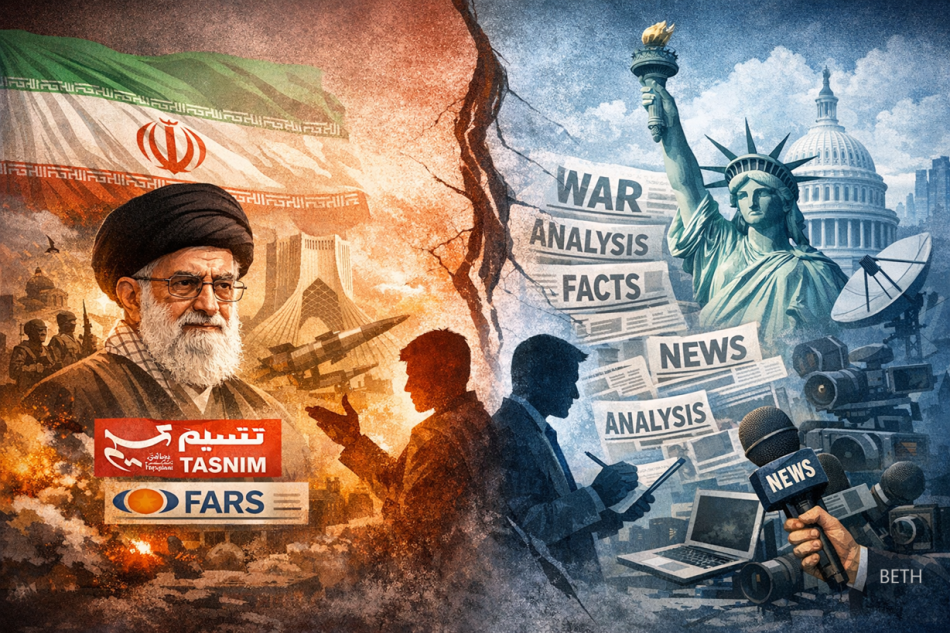
A comparison revealing how Iranian discourse constructs a directed narrative, while Western media presents a multi-angled analytical reading.
Prepared & Analyzed by | Strategic Media Department – BETH News Agency
In modern wars, truth is not shaped by facts alone,
but by the way those facts are told.
As the conflict escalates, three different perspectives emerge before the observer, each with its own method of constructing meaning and directing perception.
Iranian Media
Despite differences in style between the agencies “Tasnim” and “Fars,” both operate within a unified narrative framework.
Tasnim tends toward a language of mobilization and escalation, presenting responses as qualitative achievements, while downplaying the impact of strikes. Its headlines do not merely report events, but provide a ready-made interpretation to the reader.
In contrast, Fars adopts a more formal and disciplined tone, relying on official statements and emphasizing an image of “control and stability,” where the news appears closer to a state message than to an open media product.
In conclusion, a dual خطاب is formed addressing the الداخل:
one raises morale, while the other attempts to reinforce confidence,
yet both converge into a single narrative, presented through two different styles.
Western Media
On the other side, Western media approaches the event differently.
An analytical language that goes beyond direct reporting,
reliance on multiple sources,
a clear presence of analysts’ opinions,
and an open space for questions and possibilities.
Here, the news does not close the meaning, but leaves it open for discussion,
and is not presented as a complete truth, but as an interpretable picture.
The Difference
While Iranian discourse seeks to present an ideological and directed narrative,
Western media tends to deconstruct the event and offer multiple readings.
The former provides an answer,
while the latter raises a question.
What appears in coverage is not merely a difference in reporting,
but a difference in the function of media itself.
A media that constructs and directs a narrative,
and a media that analyzes and deconstructs.
In times of war, it is not enough to follow what is happening,
but more importantly to understand who is telling the story, and how they want it to be understood.
The battle is no longer only in the field…
but in the mind of the audience.Analytical Note:
Although Western media is not entirely neutral, and is also subject to political considerations and interests,
the difference lies in the tools and the style:It is more professionally developed, and more capable of presenting its narrative within a renewed analytical framework,
while Iranian discourse remains more direct and traditional, relying on a clearly mobilizing language.