



The Struggle of Meaning
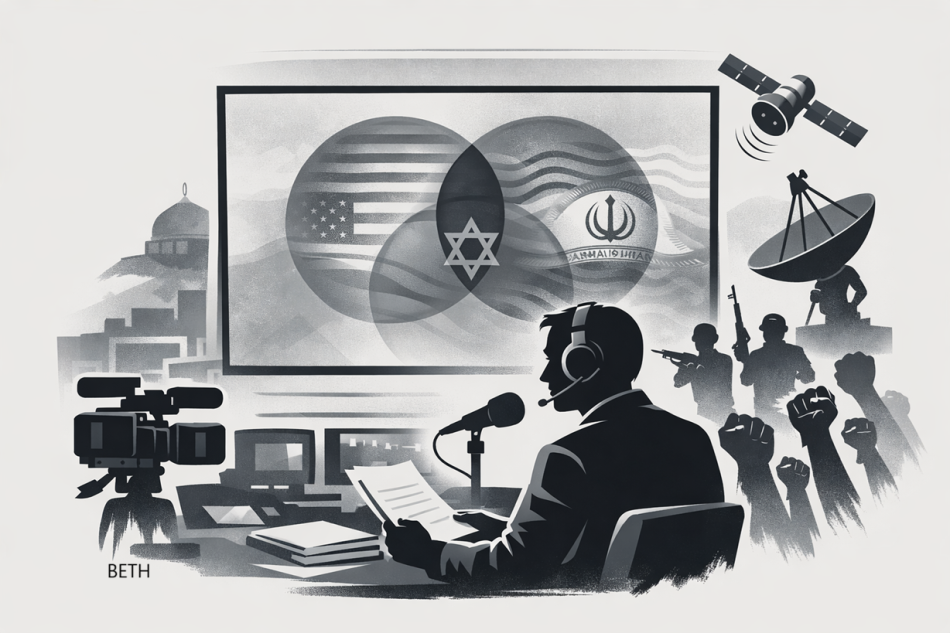
Who shapes the narrative .. and who directs awareness?
A reading into the making of media narratives and their impact in modern wars
Monitoring & Analysis | Strategic Media Department – BETH
Supervision: Abdullah Al-Omairah
Introduction
How does American and Israeli media deal with war?
How do Western and Israeli analysts read it?
Where do perspectives converge, and where do they diverge—and why?
And what impact does this have on public opinion in the West and Israel?
And how does Iranian media—and its affiliates—approach the war?
This report attempts to deconstruct these questions from within the media landscape itself, not from outside it, through a precise professional reading of coverage methods, analytical angles, and their impact on audiences.
How does media deal with war?
American media: A war measured by cost and outcome
American media does not appear as a single front, but as a system of competing interpretations.
Coverage in major institutions focuses on three main axes:
Regional risk and expansion of the conflict
Energy costs and their impact on the American الداخل
The possibility of direct military involvement
American media does not promote the idea of an “easy victory,” but consistently ties the event to two central questions:
What is the cost? And what is the exit?
In this context, a clear internal division emerges:
A current that sees the war as necessary to impose deterrence and curb Iran
And another that views it as a strategic gamble that may exceed direct American interests
More precisely:
American media treats the war as a complex test of deterrence, economics, and political legitimacy.
Israeli media: A clear threat… and an unclear end
Israeli media is more cohesive in defining the threat, but less cohesive in defining the end.
It starts from a core assumption:
Iran represents a direct strategic threat,
and therefore a security-driven tone of mobilization prevails.
Yet within this framework, sharp questions emerge:
Is the goal to weaken capabilities or overthrow the system?
Is there a plan for the day after?
Is what is presented to the public complete or subject to censorship?
Do strikes lead to sustainable security or prolonged attrition?
Conclusion:
Israeli media is unified in defining the enemy, but divided in defining success.
How do analysts read the war?
Western and Israeli analysts are not a single bloc, but multiple analytical currents:
One current sees the war as aimed at containing Iran’s nuclear and missile programs and limiting regional influence.
Another sees it as exceeding military goals into broader political objectives, potentially becoming an economic and geopolitical burden.
A third highlights a gap in objectives between Washington and Tel Aviv:
The United States tends toward limited, manageable goals,
while some Israeli circles lean toward broader goals that may include regime change.
Is there unity in perspective?
Unity in defining the threat
There is broad agreement among media and analysts in the West and Israel that the war revolves around three core files:
Iran’s nuclear program
Missiles
Regional influence
There is also a shared understanding that the war is not local, but a global crisis affecting energy, trade routes, and alliances.
Difference in defining the end
After this agreement, fundamental differences emerge:
In the United States:
The debate revolves around cost, legitimacy, and limits of involvement,
with strong focus on the impact on the American citizen.
In Israel:
The debate revolves around how to end the war,
with emphasis on achieving security even if it requires prolonged escalation.
Why this difference?
The position of each state in the war plays a decisive role:
Israel sees the war as a direct threat to its security,
while the United States sees it as an external crisis with domestic consequences.
The nature of the audience also differs:
Israeli audiences are more receptive to war due to a long security memory,
while American audiences are more sensitive to economic and human costs.
The function of media differs as well:
Israeli media operates closer to security and mobilization,
while American media operates within a broader space of political and economic debate.
Measuring impact on public opinion
In Israel, there is high mobilization with underlying concern:
Broad support for the war at its outset,
high confidence in its necessity,
but increasing questions about duration and outcomes.
In the United States, division and hesitation prevail:
Lower support for the war,
clear rejection of escalation or ground deployment,
and direct linkage between war and cost of living.
Evaluation
American media is strong in analyzing cost and context,
but less engaged with the existential security dimension.
Israeli media is strong in shaping threat perception and mobilization,
but its critical distance narrows during escalation.
Conclusion
American and Israeli media do not tell the same story…
even when describing the same event.
The Israeli narrative says:
This is a necessary war… how do we win?
The American narrative says:
This is a dangerous war… how much will it cost?
The deeper reality:
There is no full unity in perspective,
but rather unity in defining the threat—and divergence in defining the end.
This is where narratives are formed…
and where public awareness is shaped.
The Narrative of Tehran’s Media… and Its Allies
If American media measures war by cost, and Israeli media by security…
how does Iranian media see it?
And does it present a unified narrative…
or construct one and ask its audience to live within it?
The Iranian narrative
Iranian media—official and semi-official—does not treat war merely as a military event,
but as a comprehensive grand narrative.
Iran is presented in a position of strength, not defense,
with strikes framed as calculated and deliberate actions,
emphasizing continuity and rapid recovery.
The war is also framed as part of a broader confrontation
extending beyond Israel to include the United States and “Western dominance,”
thus transforming it into an ideological cause.
Multiple fronts are not portrayed as a burden,
but as proof of reach and influence,
presented as spheres of influence rather than zones of attrition.
Thus, Iranian media remains within this framework,
because its narrative is built on ideological legitimacy of expansion, not cost-based calculations.
The narrative of Iran’s allies
The narrative is not only transmitted—it is reshaped depending on the audience.
In the Arab region:
Focus on “resistance,”
portraying Iran as a supporter rather than a driver.
In the West:
Critical narratives highlighting double standards,
and emphasizing humanitarian consequences.
In allied media:
The narrative is reproduced with reduced ideological tone,
and increased humanitarian or rights-based framing.
Analysis
Iranian media does not describe war—it redefines it.
Unlike American media, which analyzes, or Israeli media, which justifies,
Iranian media reconstructs reality psychologically before reporting it.
It relies on selective presentation,
blends news with ideology,
and constructs meaning before events fully unfold.
Evaluation (Strengths and Limitations)
Clarity of message is a defining feature,
but it does not necessarily reflect diversity of understanding,
rather disciplined execution of a centralized narrative.
The narrative is stable, providing internal influence,
but less adaptable to changing realities.
Mobilization is effective among supporters,
but does not extend equally across all segments,
with noticeable skepticism among younger audiences.
On the other hand, it suffers from limited plurality,
a widening gap between reality and narrative,
and reliance on ideological discourse that limits global reach.
Measuring impact
Inside Iran:
It reinforces resilience and reduces shock impact,
but may create a gap between reality and perception.
Among allies:
It achieves temporary mobilization
and strengthens identity around confrontation.
In the West:
Its influence is limited on the general public,
but present within activist, alternative media, and critical circles.
It is promoted through sympathizers, alternative platforms, and digital networks,
with motives ranging from ideological conviction to opposition to dominant narratives.
Despite its limitations, it spreads when it finds audiences seeking alternatives to mainstream narratives.
Arab media
Arab media operates between transmission and influence,
more than as a producer of narrative.
In many cases, it does not generate its own narrative,
but recycles others,
with variation in angle, not in foundation.
Between media adopting Western narratives,
and others leaning toward Iranian discourse,
the Arab voice remains oscillating between alignment and hesitation,
with limited presence in shaping global meaning.
Arab media does not lack events…
but lacks ownership of the narrative.
Yet, limited attempts have emerged to break this pattern,
seeking to build a different discourse—
one that interprets, not merely transmits.
This approach starts not from “what was said,”
but from “how should it be understood,”
does not align with ready-made narratives,
but deconstructs and reconstructs them,
and addresses a global, not just local, audience.
Final Conclusion
Iranian media does not compete in speed of news…
but in stability of narrative.
It does not ask: what happened?
It asks: what should it mean?
While American media seeks cost,
and Israeli media focuses on security…
Iranian media does something entirely different:
Arab media, in many cases, is still searching for its place among these narratives,
more than striving to own its own narrative…
And the final judgment remains with the awareness of the audience.