



Day 26: Strikes & Signals
Riyadh | BETH
26 Ramadan 1447H | March 25, 2026
Synchronized Escalation… From the Negev to the Caspian
Explosions were reported in the Negev, southern Israel, on Wednesday, after the Israeli army detected missile launches from Iran. Sirens were activated across southern Israel, as a new wave of attacks targeting strategic sites began.
Meanwhile, Iranian media reported a series of explosions and aerial movements inside the country, including:
- Fighter jet activity and explosions in Tabriz
- Strikes targeting a marine infantry unit in Bandar Abbas at dawn
- Five explosions at a missile site in Isfahan in the morning
- Explosions in the Al-Bazr industrial city in Qazvin
Strike in the Caspian… Cutting the Supply Artery
Israel carried out a military strike targeting a maritime site in the Caspian Sea, in a notable development that extends beyond the traditional geography of the conflict.
According to the Wall Street Journal, the strike aims to undermine Russian support for Iran by targeting one of the supply routes used to transport ammunition and drones.
IAEA Withdraws… Program Remains Open
The Director General of the International Atomic Energy Agency, Rafael Grossi, announced that all technical specialists have left Iranian territory due to the ongoing war, while expressing hope that inspections can resume.
He noted that Iran’s nuclear program is not limited to specific sites, but spans a wide network of facilities, making accurate assessment difficult in the absence of inspectors.
Temporary Immunity… Negotiations Under Fire
In a notable political development, reports indicated that the United States and Israel have granted temporary immunity to two senior Iranian officials:
- Foreign Minister Abbas Araghchi
- Parliament Speaker Mohammad Bagher Ghalibaf
This comes within the context of indirect negotiations underway with Tehran, despite ongoing military operations.
BETH Analysis | Parallel War Tracks
What is happening on Day 26 is no longer a conventional war…
but the management of conflict across three parallel tracks:
1. The battlefield is expanding geographically
The strike in the Caspian indicates that the conflict is no longer confined to the Gulf or inside Iran, but has extended to international supply lines.
2. Iran under layered pressure
Repeated strikes on military and industrial sites reflect an attempt to dismantle operational structures, not merely weaken them.
3. Negotiations do not stop… they operate under fire
The granting of temporary immunity reveals that communication channels remain open, and are now part of the tools of war management.
BETH Conclusion
The real battle today is no longer who strikes more…
but who succeeds in managing the balance between fire, negotiation, and narrative.
Escalation .. and Mediation
Israel announced that it carried out airstrikes at noon today targeting Zahran inside Iran, in a new escalation within ongoing operations.
Meanwhile, the U.S. Department of Defense revealed a framework agreement with Honeywell to enhance munitions stockpiles, indicating preparation for a prolonged phase of operations.
On a parallel track, China has entered the crisis line, announcing diplomatic moves aimed at stopping the war and saving Iran from the consequences of escalation.
At the same time, the Iranian Foreign Ministry stated that it does not trust U.S. diplomacy, reflecting a deep gap in the path toward de-escalation.
Ankara has also emerged as a mediator, beginning to relay de-escalation messages between Washington and Tehran, in an attempt to open an indirect communication channel.
BETH Analysis
The current scene reveals a dual equation:
Military attrition vs. political rescue
Israeli strikes and the expansion of U.S. munitions stockpiles indicate an intention to deeply exhaust Iran’s capabilities.
In contrast, moves by China and Turkey reflect international concern over a potential collapse of regional balance.
But the key question remains:
Is the goal to eliminate capability… or to push Iran toward a clear declaration of submission?
The United States is not only seeking to stop the war,
but to reach an end that is translated politically.
Conclusion
The war is not managed only in the sky…
but also at the negotiation table.
And any ceasefire will not occur…
unless military pressure is transformed into a declared political gain.
Evening Developments.. Broad Escalation
The United Nations Human Rights Council held an emergency session to discuss the repercussions of Iranian strikes that targeted Gulf states, where it condemned the attacks and called on Iran to pay compensation for the damage caused to energy facilities and infrastructure, while urging an immediate de-escalation and rejecting any moves to close the Strait of Hormuz.
Meanwhile, the Iranian army announced that it had launched cruise missiles from its coasts toward the U.S. aircraft carrier USS Abraham Lincoln, claiming that some of them hit the vessel, with no confirmation from the U.S. side so far.
On the ground, Israeli media reported that Israeli strikes are currently focusing on military infrastructure inside Iran, while the U.S. Central Command (CENTCOM) confirmed that it is targeting Iranian military capabilities that it said have posed a long-term threat to the region.
On the military-industrial front, the U.S. Department of Defense announced the signing of agreements with Lockheed Martin, BAE Systems, and Honeywell to increase the production of missiles and munitions, including quadrupling the production of components related to the THAAD missile defense system.
In a notable development, Israeli reports indicated that Prime Minister Benjamin Netanyahu has ordered the execution of large-scale strikes inside Iran within 48 hours.
BETH Analysis
The current scene is heading toward a calculated expansion of the war… not its end.
UN condemnation = political pressure
Ongoing strikes = military pressure
Increased military production = preparation for a longer war
As for Iran’s announcement of targeting an aircraft carrier, it represents a high-risk symbolic escalation, even if not confirmed on the ground.
Leadership Underground
Pakistan stated that it is still awaiting an official response from Iran regarding the U.S. proposal, noting the difficulty in reaching any Iranian official at the present time.
It added that Iranian leadership is “underground,” indicating the complexity of communication channels and delays in official responses.
BETH Analysis
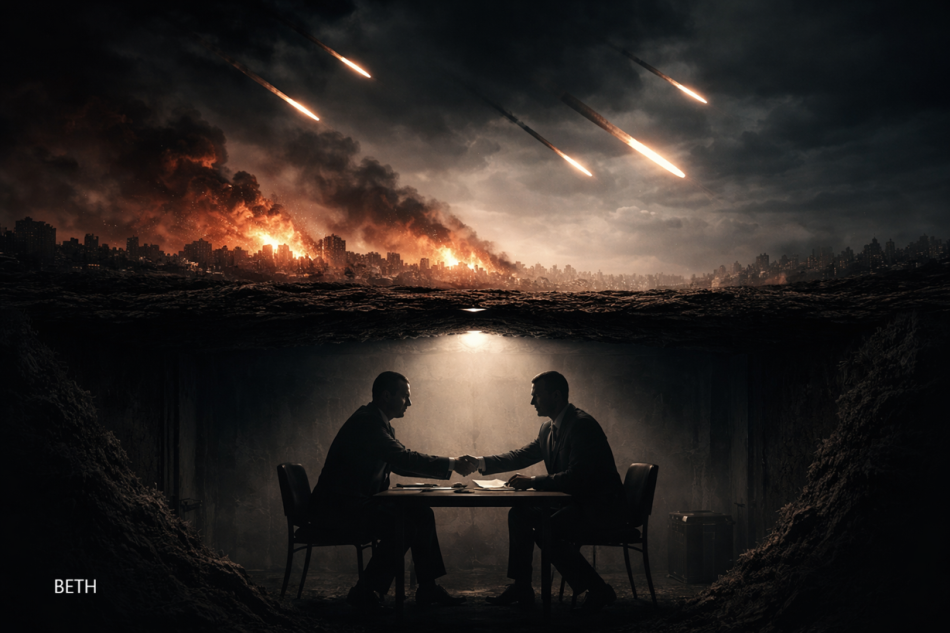
The term “underground” is not merely a figurative description…
but carries two overlapping meanings:
Security-wise:
Iranian leadership may have physically relocated to fortified shelters and underground facilities in anticipation of targeting, which is a common measure in high-intensity conflicts.
Politically and in terms of communication:
It means that decision-making channels are either closed or slow,
due to:
Reorganization of leadership
or difficulty in coordination between decision centers
or a deliberate delay in response as a negotiation tactic
Recognition of Defeat
The White House announced that U.S. President Donald Trump will escalate strikes against Iran “with greater force” if Tehran does not accept the reality of its defeat.
The statement reflects a notable shift in U.S. rhetoric, from managing escalation to imposing a defined end to the war.
The statement is not merely about military pressure…
but about a declared political subjugation.
Washington is not just signaling strikes,
but linking de-escalation to a psychological and sovereign condition:
Recognition of defeat
This fundamentally changes the nature of the conflict:
The objective is no longer weakening capabilities,
but breaking political will.
This is not a message of escalation…
but a message of an imposed end.