



Day 25: The War Is Moving Toward Its End
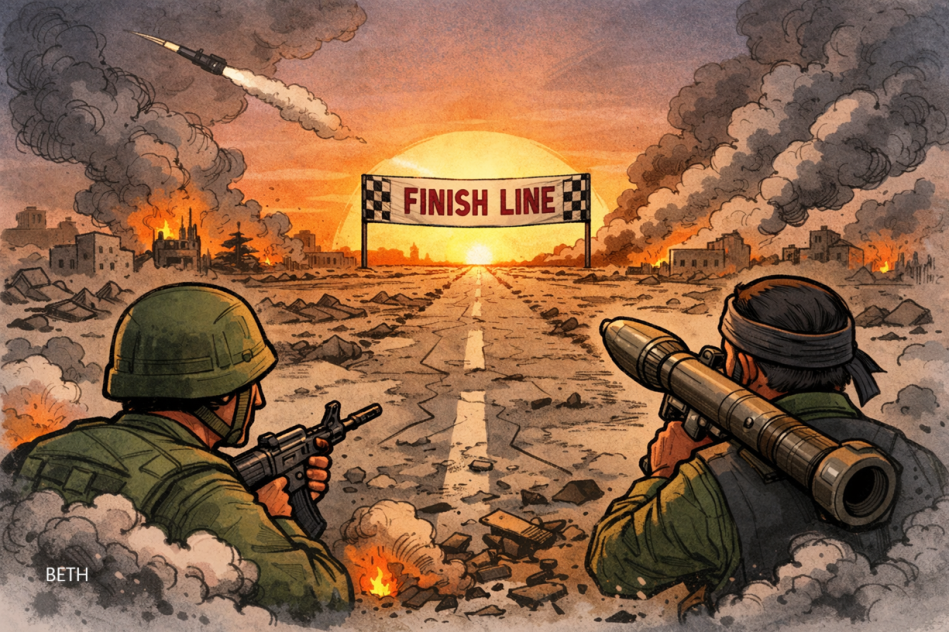
Riyadh | BETH
25 March 2026
The war in Iran continues into its twenty-fifth day, amid wide-scale military escalation reflecting a transition into a deeper and broader phase of confrontation.
Israel has launched a new wave of airstrikes on sites in western Iran, while the Israeli military announced targeting more than 50 locations across northern and central parts of the country overnight, including sites used for launching and storing ballistic missiles, as well as an intelligence headquarters of the Islamic Revolutionary Guard Corps in Tehran.
In response, fragments of Iranian missiles fell in multiple locations in Tel Aviv, causing injuries and material damage to several buildings, in a continuation of the ongoing exchange of attacks.
The U.S.-based Institute for the Study of War also reported strikes targeting Basij units and research centers specializing in electronics and missile technologies in Tehran, in addition to attacks on Isfahan, Tabriz, and Shahrekord.
Politically, Washington continues its military operations while temporarily excluding Iranian energy facilities, amid statements by U.S. President Donald Trump about “constructive talks” with Iranian parties, despite official denials from Tehran.
In a notable development, reports revealed an unannounced internal approval within Iran to enter negotiations, alongside information indicating U.S. interest in engaging Iranian Parliament Speaker Mohammad Bagher Ghalibaf as a potential partner in the next phase.
Meanwhile, the Israeli Prime Minister confirmed that he informed Washington of Israel’s intention to continue military operations until its objectives are achieved, signaling no retreat despite political indications.
BETH Analysis
On its 25th day, the scene reveals a significant shift:
The war is no longer purely military…
it has become a process of reshaping Iran’s political future.
- The battlefield: broad escalation and precision targeting of military infrastructure
- Politics: talk of negotiations… alongside simultaneous denial
- Background: a search for an alternative “partner” within Iran
Here, the most critical dimension emerges:
The conflict is no longer only about capabilities…
but about who will lead Iran after the war.
Conclusion
We are facing a war managed on two levels:
Striking the present…
and shaping what comes after.
When strikes continue…
and names begin to surface…
know that the war…
has entered the phase of writing its ending.
Accelerating Escalation
The region is witnessing rapid developments reflecting simultaneous political and military escalation, amid the ongoing confrontation between Iran on one side, and Israel and the United States on the other.
Lebanese authorities have announced the expulsion of the Iranian ambassador, granting him until Sunday to leave, in a move carrying notable political implications for relations between Beirut and Tehran.
Inside Iran, Mohammad Baqer Zolghadr has been appointed Secretary of the Supreme National Security Council, replacing Ali Larijani, indicating a reshaping of decision-making centers amid the ongoing escalation.
On the ground, missiles were reported launched from Iran toward Jerusalem, while powerful explosions shook the city of Tabriz, in a continuation of exchanges and an expansion of operational scope.
BETH Analysis
The scene is moving toward multi-layered escalation:
- Politically: rising diplomatic tension (Lebanon – Iran)
- Internally: restructuring of decision-making centers in Tehran
- Militarily: continued exchanges and geographic expansion of strikes
Conclusion
We are entering a phase where the war is not only being managed…
but the balance of the region is being reshaped.
Iran Imposes Transit Fees in Hormuz
In a notable move, Iran has imposed fees of up to $2 million on every vessel passing through the Strait of Hormuz, one of the world’s most vital energy corridors, in a development that reflects an economic escalation parallel to the ongoing military confrontation.
The decision comes amid rising U.S. threats and increasing European efforts to secure navigation in the strait, alongside concerns over direct impacts on global energy markets and supply chains.
BETH Analysis
The Iranian decision is not merely a financial measure…
but a redefinition of control over the strait:
- Economically: turning the passage into a pricing and pressure tool
- Politically: imposing a new reality without full closure
- Militarily: testing the limits of U.S. and European response
What does this mean?
Iran is not closing Hormuz…
it is shifting to a new phase, signaling:
we manage Hormuz on our own terms.
Conclusion
This is not a traditional blockade…
but a form of coercion and strategic challenge.
Surrender Under Pride
Israeli media outlets are reporting that the newly installed Iranian Supreme Leader, Mojtaba Khamenei, has agreed to halt the war and enter negotiations with the United States under Iranian conditions.
So are we facing:
- Retreat without acknowledgment?
- Negotiation under pride?
- A silent retreat?
- Or a surrender that is not spoken?
Is it surrender?
Most likely… not in the traditional sense.
True surrender is:
- Without conditions
- With acknowledgment of defeat
- And clear concessions
None of which appear in the current indications.
So what is happening?
1) Negotiation under pressure
Iran—if the reports are accurate—is acting from a position of:
- Sustained military strikes
- Economic and military pressure
- A need to stop the bleeding
Yet without accepting to appear defeated.
2) Unannounced (tactical) retreat
This can be described as:
Retreat… without admitting retreat
- Negotiation
- With conditions
- While maintaining a firm narrative
3) Civilizational pride
States with deep civilizational roots—such as Iran—
do not see themselves merely as a state…
but as an extension of a history that must not be defeated.
Therefore:
even retreat is presented as:
- A sovereign decision
- Or a political victory
- Or a smart management of conflict
4) Redefining the outcome
Instead of saying:
“We lost”
They say:
“We imposed our conditions… and entered negotiations”
Conclusion
We are not facing a clear surrender…
but rather:
Some states do not surrender…
they simply rename surrender.
Victory is not built on wishful thinking… but on a structured analysis that combines qualitative judgment grounded in expertise and insight, with quantitative forecasting based on data and models, alongside constant readiness to adapt to emerging dynamics.
Trump: Iran Gave Us a “Very Big Gift”
U.S. President Donald Trump said on Tuesday that Iran had given the United States a “very big gift” in terms of oil and gas, without providing further details.
Speaking to reporters at the White House, Trump stated:
“It was a very big gift, worth a tremendous amount of money.”
He also indicated that the system in Iran has changed, adding:
“We now have a new group of leaders in Iran, so let’s see how they perform.”
Trump further confirmed that the United States is “currently” negotiating with Iran to reach a ceasefire in the ongoing conflict between the two sides.
What does he mean? | BETH Analysis
Trump’s statement suggests that Iran’s actions have provided Washington with an advantage—whether in energy markets or in its negotiating position—without direct intent.
As for his remark that “we are currently negotiating,” it does not necessarily indicate formal talks, but rather backchannel communications and testing of positions under continued military pressure.
It is not a real gift…
but a strategic gain that has turned into a bargaining leverage.