



Day 24: Hormuz Under Deadline
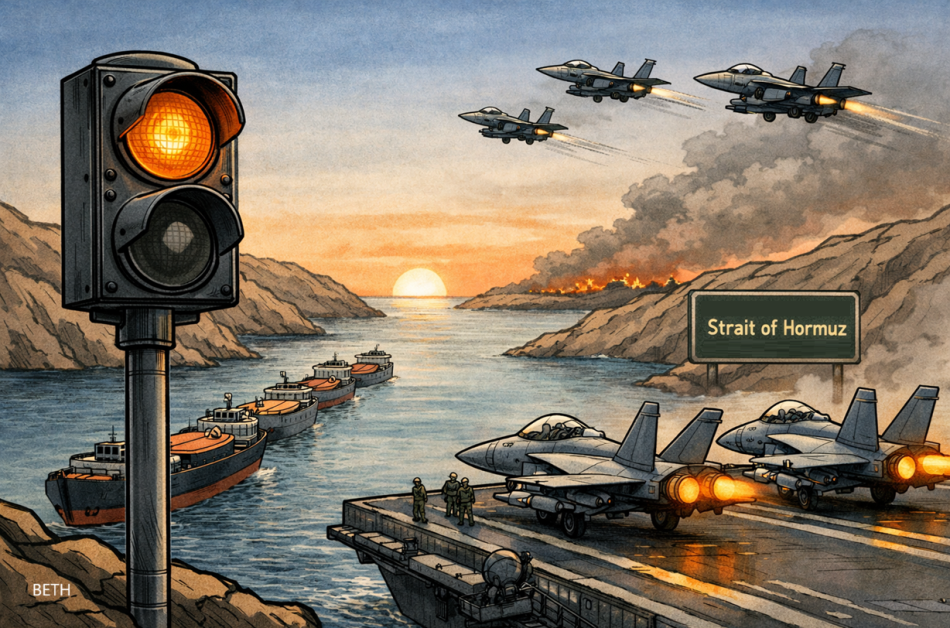
Riyadh | BETH
24 March 2026
As the war between Iran on one side, and the United States and Israel on the other, enters its 24th day, tensions are escalating to a new level, with the conflict shifting from direct military strikes to threats targeting the world’s vital energy artery.
In this context, U.S. President Donald Trump reiterated his long-standing principle of “peace through strength” in a post on his platform, Truth Social, emphasizing that military and economic power remain the most effective path to maintaining peace, rather than weakness or excessive concessions.
At the same time, Trump granted Iran a 48-hour deadline to reopen the Strait of Hormuz, warning of its destruction if the waterway remains closed. The strait is a critical passage through which nearly 20% of global oil and gas supplies flow.
More than 24 hours into the deadline, the U.S. president renewed his warnings, signaling a shift in the conflict toward a strategic economic dimension that goes beyond direct military confrontation.
On the ground, Israel intensified its airstrikes deep inside Iran, targeting multiple areas across the capital, Tehran—including eastern, western, northern, and central districts—as well as the city of Karaj, in one of the most extensive waves of strikes on the capital since the war began.
BETH Analysis
What is unfolding is not merely escalation… but a redefinition of the battlefield:
1. From battlefield to lifeline
The threat to the Strait of Hormuz signals that the war is no longer measured by missiles alone, but by control over global economic flows.
2. “Peace through strength”… doctrine or tactic?
Trump is not presenting a slogan, but applying a model built on time pressure, high-intensity threats, and a flexible negotiation window.
3. The deadline… a psychological tool before a military one
The 48-hour window is not just an ultimatum, but an attempt to compress decision-making in Tehran under time pressure.
4. Strikes on Tehran… beyond military objectives
The scale of attacks on the العاصمة carries a symbolic message:
the “core is no longer secure”… and the war has entered a phase of breaking deterrence perception.
Conclusion
On Day 24, the war is no longer seeking battlefield superiority…
but a strategic breaking point:
Either Hormuz reopens…
or a more dangerous phase begins.
The Deadline Extends
In a notable development in the course of escalation, U.S. President Donald Trump announced the postponement of any potential military strikes on Iranian energy facilities for five days, instead of the previous 48-hour deadline set for reopening the Strait of Hormuz.
This decision comes after direct U.S. threats to target Iran’s energy infrastructure if the strait remains closed, which is considered one of the world’s most critical energy corridors.
So far, no official statement has been issued by the Iranian side regarding any change in its position, while attention is turning to whether this new deadline represents a shift in the course of the crisis, or merely a recalibration of the escalation tempo.
BETH Analysis
The shift from “48 hours” to “5 days” opens three possibilities:
1. Tactical De-escalation
Not a retreat from the decision… but a reduction in immediate pressure, while maintaining the threat.
2. Unannounced Response
Backchannel signals may have led to granting additional time to translate preliminary understandings without formal declaration.
3. Mediation in Motion
Extending the deadline often reflects the activation of diplomatic channels working to contain escalation before reaching a point of no return.
The Deadline… and Who Writes the Ending?
Riyadh | BETH
24 March 2026
In a notable development, U.S. President Donald Trump announced the postponement of any potential military strikes on Iranian energy facilities for five days, instead of the previous 48-hour deadline set for reopening the Strait of Hormuz, noting that there have been “good and very productive” talks with Tehran.
In contrast, Iran firmly denied holding any contacts, considering the U.S. statements as an attempt to buy time and lower energy prices.
At the same time, Israeli Prime Minister Benjamin Netanyahu entered the scene, stressing that Tel Aviv will not allow a “bad deal” with Iran, in a position reflecting an effort to set the سقف of any potential negotiation path.
In an additional development, Trump stated that the United States has briefed Israel on the results of the talks, indicating continued coordination… or a managed divergence.
BETH Analysis
The shift from “48 hours” to “5 days” does not appear to be a retreat, but rather a recalibration of the escalation tempo.
The scene reveals three parallel angles:
- Washington: applying pressure while opening the door to negotiation at the same time
- Tehran: denying and maintaining the image of resilience
- Tel Aviv: raising the ceiling and preventing any settlement that does not suit it
Here, no direct conflict appears…
but rather a difference in managing the end of the battle.
Conclusion
We are facing a moment that is not decided by statements…
but by the timing of decisions.
What’s Next?
The situation stands at a crossroads:
- Reopening Hormuz → success of pressure through strength
- Continued closure → return of military options
- Extension of the deadline → negotiation under threat
The scene now stands at a sensitive crossroads:
- If the strait is reopened → the crisis turns into a success of pressure through strength
- If closure continues → military options return to the forefront
Statements
Amid the accelerating escalation, the successive statements from the concerned parties reveal a highly complex scene, where the military overlaps with the political, and threat intersects with negotiation.
U.S. President Donald Trump announced that his country is holding talks with a “senior Iranian official,” noting that this official is not the Supreme Leader, and suggesting that leadership in Iran may be “collective.” He also confirmed that Tehran initiated the contact, not Washington.
In a tone that combines escalation and openness, Trump said that U.S. strikes have “wiped out” significant capabilities, adding that around 15 points are under discussion with Iran, with the possibility of reaching an agreement within five days or less, despite offering no firm guarantees.
In a notable statement, he indicated that most Iranian leaders have been “eliminated,” with only a few remaining, in a remark carrying political dimensions beyond its direct military meaning.
On the Russian side, Foreign Minister Sergey Lavrov announced that he held talks with his Iranian counterpart Abbas Araghchi to discuss ways to achieve a ceasefire, signaling Moscow’s entry into de-escalation efforts.
As for Tehran, it presented a different narrative, with an Iranian official stating that the Strait of Hormuz “will not return to what it was” as long as psychological warfare continues, stressing that the country will continue to defend itself.
BETH Reading
The statements do not reflect a single trajectory…
but reveal three overlapping layers:
- Sharp rhetorical escalation (wipe out – kill – threaten)
- An open negotiation track (15 points – deadline – possible agreement)
- Ongoing psychological warfare (denial – defiance – redefining reality)
Here, an apparent contradiction emerges:
How can “eliminating the opponent”… coexist with “negotiating with them”?
The answer:
We are facing a modern model of conflict management,
where force is used… to improve negotiating conditions, not only to end the conflict.
Conclusion
The scene has not reached resolution…
nor has it entered a phase of peace…
It stands in a grey zone:
A war being managed… and an agreement being tested.
In the age of statements…
words do not reveal what is happening…
but reveal how each side wants what is happening to be understood.
Talks.. and Mutual Denial
In a scene reflecting the complexity of the political track running parallel to military escalation, statements are conflicting between Washington, Tehran, and Tel Aviv regarding the existence of ongoing negotiations.
While Israeli officials revealed indirect contacts led by U.S. envoys Steve Witkoff and Jared Kushner with Iranian Parliament Speaker Mohammad Bagher Ghalibaf, the latter firmly denied that any negotiations had taken place with the United States, considering such reports as being used to manipulate financial and energy markets.
In contrast, U.S. President Donald Trump confirmed the existence of talks with Tehran, describing them as “good and great,” indicating that Iran “wants peace” and has agreed not to possess nuclear weapons, while maintaining the five-day deadline as a decisive timeframe.
Meanwhile, Israeli positions showed clear reservation, as an Israeli official confirmed that Tel Aviv had been informed in advance of the U.S. moves, indicating continued coordination, but without apparent enthusiasm for a negotiation track that may not align with its priorities.
BETH Analysis
The scene does not only reveal the existence of negotiations…
but rather a struggle over the narrative of the negotiations themselves:
- Washington: confirms progress… and applies time pressure
- Tehran: denies publicly… and maintains its negotiating position
- Tel Aviv: observes… and sets an unspoken ceiling for outcomes
Here, the clearest pattern emerges:
Negotiations are taking place… but acknowledging them is part of the battle.
Conclusion
We are not facing an absence of talks…
but rather a multiplicity of their levels:
Negotiations being managed…
and narratives being constructed…
Each side chooses what to disclose…
according to what serves its position in the conflict.
In some wars…
the question is not: Are there negotiations?
But rather:
Who acknowledges them… and when?
War..Despite Negotiations
At a time when indications of an indirect negotiation track are increasing, military operations between Iran on one side, and the United States and Israel on the other, continue at a high pace, reflecting a clear gap between the political and the field tracks.
The U.S. Central Command announced that more than 9,000 air sorties have been carried out since the beginning of the operation, indicating the scale of escalation and the widening scope of strikes.
On the ground, the Israeli military targeted the headquarters of the Islamic Revolutionary Guard Corps in Tehran, while powerful explosions shook sites in Bandar Abbas in southern Iran, in addition to strikes that hit northern Isfahan in central parts of the country.
In response, Iran launched missiles toward Israel this evening, in a continuation of direct engagement.
On the political front, the Foreign Minister of Oman stated that “this war is not of Tehran’s making,” in a remark reflecting ongoing divergence in interpreting the causes of the escalation.
BETH Analysis
The scene reveals a clear paradox:
Negotiations are being proposed…
while the war escalates.
Here, a new pattern of conflict management emerges:
- The battlefield: continuous military pressure
- Politics: parallel negotiation channels being opened
Who Writes the End of War?
At the very moment strikes escalate…
the ending is being shaped.
The current scene does not reflect a war nearing resolution,
but a war being managed on two levels:
A battlefield that applies pressure…
and politics negotiating the outcome.
The United States signals and delays,
Iran denies and maneuvers,
and Israel raises the ceiling of what it is willing to accept…
But the real question is not:
Who is winning now?
Rather:
Who determines when it ends… and how it is understood?
Modern wars are not decided by force alone,
but by the timing of decisions… and the shaping of the narrative.
The end of war…
is not written by the one who fires the last missile…
but by the one who writes
the final interpretation of what happened.