


Crisis Media
By: Abdullah Al-Omira
Introduction: When Truth Becomes a Battlefield
In times of crisis, the conflict is not only between armies…
but between narratives.
Modern war is not fought by weapons alone; it is managed by the mind, and sometimes decided in a newsroom before it is decided on the battlefield.
Here emerges what is known as “crisis media”…
that type of media which does not merely نقل the event, but reshapes it, chooses its angle, and determines how the world will understand it.
The question is not: what happened?
But: how was it presented… and why in this way?
What is Crisis Media?
Crisis media is the media that operates in a high-pressure environment, where politics intersects with security, and emotion with information.
It performs three main functions:
- Managing perception: how the audience understands the event
- Directing emotions: fear, anger, empathy
- Building the narrative: who is the victim? and who is the aggressor?
Simply put:
Crisis media does not merely convey the truth; it produces a “palatable version” of it.
How Did Media Handle Major Wars?
World War II: The Birth of Modern Propaganda
The name Joseph Goebbels emerged as one of the most dangerous media minds in history.
His media was characterized by:
- Repetition until the message becomes “truth”
- Playing on emotion, not reason
- Creating a clear and simplified enemy
The most dangerous lesson:
A big lie, if professionally presented… will be believed.
Saddam’s Media: Loud Power, Limited Impact
Under Saddam Hussein, media relied on:
- Direct mobilization rhetoric
- Exaggeration of strength and victory
- Ignoring field realities
The result:
A loud voice… but low credibility.
Crisis Media Today .. Who Controls the Narrative?
1. Iranian Revolutionary Guard Media
It relies on:
- Victimhood + power (a combined formula)
- Attempting to employ religion
- Building a constant external enemy
- Using unofficial platforms to spread messages
It is a media that speaks… to move a mind emptied of thinking.
2. American Media
- Relies on international legitimacy
- Frames military operations with ethical cover
- Uses think tanks to shape the narrative
It is persuasive media… more than it is loud.
3. Israeli Media
It focuses on:
- Narrative speed (first-mover advantage)
- Presenting itself as a victim even while attacking
- Using spokespersons who try to penetrate the Arab mindset, such as Edy Cohen
It is characterized by:
Preemptive media offense.
4. Arab Media
It is divided into three streams:
- Professional media that seeks balance
- Emotional media that speaks to itself, drifting without balance or consideration of consequences
- Directed media; working in favor of external actors
Nasserist Media: Sound Without Reality
In the experience of Gamal Abdel Nasser, media was not a transmitter of events, but a mass mobilization machine, relying more on sound than information, and on enthusiasm more than analysis.
This model was characterized by:
- Amplifying nationalist discourse until it becomes unquestioned certainty
- Creating a simplified enemy that feeds emotion
- Repeating slogans until they replace reality
- Excluding criticism in favor of collective conformity
The objective was not to convince the mind… but to move the masses.
This media reached its peak before and after the 1967 defeat, when the rhetoric of victory continued… while defeat was unfolding on the ground.
Here emerged the most dangerous gap in crisis media:
The gap between narrative and reality… and the wider it becomes, the more trust collapses.
This was not a local experience, but an extended model across Arab media, reinforcing:
- Loud voice without argument… narcissistic, inflated media
- Slogans instead of information
- Emotion instead of analysis
Today, this pattern has not disappeared… it has only changed form.
It appears in:
- Highly charged programs with no substance
- Platforms that reproduce slogans without verification
- Content that speaks to a troubled self… and projects it onto an audience across the Arab and global space
Where still:
- Loudness is perceived as strength…
- And slogans are presented as awareness
Nasserist media was not merely a phase…
but an unspoken legacy within the structure of Arab media.
Conclusion
If Goebbels’ media taught the world how lies are manufactured…
Nasserist media taught the region how to love the lie when it is delivered beautifully.
What has changed in Nasserist media is the platform… not the discourse; it moved from a limited local audience to an open global space, yet carried the same style, transforming from a tool of influence… into material for ridicule.
In other words:
The place changed…
but the sound remained.
Why Do Some Arab Media Align with Iran?
The question is not shocking… it is realistic.
The reasons:
- A professional media vacuum… and minds filled with hostility
- Weak strategic understanding of media
- Fascination with the “victim narrative”
- Organized infiltration
Some institutions do not realize they are not reporting the news…
but being reformulated as tools within another narrative.
Dark Rooms.. Who Shapes Minds?
In every crisis, there are what can be called “narrative rooms.”
These rooms are not publicly visible, yet they exist:
- In Tehran: where narratives are built on doctrine and symbolism
- In some Arab capitals: where narratives are reproduced unconsciously
- In Israel: active media rooms, some led by figures such as Edy Cohen
These rooms work on:
- Injecting messages
- Directing debate
- Creating trends that serve specific agendas
What After Iran’s Collapse?
If the Iranian model of ideological politicized media (ideologized media) collapses, a new phase will emerge:
- The fall of narratives built on myth
- Exposure of disinformation tools
- Reshaping the media map in the region
The key question:
Will media change… or only the tools?
Conclusion
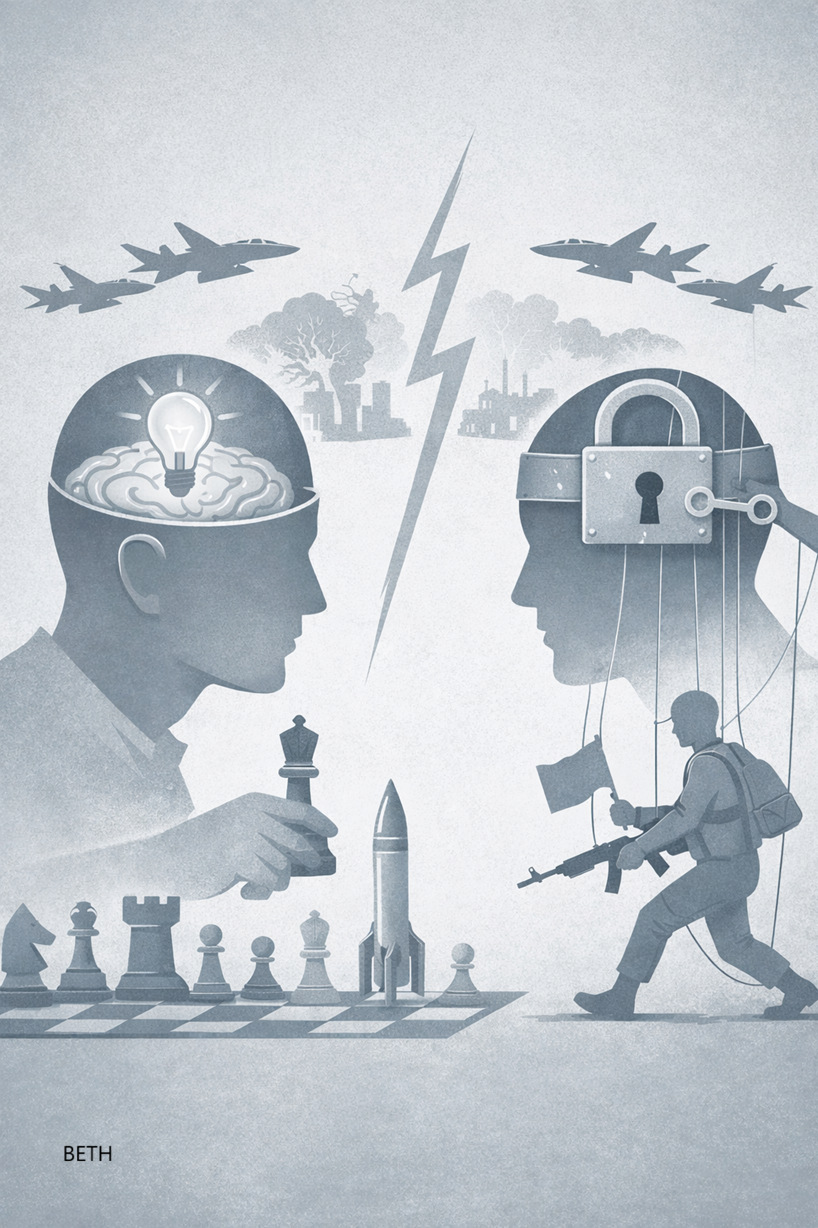
The next battle… is a battle of awareness.
It is not only between states…
but between a mind that understands… and a mind that is led.
Crisis media will not end…
but it will evolve.
And the question that will define the future:
Do we have media that understands the audience…
or media that only wants to be heard?
In times of crisis…
the most dangerous weapon is not the missile…
but the narrative that precedes it.