



Day 23: IOngoing Strikes on Irane .. Preparing for the Hormuz Battle
Analysis & Coverage | Strategic Media Department – BETH News Agency
Introduction
As the confrontation between Iran on one side and the United States and Israel on the other enters its fourth week, the war is no longer measured by the number of strikes, but by the nature of targets and the level of threats.
The latest escalation does not indicate a continuation of war… but a redefinition of it.
From limited military attrition… to a battle touching the artery of global energy.
Overview
U.S. President Donald Trump escalated his rhetoric to an unprecedented level, threatening to “wipe out” Iranian energy facilities within 48 hours if Tehran does not fully reopen the Strait of Hormuz, in a move reflecting a shift from military pressure to strategic economic pressure.
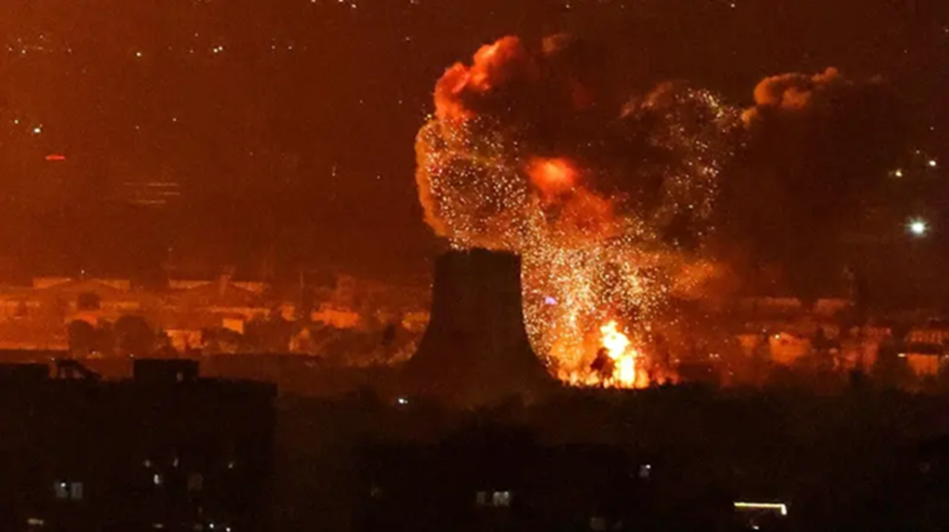
Meanwhile, Tehran witnessed the most intense attacks since the beginning of the war, according to Iranian media, while US Central Command published footage documenting precise strikes aimed at degrading Iran’s military capabilities.
On the ground:
Missiles targeting U.S. sites at Baghdad Airport
Explosions in Israel due to air interception attempts
Consecutive strikes in Isfahan
Targeting a fortified underground facility at the Isfahan nuclear complex
Intercepting missiles and drones launched by Iran toward Bahrain and the UAE
Economically, U.S. sources revealed that gas power plants—particularly the Damavand facility—are among potential targets, opening the door to direct strikes on energy infrastructure.
In parallel, Iran’s Revolutionary Guard is working to restructure its regional arms, particularly Hezbollah, following the heavy blows it suffered in 2024, by injecting Iranian leadership and reorganizing its military structure.
The most dangerous development on the horizon:
Preparations for a Hormuz confrontation… with indications of a potential U.S. ground landing scenario.
Analysis
What is happening now is not a conventional escalation… but a transition into a phase of breaking will.
The United States is not only targeting Iran’s military capabilities, but pressing on a far more sensitive point:
Energy = Economy = Internal Stability
Targeting energy infrastructure carries three deep messages:
- Shifting the battle inside Iran
Not only through strikes, but by affecting daily life. - Neutralizing the Hormuz card
By making its closure more costly for Iran than for the world. - Redefining the rules of engagement
From mutual responses… to strict time-bound conditions (48 hours).
On the other hand, Iran is attempting to rapidly rebuild its regional proxies to preserve deterrence, but the gap between the pace of strikes and the pace of recovery appears to be widening.
As for the talk of a ground landing, it is not merely a military decision… but an implicit signal that the war may shift from remote control to direct confrontation.
BETH Conclusion:
Hormuz is no longer just a waterway…
It has become a fault line between the global economy… and the will of war.
Europe Moves
Kaja Kallas held a phone call with Abbas Araghchi amid escalating tensions between Iran, the United States, and Israel, and growing concerns over a wider conflict impacting energy security and global shipping.
BETH Analysis:
The call suggests a European move toward de-escalation and an attempt to open a communication channel with Tehran at a critical moment, particularly with rising risks surrounding the Strait of Hormuz.
It also reflects Europe’s effort to contain economic repercussions and preempt a broader confrontation that could spiral out of control.
Multi-Front Escalation
Latest Updates | Evening Brief
The region is witnessing rapidly accelerating escalation across multiple fronts, with military and political dynamics intertwining, signaling that the confrontation is approaching a more sensitive phase.
Trump: You Will Know Soon About Iran’s Surrender
Donald Trump said in a statement to an Israeli channel, commenting on the possibility of Iran’s surrender:
“You will know that soon.”
The statement carries deliberate ambiguity, and comes within the context of increasing psychological and political pressure, without offering a direct commitment.
President Trump gives Iran 48 hours to reopen the Strait of Hormuz
A senior commander in the Islamic Revolutionary Guard Corps has been killed (name not yet disclosed)
Continued missile launches toward Israel and Gulf states
Iranian media: attacks on a missile complex in Yazd, central Iran
U.S. military: we continue targeting Iran’s drone-launch capabilities
Mark Rutte: the U.S. operation is decisive in confronting the Iranian threat
A British nuclear submarine arrives in the Arabian Sea
Benjamin Netanyahu vows to expand operations in Lebanon
Iranian media: failure of a hypersonic missile launch
U.S. official: we have received messages from Iran to end the war
BETH Analysis
The current scene reflects calculated escalation… not full-scale chaos.
The U.S. ultimatum (48 hours) raises pressure to a strategic–economic level
Naval movements (the British submarine) indicate readiness for a broader scenario
Continued strikes alongside Iranian messaging reflect duality:
field escalation… alongside attempts to open a political channel
Outcome:
We are entering a phase of mutual pressure testing, where each side is probing the limits of the other… without a decisive outcome yet.
After Trump’s Deadline to Iran
In a direct threat, Donald Trump set a clear equation:
A full reopening of the Strait of Hormuz… or it will be forced open by power.
Recent statements have left no room for maneuver, rejecting any partial arrangement, in contrast to an Iranian announcement of opening the strait to some parties while excluding others.
BETH Analysis (Forward-Looking)
The equation has shifted from pressure to a phase of resolution.
After the deadline expires, BETH anticipates three scenarios:
1. Full reopening under pressure
A practical reopening of the strait to avoid a severe strike, without an explicit admission of retreat.
2. Forcing it open by force
Military operations to secure navigation and target the capabilities threatening it, marking a more direct confrontation.
3. Limited reciprocal escalation
Calculated strikes and counter-strikes, before the Hormuz file is resolved on the ground.
Decisive Reading
Hormuz is no longer a bargaining card…
but a test of will.
Conclusion
The next phase will not be managed by statements…
but by what happens in the world’s most critical waterway.
After the deadline…
either a full reopening… or a full imposition
NATO Secretary General responds after Trump’s remarks describing the alliance as weak and ineffective without the United States: the alliance is capable of opening the Strait of Hormuz. What does this statement mean?
Reading
It is an offer of alignment with the United States, but in the form of:
“We are not outside the equation… and we can be part of the execution.”
Meaning:
Expanding the cover… not changing the decision.
The statement also carries an indication that:
“There are collective options… there is no need for a rapid unilateral decision.”
Meaning:
Reducing the pace of the American decision… without opposing it.
An attempt to regulate the tempo, not disrupt it.
It is not an attempt to confuse Trump’s plan…
but rather an attempt to organize it within a broader framework (NATO).
The objective:
Reducing risks
Distributing responsibility
Preventing an uncontrolled escalation
A message of deterrence to Iran
The statement is also directed at Tehran:
“You will not face the United States alone… but a full alliance.”
This raises the cost of any Iranian escalation.
What is the “different” element?
The core idea:
Europe does not want a unilateral American war…
but a controlled, international operation.
Conclusion
The NATO statement is neither opposition…
nor escalation…
but:
An attempt to bring the decision of escalation into a collective control framework.
NATO is not changing the battle…
but wants to participate in leading it.
Will Trump change his decision after NATO’s statement?
Most likely: No.
BETH Analysis (brief)
The NATO statement does not change the course of the decision…
but changes the framework of its execution.
Meaning:
The decision is directly tied to the deadline announced by Trump,
and any retreat at this level of escalation would weaken the credibility of the threat.
What may change?
Not the decision… but:
The shape of the strike
Its precise timing
The level of international coordination
Meaning:
A collective or internationally covered execution… instead of a purely unilateral one.
Conclusion
Trump will not change direction…
but may change the way he gets there.