



Day 22 | Ongoing Strikes on Iran.. and a War Searching for Its Final Shape
Monitoring & Analysis | BETH
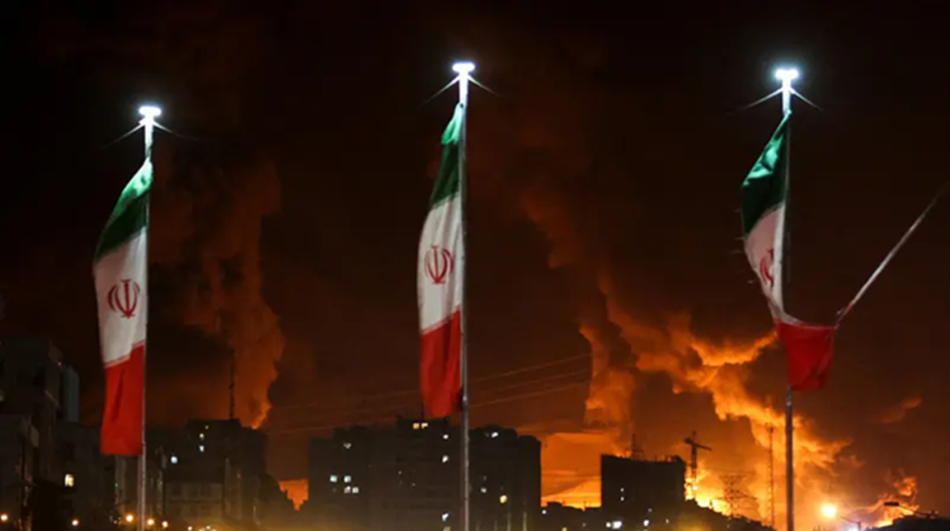
The war in Iran has entered its fourth week, Saturday, March 21, 2026, with continued U.S.–Israeli strikes deep inside Iranian territory, alongside increasing pressure on the maritime and military routes surrounding the conflict. In the latest developments, Iranian media reported explosions in Pirouzi Street in Tehran and the activation of air defenses, while cross-referenced reports indicated strikes on Bandar Abbas and sites linked to military and naval infrastructure. Reuters also reported that Israel continued targeting sites in Tehran, Karaj, and Isfahan, alongside strikes on Hezbollah targets in Beirut.
On the broader battlefield, Trump stated that the United Kingdom should have acted much faster to allow the use of its bases to strike Iranian sites linked to threats against navigation in the Strait of Hormuz, after London officially approved the use of British bases, including Diego Garcia and RAF Fairford, in operations described by Reuters as targeting Iranian missile sites. Reuters also reported that Iran launched two ballistic missiles toward the joint U.S.–British base in Diego Garcia, but they did not hit their target.
Politically, Iranian Foreign Minister Abbas Araghchi said that his country seeks to end the war permanently, noting that it is open to mediation initiatives, while maintaining what he described as its right to defend itself. At the same time, Reuters reported that Tehran is willing to allow the passage of certain vessels linked to Japan through Hormuz, indicating that the strait has not been fully closed, but has instead become subject to selective management tied to the war and alignments.
In the ongoing targeting of leadership figures, it has been confirmed in recent days that Gholam Reza Soleimani, commander of the Basij forces, was killed, while Western and Israeli reports indicated the killing of Esmail Ahmadi, head of Basij intelligence, as part of strikes on Iran’s security structure. Meanwhile, assessments of the impact of these strikes on the cohesion of the Basij apparatus remain under discussion, as reports suggest that the force has suffered significant blows but has not entirely lost its internal grip.
At the rhetorical level, Iran’s new Supreme Leader Mojtaba Khamenei reaffirmed, in a Nowruz message, adherence to the line of the “resistance economy” and national security, while Vladimir Putin continued to emphasize Moscow’s support for Tehran as a “loyal friend and reliable partner.” In Washington, Trump said that the United States is getting very close to achieving its objectives, while Reuters clarified that his declared goals focus on reducing Iran’s missile capabilities, destroying its defense industrial base, weakening its naval and air power, and preventing it from approaching nuclear capability, with indications of a possible reduction in U.S. military efforts if the mission is deemed near completion.
On the Lebanese front, Israeli strikes continued on Beirut and areas in Lebanon, alongside Israeli signals of a possible expansion of operations, reflecting that the war is no longer confined to Iran, but is now being managed across multiple, simultaneous pressure fronts.
BETH Reading | A War Approaching Its Ceiling… Not Its End
The scene on Day 22 does not suggest that the war is nearing full resolution, but rather that it is approaching the definition of how it will end.
Strikes on Tehran, Bandar Abbas, and the Diego Garcia axis reveal that the battle is no longer only about destroying targets, but about reshaping Iran’s ability to respond:
in the air, at sea, and within its internal security structure.
Meanwhile, Araghchi’s talk of a permanent end to the war, and Trump’s statements about nearing objectives, suggest that both sides are now testing a critical question:
How does the war stop… without either side appearing to retreat?
BETH Forecast
In the near term, the most likely scenario is the continuation of strikes on:
missile bases, naval infrastructure, and leadership and internal security centers, with pressure on Hormuz remaining more of an economic deterrence tool than a full closure scenario.
The deployment of 2,500 U.S. Marines and additional naval assets to the region supports a scenario of reinforced deterrence and positioning, rather than a large-scale ground war inside Iran.
Possible Outcomes
The most likely outcome is not a “clean victory” for any side, but one of three paths:
1) A Weakened but Standing Iran
Its missile and naval capabilities decline, its security structure is hit hard, but the system remains sufficiently intact to endure.
2) Conditional De-escalation
The war halts at a controlled level of attrition, with Hormuz and the Lebanese front remaining tools of mutual pressure.
3) Expansion Before De-escalation
If escalation is not contained, Beirut, Hormuz, or distant bases such as Diego Garcia could become additional arenas before reaching an undeclared ceasefire.
Conclusion
On Day 22,
the war does not appear to be heading toward an immediate end…
but toward a moment of sorting:
Who still has the capacity to sustain pressure?
And who has the ability to declare that what has been achieved… is enough?
Natanz Under Fire.. and the Expanding Scope of Strikes
Airstrikes on targets داخل Iran continue, in an escalation that includes multiple strategic and military objectives.
The Natanz nuclear facility has come under renewed attacks, while the International Atomic Energy Agency (IAEA) confirmed that no radiation leakage has been detected outside the site, indicating that the damage remains contained.
In the south, strikes intensified on economically and strategically significant areas, particularly in Bushehr and key ports, alongside attacks targeting sites affiliated with the Islamic Revolutionary Guard Corps (IRGC) across several regions.
Strikes also hit northern Tehran and locations outside Yazd in central Iran, reflecting a widening geographical scope of operations.
Regionally, reports indicated an attack on the Iraqi intelligence headquarters in Baghdad, signaling that the impact of escalation is extending beyond Iran’s borders.
Multi-Layered Strikes
The scene does not reflect a conventional attack…
but a comprehensive pressure strategy:
Natanz → Nuclear deterrence without radiological escalation
South & Ports → Targeting the economy and supply chains
IRGC → Weakening the military structure
Extension to Baghdad → Expanding regional impact
Conclusion
Strikes are no longer focused on a single objective…
but are operating across multiple, simultaneous fronts:
Nuclear… economy… military… and regional influence
Ahvaz… Today’s Pressure Point
The focus on Ahvaz does not mean targeting an ordinary city,
but rather a highly sensitive نقطة within Iran’s strategic equation.
Ahvaz lies in Khuzestan Province, one of Iran’s most critical centers of oil and energy,
and is home to an Arab-majority population, carrying demographic and historical sensitivities.
Thus, targeting it carries multiple implications:
Pressure on a key economic artery
Testing the fragility of Iran’s internal cohesion
A message that extends beyond the military into political and social dimensions
In short:
The battle here is not targeting a location…
but testing oil, identity, and internal cohesion all at once.