



War Reveals Positions
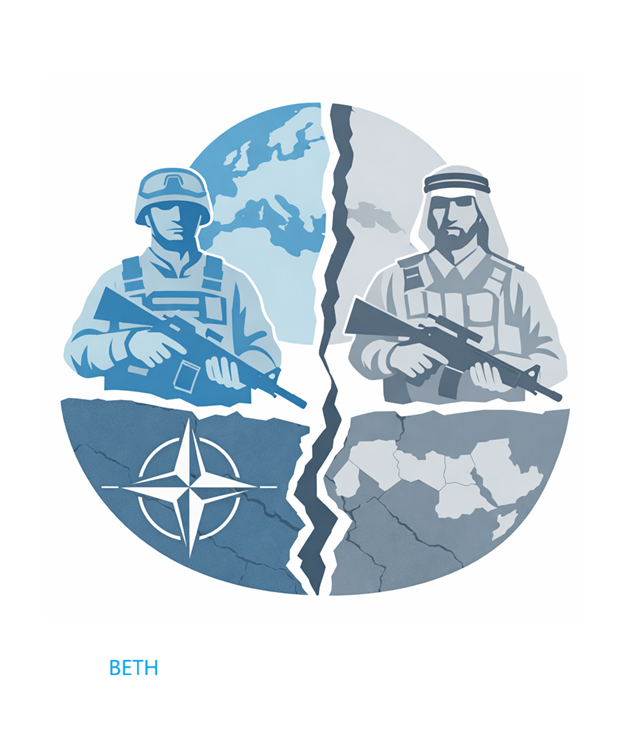
Analysis | Strategic Media Department – BETH News Agency
Introduction
As the war enters its seventeenth day, it is no longer only the military battlefield that draws attention, but also the international and regional positions that are beginning to take shape around the conflict.
While strikes and attacks continue across several fronts, certain reactions have appeared surprising to some observers, particularly from Europe and from some Arab countries. This has opened a broader discussion about the nature of alliances and the limits of solidarity during times of war.
The European Position
In recent remarks, U.S. President Donald Trump expressed disappointment with the positions taken by some European countries, which appeared less enthusiastic about the military approach adopted by Washington.
The European stance reflects a traditional pattern in the management of international crises, as European capitals tend to favor reducing military escalation and pushing toward political and diplomatic solutions.
This approach is linked to several considerations:
Concern about the expansion of the war in a region that represents a vital artery for global energy supplies.
Fears of economic repercussions that could affect European markets.
A long-standing European preference for diplomatic solutions in Middle Eastern crises.
For these reasons, the European position has appeared more inclined toward de-escalation and keeping the door open for negotiations.
The Arab Position
In contrast, the positions taken by some Arab states have raised questions from a different perspective.
The issue here is not military intervention, as Gulf states have not requested such involvement, nor has the United States called for direct Arab military participation.
However, what has drawn attention is the weak political and moral stance of some countries toward the attacks that Gulf states have been subjected to by Iran. Some voices have even indicated sympathy with, or understanding of, the Iranian position.
At the same time, support from some Arab countries for the Gulf appeared relatively late, emerging only after signs of the war’s potential conclusion and the weakening of the Iranian regime began to appear on the horizon.
Nevertheless, such positions — even when delayed — remain better than complete silence.
This situation has revived an old question that often emerges during times of crisis:
Where is the Joint Arab Defense Agreement, adopted in 1950 within the framework of the Arab League, which stipulates that an attack on one Arab state should be considered an attack on all?
Historical experience, however, indicates that this agreement has remained largely a legal framework rather than an operational defense system.
Common Ground Between the Two Positions
Despite the differences between the European and some Arab responses, there is a shared element between the two:
Avoiding being drawn directly into the war.
In both cases, there is a clear tendency to remain outside direct confrontation, whether through calls for de-escalation in the European case or through cautious political positions in the Arab context.
Such behavior is not unusual during wars, as states generally calculate the cost of alignment before taking sides.
Deeper Causes
These positions can be understood through several realistic factors:
Domestic security considerations
Entering a wide regional conflict could trigger internal security consequences.
Economic interests
Energy markets, trade stability, and regional security encourage many countries to avoid escalation.
Changing nature of alliances
In the contemporary international system, alliances are no longer based solely on geographic or ideological alignment, but increasingly on shifting interests and the circumstances of each crisis.
Does This Indicate the Collapse of Alliances?
Not necessarily.
History shows that alliances during wartime often pass through phases of hesitation and testing before their true direction becomes clear.
What appears today may not represent fragmentation as much as political repositioning, where states seek to avoid the costs of a conflict they do not wish to enter directly.
At the same time, such moments reveal a fundamental truth in international relations:
Alliances are tested in crises, not in official statements.
Thus, as in every major war, conflicts reveal not only the balance of military power, but also the limits of solidarity and the boundaries of national interests.
Will Europe’s Position Toward NATO Change?
For Europe, NATO is not merely a military alliance but an existential security umbrella dating back to the Cold War.
However, current developments may push Europe toward several adjustments:
Strengthening European defense autonomy
Some European countries have already begun considering stronger independent defense capabilities.
Redefining NATO’s role
The alliance may increasingly focus on strategic deterrence against major powers such as Russia and China rather than deep engagement in Middle Eastern crises.
Reducing political dependence on Washington
Political tensions between European capitals and successive U.S. administrations have encouraged some European governments to consider greater strategic independence.
Nevertheless, there is no realistic scenario for the collapse of NATO, as Europe still relies heavily on American military capabilities.
What About the Arab World?
The situation in the Arab world is quite different.
The Arab regional system represented by the Arab League has long suffered from a weak executive structure and the absence of binding mechanisms for collective decision-making.
Therefore, the current crisis is unlikely to significantly alter the fundamental nature of the Arab League for several reasons:
The absence of a unified Arab military command
Diverging regional alliances among Arab states
Different assessments of regional threats
In other words, the Arab League functions more as a political consultation forum than an effective collective security system.
Who Leads the Arab Position?
In practical terms, the Arab position is no longer managed from a single central authority within the Arab League.
Instead, it is increasingly shaped through regional power centers, most notably the Gulf states, which today possess significant economic and political influence in shaping regional balances.
As a result, the Arab political landscape now resembles a decentralized leadership structure.
Can the Divide Be Repaired?
Yes — but such reconciliation rarely occurs through political rhetoric alone.
Experience suggests that Arab rapprochement generally occurs when three factors are present:
A clear common threat that pushes states toward cooperation
Mutual economic interests that make coordination necessary
A rational media and cultural discourse that reduces polarization and rebuilds trust
Why Do Alliances Succeed in the West and Struggle in the Arab World?
With every regional crisis or war, an old question reappears:
Why have Western military alliances succeeded in building effective deterrence systems, while Arab alliances have struggled to evolve into meaningful collective power?
In the West, NATO stands as one of the most stable military alliances in modern history, based on the principle of collective defense.
In the Arab world, however, the Joint Arab Defense Agreement adopted in 1950 has largely remained a political framework rather than an operational defense structure.
Clarity of Threat
Western alliances historically succeeded because the threat they faced was clear and defined.
During the Cold War, the Soviet Union represented a shared threat that encouraged unified Western defense strategies.
In the Arab world, by contrast, multiple perceived threats and differing national priorities made it difficult to form a unified security vision.
Shared Military Institutions
NATO operates through an integrated military structure that includes:
A unified command structure
Joint operational planning
Continuous military exercises
Integrated defense coordination systems
In contrast, the Arab defense agreement never evolved into a permanent operational military structure capable of rapid response during crises.
Political Culture of Alliances
In Western political systems, alliances have become part of the strategic culture of states, where disagreements are managed within the framework of the alliance without threatening its existence.
In the Arab world, however, alliances have often been affected by political disputes and shifting regional dynamics, making them more fragile during crises.
Interests Versus Rhetoric
Western alliances generally rest on clearly defined strategic interests related to security, energy, and economic stability.
Many Arab alliances, by contrast, historically relied more on political rhetoric than on clearly defined security interests supported by effective mechanisms.
BETH Analysis
Historical experience demonstrates that the success of alliances depends not only on signing agreements but on building institutional systems capable of transforming texts into real power on the ground.
True alliances are not built on political statements alone, but on joint planning, operational capability, and sustained political will.
Recent developments reveal an important shift in the regional security equation.
The Gulf states are no longer merely recipients of the consequences of regional crises; they increasingly possess the defensive and political capabilities to protect their security and contribute to shaping regional balances.
As these capabilities and experiences accumulate, it becomes increasingly clear that the future of the region may not be governed by the same mechanisms that defined the past.
The region — and its political institutions such as the Arab League — may therefore be entering a new phase shaped by evolving balances of power, responsibility, and capability.