



Water Security in Saudi Arabia .. Development Continues
Riyadh | BETH
How did a country located in the heart of one of the driest regions on Earth manage to build one of the largest water systems in the world, securing the needs of millions of residents, cities, and industries in a harsh desert environment?
What Saudi Arabia has achieved over the past decades has not been merely a collection of water projects. Rather, it represents the construction of an integrated water system resembling artificial rivers crossing the desert, beginning at the sea and ending in cities, homes, and farms through a complex engineering network of desalination plants, pipelines, reservoirs, and dams.
Seawater Desalination
Saudi Arabia relies primarily on seawater desalination as its main source of fresh water and has become the largest producer of desalinated water in the world.
Key figures:
Production exceeding 7.6 million cubic meters of desalinated water per day
The Kingdom accounts for around 20% of global desalinated water production
More than 30 desalination plants along the Arabian Gulf and Red Sea coasts
Several plants rank among the largest in the world, producing hundreds of thousands of cubic meters daily
Water Transmission Across the Desert
Producing water on the coasts is only the beginning. The real challenge lies in transporting it to cities deep in the desert.
To address this, the Kingdom has built one of the world’s longest water transmission networks.
Key figures:
More than 14,000 kilometers of water transmission pipelines
A vast network of pumping stations and intermediate reservoirs
Water transported from coastal plants to inland cities hundreds of kilometers away, such as Riyadh and Qassim
Strategic Water Storage
Just as countries maintain reserves of food and energy, Saudi Arabia also maintains massive strategic water reserves.
This system includes:
Dozens of giant reservoirs distributed across cities
Storage capacities reaching millions of cubic meters per reservoir
The ability to secure water supplies for months during emergencies
Dams and Rainwater Utilization
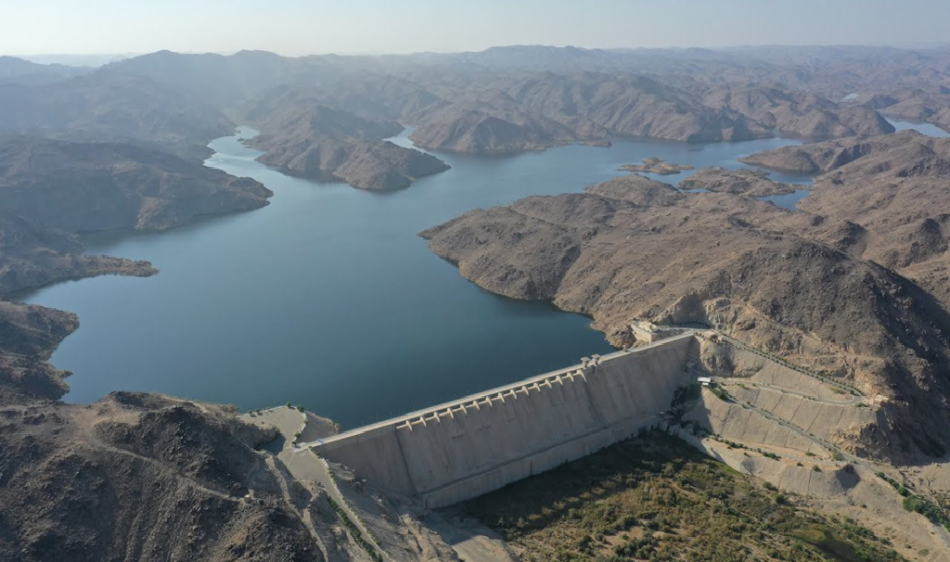
Despite its desert climate and limited rainfall, Saudi Arabia has invested heavily in building a wide network of dams to capture rainwater and seasonal floods.
Key figures:
More than 550 dams across the Kingdom
Storage capacity exceeding 2.6 billion cubic meters of water
Contributing to groundwater recharge, agricultural support, and flood mitigation
Forming an additional water network complementing desalination and transmission systems
Demand Management and Efficient Use
Producing water is not the only challenge. Managing consumption is a crucial component of water security.
Saudi Arabia is therefore working to:
Develop distribution networks and reduce water loss
Use advanced desalination technologies that lower energy consumption
Reuse treated wastewater for agriculture and irrigation
Artificial Rivers Across the Desert
In a region that almost entirely lacks natural rivers and lakes, Saudi Arabia has succeeded in building artificial rivers stretching thousands of kilometers across the desert, starting from the sea and ending in cities.
From desalination plants to pipelines, reservoirs, and dams, this system forms one of the most complex and largest water networks in the world, serving as a cornerstone for urban stability and economic growth in the Kingdom.
BETH Commentary
Water security in Saudi Arabia has not been merely a technical undertaking, but rather a long-term strategic decision.
In one of the world’s driest regions, water has been transformed from a geographical challenge into a massive national infrastructure system built on technology, engineering, and effective management.
Today, water in the Kingdom is no longer just a natural resource; it has become a sovereign infrastructure system that safeguards urban stability, supports economic growth, and enables long-term planning for the future in a harsh desert environment.