



The Lessons of War
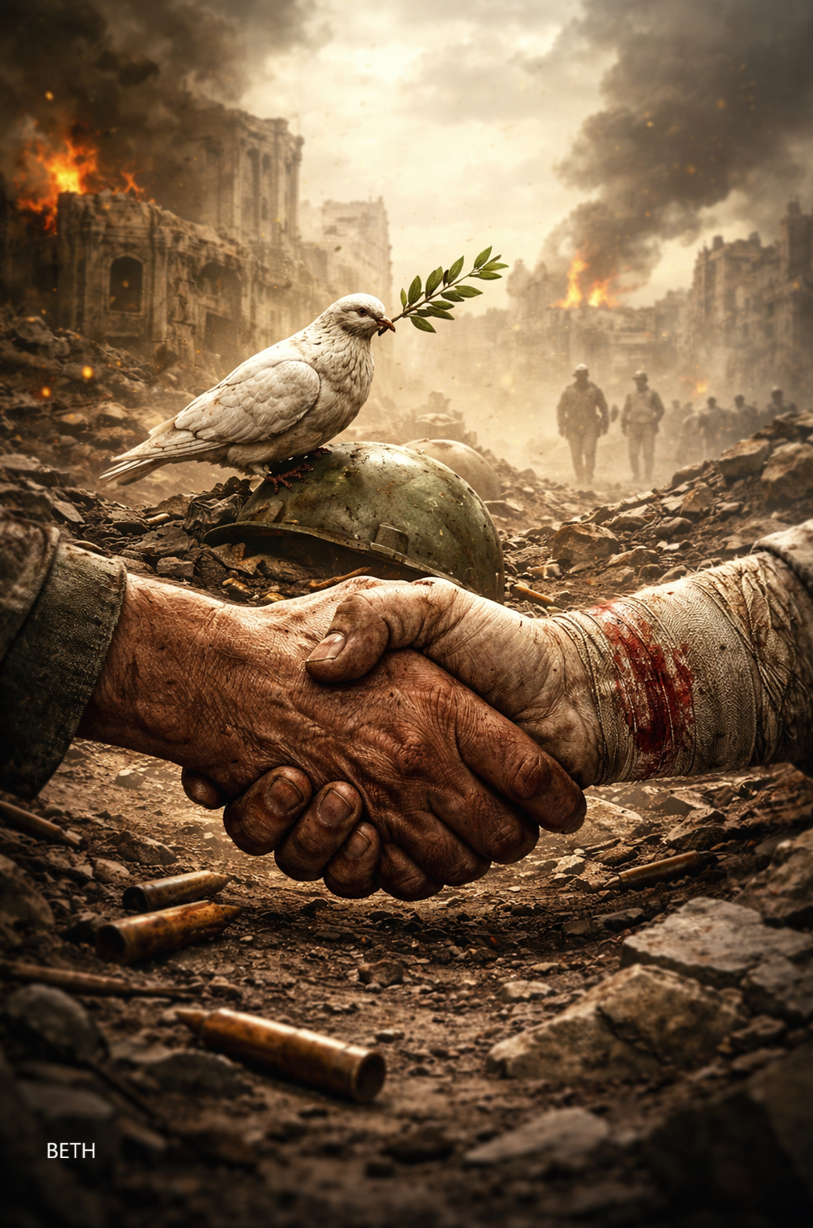
When Hardships Reveal What Days Conceal
Prepared and Analyzed | Strategic Media Department – BETH News Agency
Supervision: Abdullah Al-Omira
Introduction
Wars are not only battles between armies; they are harsh moments that reveal the nature of people and societies.
When life becomes unstable and nations experience fear, loss, and pressure, many truths that were hidden during times of peace begin to appear: relationships change, interests are exposed, and the true character of individuals and states emerges.
For this reason, wars—despite their cruelty—sometimes become a social school that reveals what was previously unseen.
When Hardships Reveal People's True Faces
One of the most repeated lessons of war is that hardships reveal the true nature of relationships.
In moments of crisis, a person may discover who truly stands beside them—and who disappears at the first test.
Hence the old saying:
"Blessed be hardships, for through them I learned who my friend is and who my enemy is."
Wars do not only test armies; they test friendship, loyalty, and the strength of societies in the face of danger.
"Blessed be hardships, for through them I learned who my friend is and who my enemy is."
A profound wisdom that summarizes many human experiences.
Yet among the rubble of hardship, an important question may arise:
Why do we discover enemies and friends only during times of crisis?
Where are the security institutions?
Where are the advisers, experts, and strategic analysts?
Is it not their role to anticipate and detect early warning signs, and to read transformations before they turn into crises?
Wisdom lies in preparing strength in all its forms—
not only the strength of deterrence, but also the strength of understanding, sound judgment, and the ability to deal with each situation as it deserves.
True power is not only in confrontation,
but in early awareness… and compassion toward those who deserve it.
We may assume good intentions and exert effort in evaluating others to distinguish friend from enemy—yet sometimes the result is disappointment.
This raises another important question:
How can we reconcile diligent assessment with the possibility of misjudgment?
The reasons may vary.
The other side may possess a high ability to conceal intentions and master hypocrisy.
Or the flaw may lie in weak evaluation tools on the first side—or in an incomplete reading of reality.
Therefore, the most important lesson remains that judging relationships—whether between individuals or states—cannot rely on goodwill alone.
It requires constant awareness, continuous evaluation, and the ability to review judgments before mistakes turn into crises.
Human Nature Between Courage and Fear
Wars also reveal the contradictory nature of human beings.
While fear and retreat may appear, courage and resilience also emerge.
Thus it has been said that a coward dies a thousand times before his death, while the brave taste death only once.
In times of danger, another truth becomes clear:
Courage may create victors—but harmony among people creates those who cannot be defeated.
Power… and Its Limits
Wars also remind humanity of a painful truth:
That human beings can become the most dangerous of all creatures when conflicts turn into widespread violence.
It has been said that no creature more savage than man emerges when war becomes the path to resolving disputes.
Yet history repeats another lesson:
The greatest victory is the one achieved without the shedding of a single drop of blood.
Who Pays the Price of Wars?
One of the most consistent truths revealed by wars throughout history is that those who pay the price are often not those who decide them.
Wars are frequently made in decision rooms, yet they are paid for with the blood of ordinary people.
Some thinkers have therefore said that wars are often massacres between people who do not know each other—
for the benefit of people who know each other very well.
And very often, when the wealthy wage wars, it is the poor who pay the price.
The Causes of Wars… Beyond Weapons
Wars may appear to begin with weapons, but history suggests that their roots often run deeper.
Major conflicts do not arise only from barrels of gunpowder, but from economic crises, struggles over resources, and competition for influence.
Thus it has been said that the causes of wars are not always found in weapons depots—
but sometimes in granaries of wheat.
Conclusion
Wars, despite their cruelty, reveal much about human beings and societies.
They reveal friends and enemies, courage and fear, truth and illusion.
But the greatest lesson that history continues to repeat is that the greatest victory is not achieved on the battlefield—
but in the ability to prevent war before it begins.