From the Shah to the Mullahs .. How Iran Devours Its Regimes
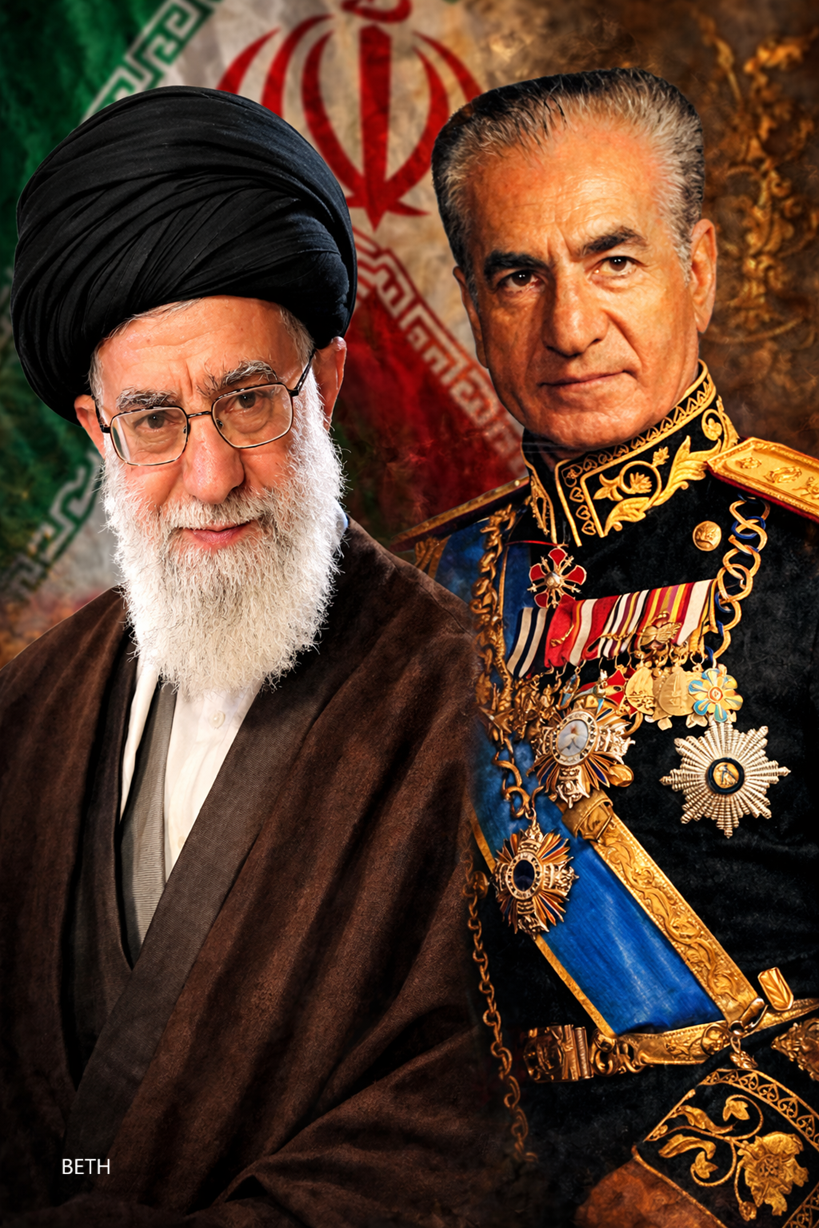
How Did the Shahanshahi End… and How Might the Mullahs End?
Prepared and Analyzed | Strategic Media Department – BETH News Agency
As the war in Iran enters its third week, attention is turning to a question that goes beyond the ongoing military battle:
Is Iran today living through a historical moment similar to the one that preceded the fall of the Shah’s regime in 1979?
The question does not only concern the outcome of the war, but also the nature of Iran’s political system and the recurring pattern that the country has witnessed throughout its modern history—where regimes that appear strong and deeply rooted suddenly collapse when internal pressures intersect with international shifts.
When the Shah Was the “Policeman of the Gulf”
In the 1960s and 1970s, Shah Mohammad Reza Pahlavi presented himself as a modernizing leader guiding Iran toward power and modernization.
His regime received broad Western support, particularly from the United States and Britain, and was then viewed as the “Policeman of the Gulf,” protecting regional balances.
Economically, Iran experienced a major oil boom, but this prosperity was accompanied by another reality at home:
A powerful security grip through the SAVAK intelligence apparatus,
Wide social inequality,
And extravagant lifestyles among the ruling elite.
Over time, the distance between the state and society widened, until a moment of political and social explosion arrived, ending with the collapse of the monarchy in 1979.
A Revolution Against Authoritarianism… or Its Reproduction?
When the clerical revolution came to power, it raised slogans of freedom, independence, and resistance to foreign domination.
But over the decades, many observers began to notice a striking historical paradox:
The regime that came to overthrow authoritarianism built, in turn, a wide and powerful authoritarian security state.
The Islamic Revolutionary Guard Corps became a major military and economic force,
Security control inside the country expanded,
While Iran became deeply involved in a network of regional conflicts through allies and proxies.
Inside Iran, waves of public protest have repeatedly emerged, reflecting a continuous tension between the state and society.
Similarities Between the Two Experiences
Despite the major ideological differences between the two regimes, some researchers point to several similarities:
A strong security grip over society.
Extravagant lifestyles among the ruling elite.
Significant spending beyond national borders to support regional influence.
A historical narrative about Iran’s greatness and its global role.
Together, these elements created in both systems a sense of strength and permanence. Yet historical experience indicates that such regimes may appear strong… until the moment crises intersect.
When Do Regimes Fall in Iran?
Iran’s modern experience offers a clear lesson:
Regimes do not fall only because of external pressures, but when these pressures coincide with an internal erosion of political and economic legitimacy.
This is why some observers today ask:
Could the current war, economic pressure, and international isolation create a moment similar to the one Iran experienced before the fall of the Shah?
The answer remains open.
Iran… A History of Revolutions
Throughout its history, Iran has witnessed numerous revolutions, coups, and uprisings. Some writers have suggested that their number exceeds one hundred—a figure difficult to verify with precision—but what is certain is that the country’s political history has been marked by repeated transformations and upheavals.
In modern history, three major turning points shaped the transformation of the Iranian state:
The Constitutional Revolution (1905–1911), which established the idea of a parliament and limited the authority of the Qajar Shah.
The 1953 coup, which overthrew Prime Minister Mohammad Mossadegh and restored the Shah’s rule.
And the 1979 Islamic Revolution, which ended the monarchy and established the Islamic Republic.
This recurring pattern suggests a clear political dynamic: when revolutions repeat themselves in any country, it often reflects fragile balances between state and society, accumulated crises without sufficient reforms, and the absence of effective channels for peaceful change—pushing transformation to occur through sudden political explosions.
Who Would Rule Iran if the System Changes?
The question does not only concern the fall of a regime—but what comes after it.
Several possible scenarios emerge:
A New Policeman
International powers may attempt to reproduce a model of rapid stability through a strong system capable of guaranteeing regional security and global energy markets.
A New Chaotic Authority
A change in faces without a real transformation in the nature of the security state—whose role would continue to generate turmoil in the region… turmoil that serves various agendas.
A Different Iran
A system that is less ideological and more open to the world, seeking economic and security integration with its neighbors rather than conflict with them.
For now, however, there are no clear indicators pointing to any of these scenarios.
The Imperial Dream
Part of Iran’s history of upheavals can be interpreted through the lens of the dream of restoring imperial glory. Some observers believe that nostalgia for the empire of Khosrow, representing the ancient Persian legacy, has played a role in shaping the Iranian political mindset across different eras.
Under the Shah, the political project was linked to reviving imperial Persian grandeur. After 1979, the discourse shifted to a revolutionary–ideological project seeking a leading role in the region.
Despite the differences in slogans between the two eras, the underlying idea remained the same: the pursuit of a role that exceeds the natural limits of the state.
For this reason, some analysts argue that the problem was not the slogan itself, but the attempt to transform this ambition into an expansionist project that often exceeded the country’s economic and political capacities.
BETH Reading
Iranian history suggests that regimes in Tehran do not always fall because of military defeat.
Rather, they fall when the state reaches a moment in which it discovers that power is no longer sufficient to protect legitimacy.
The Shah realized this moment too late.
And the question some observers are asking today is:
Is the clerical regime facing a similar moment?
The answer is still taking shape.
But what is certain is that what is happening today may not only determine the outcome of a war…
It may determine the shape of Iran in the decades to come.
For these reasons and trajectories, Iran has long been—and continues to be—a global stage for transformations and conflicts.
Can internal openness, a change in the mindset of the neighborhood, and the world’s prioritization of lasting common interests… reshape the future?