



After 16 Days of War .. What Has Changed in the Region?
Prepared and Analysis | Strategic Media Department – BETH News Agency
Introduction
After sixteen days since the outbreak of the military confrontation, the war is no longer merely an exchange of strikes with missiles and drones between two sides.
With every additional day, the battle is gradually turning into a much broader test that involves regional balances, global energy markets, the calculations of major powers, and even the future of Iran’s political system itself.
Therefore, the most important question is no longer:
Who struck whom?
Rather, the deeper question has become:
What has this war actually changed?
The Battlefield: Strikes Expanding… No Decisive Outcome Yet
So far, the military picture appears more like a war of mutual attrition than a rapid decisive conflict.
Air and missile strikes continue, and the military infrastructure of both sides is under constant pressure, yet without a clear battlefield outcome that could be described as a decisive strategic shift.
In such wars, reciprocal strikes often become a tool to adjust deterrence balances rather than a direct path toward immediate victory.
Politics: Negotiation Statements… Under the Sound of Guns
Political statements about negotiations or ending the war cannot be read in isolation from developments on the battlefield.
Diplomacy in times of war often moves as an extension of the battle rather than a substitute for it.
While some parties attempt to keep mediation channels open through regional countries, the positions of major powers indicate that the military phase has not yet reached a point that would push everyone toward a near political settlement.
For this reason, some political statements appear closer to rhetorical maneuvering or attempts to manage international pressure, rather than real signals that the war is approaching its end.
Energy: The War That Entered the Global Economy
One of the most significant transformations revealed during the first sixteen days of the war is that the conflict is no longer confined to a specific geography.
Merely mentioning the Strait of Hormuz, oil transport routes, ports, and vital infrastructure has brought energy back to the center of the strategic equation.
The world realizes that any major disruption in the Gulf does not simply represent a regional crisis, but rather a direct test of global economic stability.
For this reason, energy markets now follow the war on a daily basis, just as closely as the militaries do.
The Gulf: Stability Under Pressure
Despite the security tensions, Gulf states have demonstrated a clear ability to manage the crisis calmly.
The region’s economic and logistical infrastructure, along with accumulated experience in dealing with regional crises, has helped limit the impact of military escalation on overall stability.
At the same time, Gulf countries have emerged during this phase as a space for diplomacy, mediation, and de-escalation efforts, alongside their vital role in maintaining the stability of global energy markets.
Inside Iran: The War and the System
One of the most sensitive angles of this war concerns its potential impact inside Iran.
History indicates that wars do not automatically topple regimes; in some cases they may even provide them with an opportunity to strengthen narratives of national mobilization.
However, prolonged military and economic pressure could also open deeper debates within Iranian society about the cost of conflict and the country’s future.
Here, the question becomes far more complex than a simple military outcome, because it relates to the future of the system itself.
The Truth That Wars Reveal
Historical experience shows that ideological or authoritarian regimes rarely declare surrender openly.
They often maintain a discourse of defiance in public, even in moments when negotiations or understandings begin behind the scenes.
For this reason, the course of a war cannot be understood through political statements alone, but through what the balance of power on the ground actually allows.
Conclusion
After sixteen days of war, it can be said that the region has entered a phase of re-testing its balances.
No clear victor has emerged yet, and a political settlement has not taken shape in the near horizon.
But what is certain is that the war is no longer merely a limited military confrontation; it has turned into an event that raises major questions about:
The balance of power in the Middle East
The stability of global energy markets
The future of the Iranian system
And the role of regional powers in managing crises
In such wars, the course of events is not measured by the number of missiles launched, but by the deep changes the war leaves in the balances of politics, economics, and regional stability.
The Question After 16 Days
After more than two weeks of fighting, an important strategic question emerges:
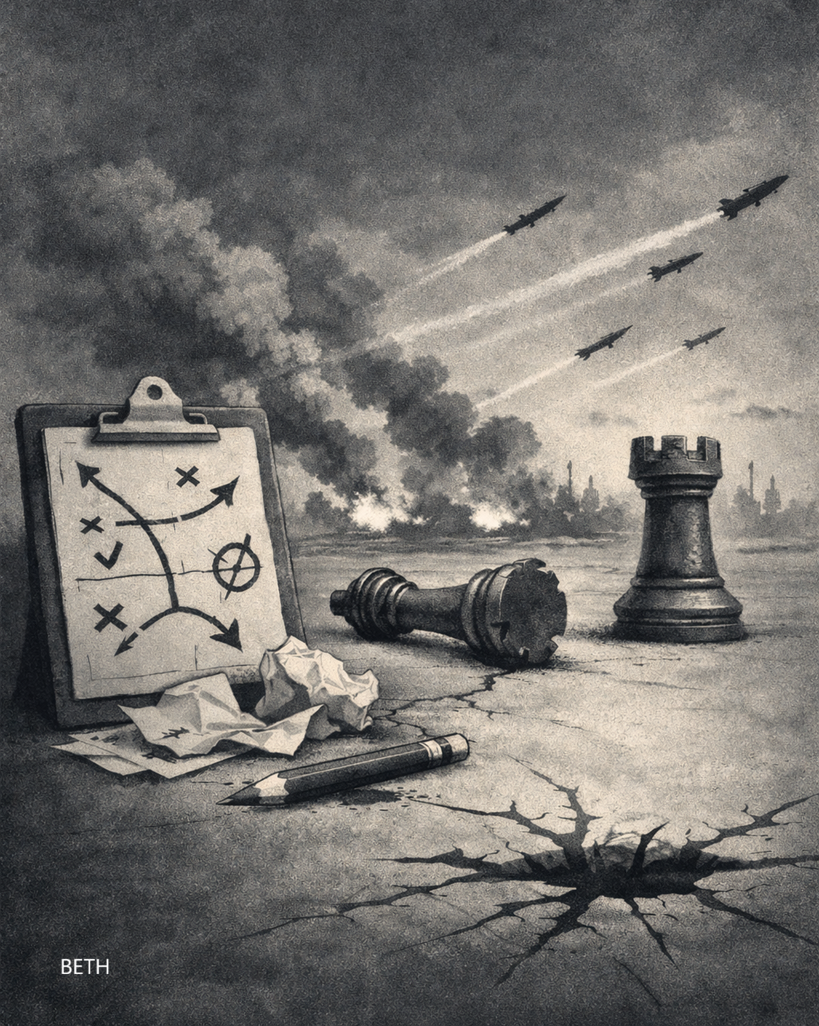
Is the war unfolding according to the plans drawn by the warring parties?
The answer is not simple.
Some indicators suggest that military operations are moving within calculated frameworks, where each side seeks to achieve specific objectives without sliding into an uncontrollable full-scale confrontation.
However, the nature of the reciprocal strikes, the widening scope of tension, and the entry of new factors into the equation reveal that wars — no matter how carefully planned — always remain vulnerable to battlefield surprises.
Therefore, the reality may be that the war has not entirely escaped the calculations of its actors, yet it is no longer moving according to the initial scenarios imagined by all sides.
With time, the battlefield itself begins to reshape plans and decisions.
In such moments, the real balance of power is not what the belligerents had planned, but what the realities of combat on the ground allow.
The war has not only changed the battlefield; it has also revealed faces, shattered illusions, and pushed the Gulf toward a more stringent reading of the region’s future.
And in the end, the stability that Gulf states seek appears to be drawing closer… while the collapse of a regime that has long destabilized the region may also be approaching.