



Missiles .. and People’s Questions
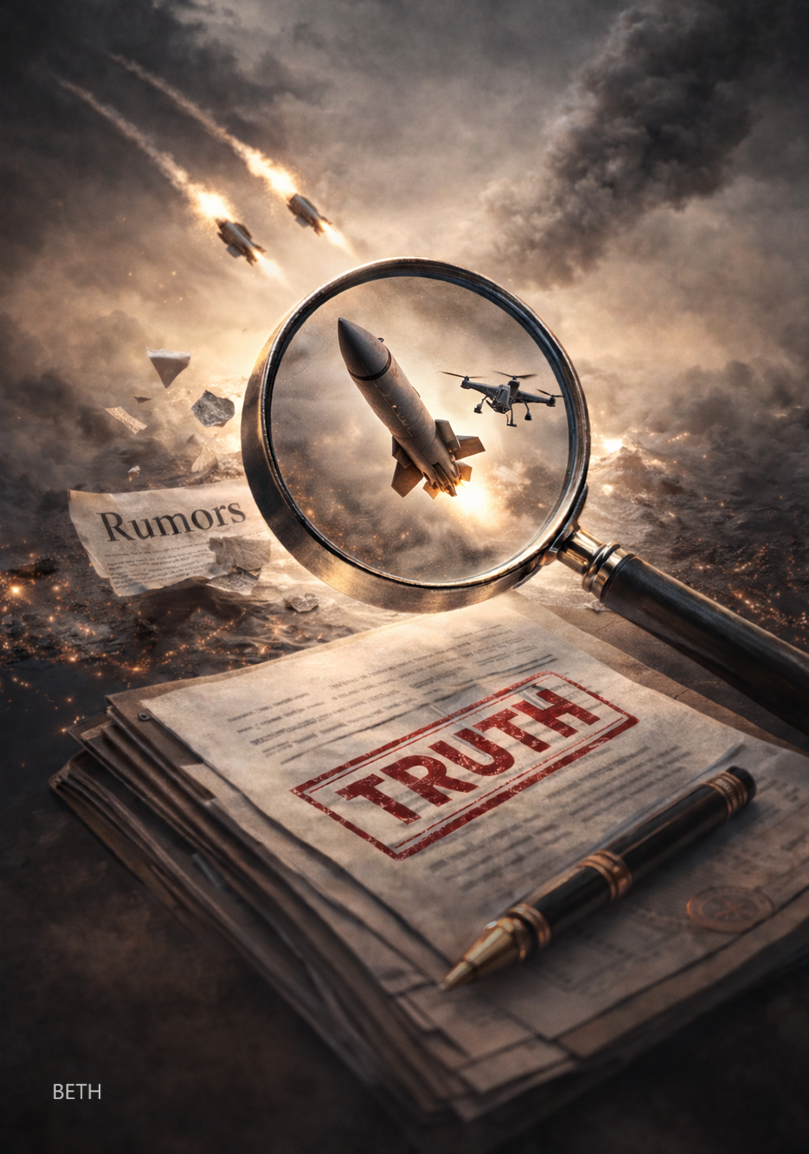
Prepared and Analyzed by | Strategic Media Department – BETH News Agency
Introduction: When Missiles Multiply… Questions Multiply
In times of war, not only missiles spread — questions spread with them.
With every report about the interception of a missile or a drone, people begin — in gatherings and on social media — trying to interpret what is happening.
This attempt to understand reality is natural.
However, during times of crisis it can sometimes turn into inaccurate narratives or rumors.
Modern warfare does not take place only on the battlefield; it also extends into the psychological and media spheres, where news, analysis, and speculation often intertwine.
From Information to Rumor
Rumors rarely emerge from nothing.
In many cases they are built on one of two foundations:
First: A fragment of real information
which is expanded and exaggerated until it turns into an inaccurate narrative.
Second: Logical speculation that appears plausible
but is based on unverified assumptions.
During periods of military tension, the media environment becomes more sensitive, allowing multiple interpretations of a single event to circulate.
Missiles Over the Gulf… and Circulating Narratives
As missile and drone attacks targeting parts of the Gulf — including areas within Saudi Arabia — continued, such as:
The vicinity of Prince Sultan Air Base in Al-Kharj
The Eastern Province
The Shaybah oil field
Limited attempts toward Riyadh
questions began circulating among the public.
Among these questions:
Are all missiles reaching the Gulf launched by a single actor?
Or can complex wars — at least theoretically — create opportunities for other parties to exploit the situation?
Could hostile groups or organizations attempt to use the chaos to complicate the scene or send indirect messages?
These questions essentially reflect a natural attempt by society to understand what is happening around it.
Investigation First
On more than one occasion, Saudi official authorities have confirmed that investigations are ongoing to determine the source of some attacks, using a clear phrase:
“We will verify.”
This phrase reflects a fundamental principle in security work:
Do not issue judgments before the evidence is complete.
Complex wars may involve multiple actors and conflicting interests, making calm and careful investigation essential to reach the truth.
This approach reflects the Kingdom’s awareness of the nature of such crises and how to deal with them. Experience has repeatedly shown that Saudi wisdom — combined with decisive firmness when necessary — has consistently been a key factor in preserving stability.
A Security Principle
In security investigations there is a well-known rule:
If a crime is complex, ambiguous, and layered — look for who benefits.
A complex crime may contain numerous details that are difficult to understand quickly.
An ambiguous crime may hide evidence or deliberately confuse the path of investigation.
But the most dangerous type is the composite crime, which may be executed in a way that suggests another party is responsible, through the creation of misleading trails — what is sometimes referred to as a scapegoat.
For this reason, professional investigations do not rely on quick impressions, but on following evidence and indicators until the full picture becomes clear.
Networks of Interests in Times of War
The Iranian regime has declared hostility toward Saudi Arabia and the Gulf states on multiple occasions, which makes attacks linked to the current confrontation part of the region’s military landscape.
However, major wars often attract additional actors seeking to exploit chaos for different interests.
These may include:
States that do not view Gulf stability favorably
Parties that see regional disruption as an opportunity to weaken its economies
Actors benefiting from volatility in global energy markets
Groups or organizations operating through proxies or driven by ideological or retaliatory motives
In such a complex environment, multiple possibilities become part of security analysis until facts prove otherwise.
War… A Space of Possibilities
War by its nature opens the door to multiple scenarios.
During moments of escalation, military messages may intersect with political and economic signals, and more than one party may attempt to influence the course of events.
For this reason, states usually approach security incidents through a methodology based on investigation and verification before drawing conclusions.
In times of war, information management becomes part of national security, just as managing the battlefield itself.
How Are Rumors Confronted?
In times of crises and war, rumors are not confronted through suppression or ignoring questions.
They are addressed through three main tools:
First: Informational transparency
The clearer and faster official information becomes, the smaller the space in which rumors can grow.
Second: Professional media
Responsible journalism does not repeat rumors; it explains how they form and why they spread.
Third: Public awareness
An aware society does not merely hear a narrative — it asks:
What is the source of this information?
BETH Reading
In the age of fast missiles, rumors may spread even faster.
But the difference between an anxious society and a balanced one does not lie in the absence of questions.
It lies in how those questions are handled.
Questions are the beginning of knowledge.
But truth always requires evidence.