


As the War Escalates .. Who Is Thinking About Iran After the Regime?
Prepared and Analyzed by | Strategic Media Department – BETH News Agency
As the war surrounding Iran enters a more intense phase in the region, political messages have begun to appear in the media that go beyond discussing military operations, raising a broader question about the future of power in Iran.
Among these messages are articles and analyses circulated through media channels discussing what is referred to as the “Third Option” in Iran — a political proposal presented by opposition forces who argue that Iran’s future should lie neither with the current system of Velayat-e Faqih nor with the restoration of the former monarchy, but rather through the establishment of a new democratic republic.
What is striking about these messages is not only their content, but also the timing of their emergence and the media channels through which they are being distributed.
Materials received by a number of journalists and media institutions were circulated through channels linked to the Turkish Anadolu Agency, raising questions about the implications of this media pathway amid rapidly evolving regional developments.
The Opposition’s Narrative: “The Third Option”
The circulated texts point to a political vision promoted by segments of the Iranian opposition, particularly the National Council of Resistance of Iran, which rejects two main options:
Foreign military intervention to overthrow the regime.
The restoration of the former Pahlavi monarchy.
Instead, these forces advocate what they call the Third Option — a change of regime through a popular uprising led by the Iranian people, ultimately leading to the establishment of a pluralistic democratic republic.
This vision includes the formation of a transitional government to manage the post-regime phase and organize free elections under international supervision, paving the way for drafting a new constitution.
The Shah Supporters’ Narrative
On the other hand, another current within the Iranian opposition promotes a different vision that calls for reviving the monarchy, or at least restoring the symbolic framework of the Pahlavi state as a possible structure for a transitional phase.
However, this proposal faces strong opposition from other segments of the opposition, who argue that restoring the monarchy could reproduce forms of authoritarian rule similar to those that existed before the 1979 Iranian revolution.
Thus, the debate over Iran’s future appears to be not only between the regime and its opponents, but also within the opposition itself.
The Western Position
So far, Western powers have not publicly endorsed any specific political project for a post-regime Iran.
Official discourse in Washington and European capitals continues to focus mainly on:
Political pressure and sanctions
Containing Iran’s nuclear program
Managing regional tensions
At the same time, Western think tanks are increasingly paying attention to discussions about possible political alternatives inside Iran.
The Arab Position: Between Caution and Readiness
Arab capitals, meanwhile, appear to be approaching the developments surrounding the war with Iran with a high degree of political caution.
While parts of the international debate focus on the future of the Iranian regime, the Arab priority seems centered on a different question: How might any change in Iran affect the region’s balance and stability?
This caution is also influenced by repeated statements by Israeli Prime Minister Benjamin Netanyahu regarding what he calls Israel’s “historical borders,” remarks that have caused concern in some Arab circles that fear potential repercussions of any reshaping of regional power dynamics.
In this context, Arab states appear inclined toward a strategy of careful observation and pragmatic engagement with developments, rather than entering early bets on what the future political system in Iran might look like.
Observers believe this approach reflects a shift in Arab strategic thinking in recent years, with priorities increasingly focused on stability, development, and economic partnerships after decades of regional conflict.
At the same time, this pursuit of stability does not imply complacency, as Arab states continue to maintain readiness to respond to any developments that might threaten regional security or balance.
The Iranian Domestic Landscape
The most complex factor in this equation remains Iran’s internal political scene.
Although Iran has witnessed waves of protests over the past years, it remains unclear whether any opposition force is capable of unifying the Iranian public or leading a comprehensive political transition.
Moreover, the regime’s strong security apparatus, combined with divisions within the opposition, makes internal change far more complicated than the political narratives circulating abroad might suggest.
Why Are These Messages Circulating Through Anadolu?
The most intriguing question concerns not only the content of these messages, but also the media channel through which they were distributed.
The Anadolu Agency, as Turkey’s official news agency with broad international reach, represents a platform capable of delivering political narratives to a wide network of journalists and media institutions.
The circulation of these materials through Anadolu may reflect several possibilities:
An attempt by Iranian opposition groups to reach international media through influential regional platforms.
Growing Turkish media interest in the debate about Iran’s political future.
Or simply the use of broad media networks to distribute analytical material at a sensitive regional moment.
In any case, the emergence of this discourse at this particular moment opens a wide range of questions about Iran’s political future.
The Question of the Moment
As military confrontation escalates across the region, the debate about Iran no longer seems confined to the course of the war itself, but is increasingly expanding beyond it:
If the Iranian regime were to change… who would rule Iran?
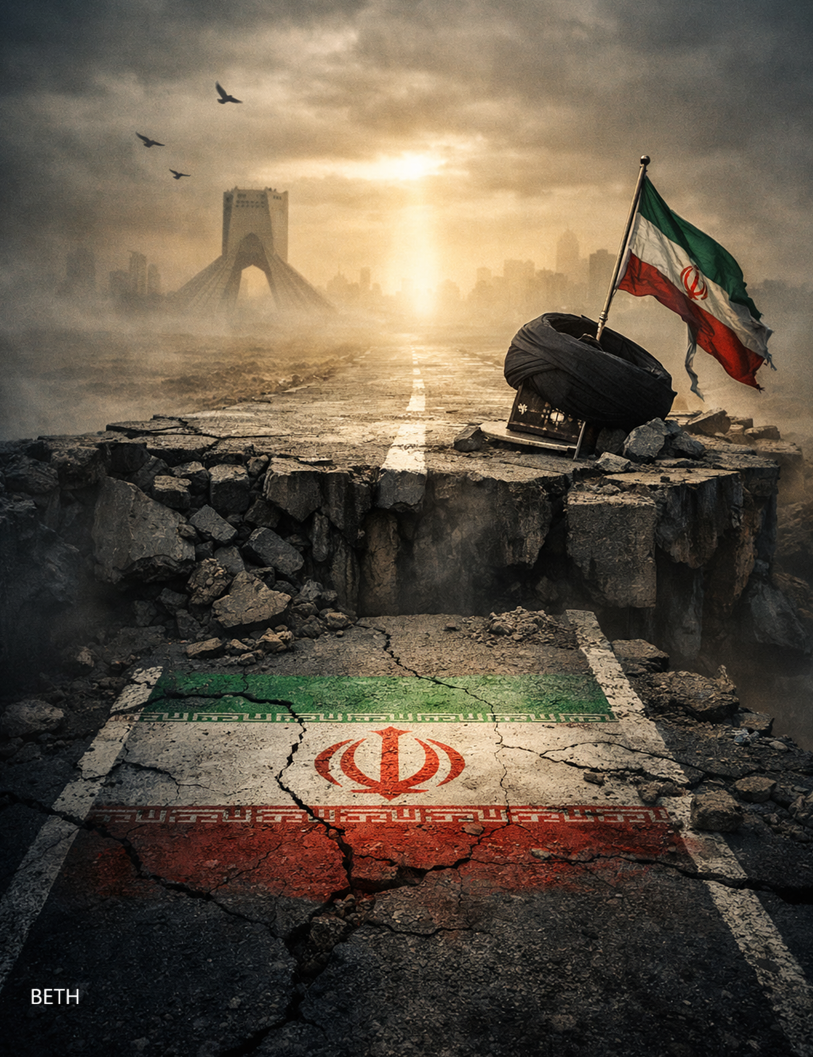
Photo Caption
A fractured road bearing the Iranian flag stretches toward an unknown edge, while the skyline of Tehran appears in the distance under the light of a rising sun.
The image symbolizes a pivotal moment in Iran’s history, where the legacy of the current system meets the question of the future: what comes next?