



The War on Iran .. Four Narratives!
Prepared and Analyzed by
Strategic Media Department – BETH Agency
General Supervision
Abdullah Al-Omaira
With the escalation of the military confrontation between the United States and Israel on one side, and the Iranian regime on the other, the battle is no longer confined to the military field alone.
Alongside aerial and naval operations and economic pressures, a parallel battle is taking place in the arena of political and media narratives.
Each side seeks to interpret what is happening according to its own perspective and interests, in an attempt to shape international public understanding of the events unfolding in the region.
Yet the reality on the ground remains the starting point for understanding these narratives:
The balance of military power in the region is largely clear, as the United States and its allies possess significant technological and military superiority, while the Iranian regime relies on traditional tools and asymmetrical escalation strategies.
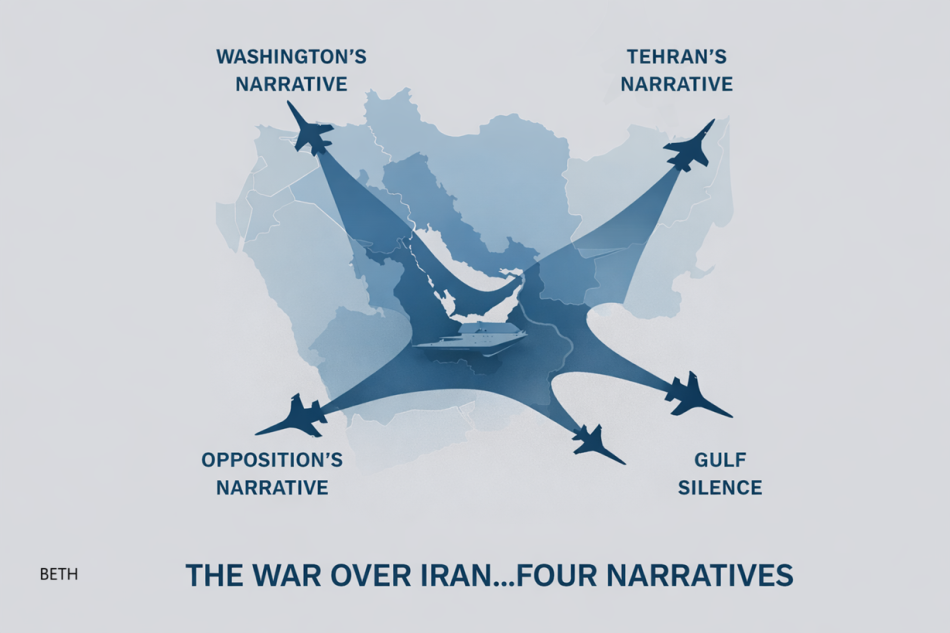
Within this context, the current conflict can be understood through four main narratives, each attempting to explain what is taking place.
First: Washington’s Narrative
Containing the Threat and Preventing Destabilization
In American and Israeli discourse, military operations are presented as an effort to undermine the Iranian regime’s military capabilities, particularly those related to missile programs and military infrastructure used to threaten regional security and maritime routes.
According to this narrative, the objective is not to overthrow the Iranian state or enter into a full-scale war, but rather to neutralize the pressure tools the regime uses to destabilize regional security.
This approach relies on employing military and technological superiority through precise operations aimed at reducing the regime’s capabilities without sliding into a large-scale open war.
Supporters of this view argue that safeguarding maritime routes and maintaining stability in global energy markets represent a strategic priority for the international community.
Second: Tehran’s Narrative
Confronting External Pressure
Conversely, the Iranian regime portrays the conflict as a confrontation with what it describes as American and Israeli pressure against Iran and its regional role.
Official discourse attempts to frame the military operations within a formula of “mutual deterrence,” emphasizing the continued existence of missile capabilities and the ability to respond through various tools across the region.
Within this narrative, threats to maritime navigation or attacks on military interests are presented as part of an asymmetrical deterrence strategy in response to Western military superiority.
However, this narrative faces clear challenges, as external escalation coincides with growing economic and political pressures inside Iran.
Third: The Iranian Opposition’s Narrative
Change from Within
A third narrative is presented by some Iranian opposition groups, which argue that the current conflict should not be reduced to a confrontation between Iran and the West, but rather reflects an internal political crisis between the regime and Iranian society.
According to this perspective, any sustainable political change cannot be achieved through foreign military intervention, but through internal transformations led by Iranian society and organized opposition forces.
This approach argues that international pressure may weaken the regime, but it cannot alone produce a new political system, since real change must originate from within.
Fourth: The Gulf’s Silence
Calculated Calm in a Turbulent Environment
Away from the sharp statements issued by the parties involved in the conflict, observers note that the official discourse in Gulf states is characterized by a significant degree of calm and diplomatic restraint.
While competing narratives escalate in their interpretation of events, Gulf governments tend to avoid verbal escalation and allow greater space for calm assessment of developments.
This approach is also reflected in the nature of Gulf media coverage, which generally falls into three patterns:
Conservative reporting focused on conveying events as they unfold
Analytical coverage that examines the conflict through regional and international balance considerations
Straightforward news reporting based on available sources
Many observers describe this approach as “the silence of wisdom.”
Regional leaderships recognize that major crises are often accompanied by considerable political and media noise, and that managing tension sometimes requires restraint and measured communication.
Within this framework, the Saudi model appears particularly notable in maintaining a balanced political discourse that avoids sensational statements, while allowing space for realistic media analysis without sliding into escalation.
Between the Four Narratives
These four narratives reveal a fundamental reality:
The current conflict is not limited to military confrontation alone; it also involves a struggle over the interpretation of events.
Washington frames the war as an effort to contain a regional threat.
Tehran presents it as resistance against external pressure.
The opposition views it as a potential moment for political change.
Meanwhile, the Gulf adopts a different approach based on calm observation and strategic balance.
Yet ultimately, developments on the ground remain the most decisive factor in determining the course of events.
Conclusion
In major crises, narratives multiply, but reality remains the primary reference.
Wars are not decided solely by what is said about them, but by what actually happens on the ground.
For this reason, the current confrontation stands as a clear example of a well-known principle in international politics:
Power shapes realities… while narratives attempt to interpret them.