



How Western Media Reads War ?
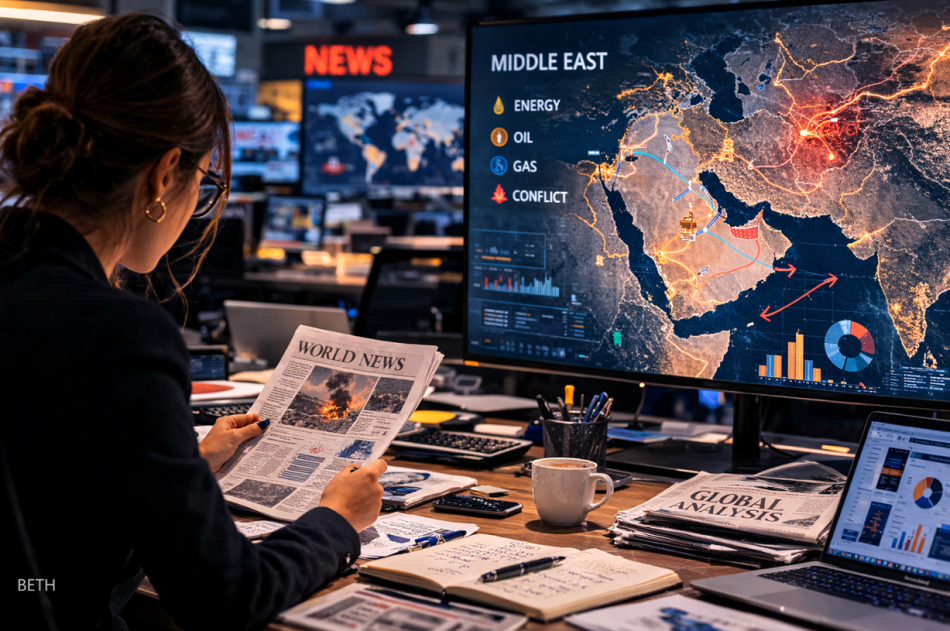
One Event… Multiple Perspectives
Follow-up & Analysis | Strategic Media Department – BETH
Supervision: Abdullah Al-Omira
Introduction: When News Becomes a Mirror of Minds
In major wars, field realities do not differ significantly among global media outlets. What differs is how these realities are interpreted.
The event may be the same, yet the angles from which it is viewed vary.
This becomes clear in the editorial message published by the Editor-in-Chief of the Financial Times, Roula Khalaf, which reached BETH and addressed the latest developments in the war in the Middle East and their impact on global energy markets.
Reading this editorial message reveals not only what is happening in the region, but also how Western media think when covering major crises.
Oil Before Politics
One of the most notable aspects of the Financial Times editorial is that the focus is not on the military operations themselves, but on the war’s impact on the global oil market.
The message notes that the confrontation between the United States and Israel on one side and Iran on the other has led to the disruption of shipping traffic in the Strait of Hormuz, through which roughly one-fifth of global oil supplies pass.
This emphasis reflects an important reality in Western economic media:
Crises are often read first through their impact on global markets and the world economy.
Information Turbulence in Times of War
The message also highlights a notable incident involving a statement posted by the U.S. Energy Secretary Chris Wright.
He wrote on the platform X that the U.S. Navy had successfully escorted an oil tanker through the Strait of Hormuz.
The statement was later deleted, before the White House denied the accuracy of the information.
This episode reflects a well-known phenomenon during major crises:
The rapid spread of information before full verification.
In a global media environment that operates at immense speed, retractions and corrections often become part of the story itself.
The Largest Disruption in Oil Market History
The message also cites the International Energy Agency describing the current situation as:
“the largest supply disruption in history.”
This characterization reflects the scale of concern among international energy institutions.
Despite the agency announcing the largest release of emergency oil reserves, markets continue to experience sharp volatility.
Why Do Perspectives Differ Despite One Event?
Although field events are the same, media interpretations differ for several reasons:
Nature of the Media Institution
Economic newspapers such as the Financial Times tend to focus on markets, energy, and the global economy.
Other media outlets may instead emphasize military or political aspects.
Target Audience
Each media organization addresses a different audience:
Investors
Decision-makers
The general public
Intellectual elites
This audience often determines the angle of coverage.
Analytical Perspective
Media do not merely report events; they choose the lens through which events are interpreted.
Here lies the diversity of perspectives.
The event may be one, but the lens of interpretation varies.
BETH Reading
The diversity of media perspectives does not necessarily mean conflicting facts.
Rather, it reflects the very nature of journalism itself.
News is a single raw material…
but analysis opens multiple doors to understanding.
This is why it is important to read different media narratives — not only to know what happened, but also to understand how the world thinks while interpreting the event.