



Never Underestimate the Mind of the Public
By: Abdullah Al-Omira
Introduction
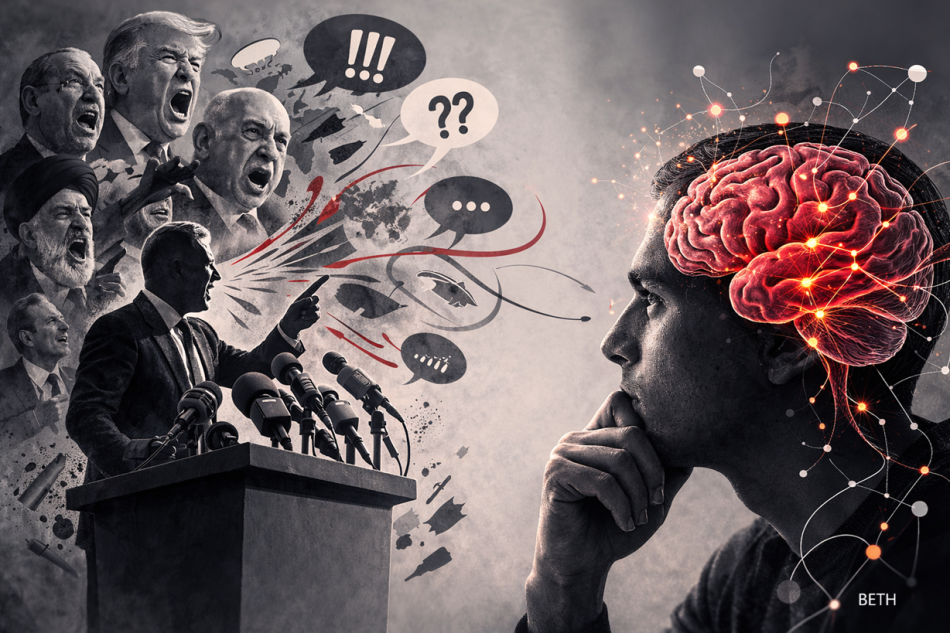
In times of war, it is not only armies that move—words, statements, and media narratives move alongside them. Yet some of what is said in press conferences or political statements sometimes appears as if it were directed at an audience that does not think, or to listeners who will not notice contradictions.
In recent days, the world has heard a series of conflicting statements.
American statements speak of Iran approaching defeat, while missiles and drones continue to be launched. Israeli statements are filled with political arrogance, as if the battle has already been decided, while the battlefield reality remains open to multiple possibilities. Meanwhile, statements from Tehran speak in the language of challenge and absolute resilience, despite the strikes hitting its facilities and military sites.
In Europe, diplomatic statements emerge that seem almost like recycled versions of old ones: calls for de-escalation, general warnings, and cautious wording that says little and changes nothing.
All these statements raise a simple yet profound question:
Do some politicians still believe that the public does not think?
Respecting Minds
In the era of open media, the public is no longer the silent audience that simply receives the official narrative. Information flows from multiple sources, images spread instantly, and analyses multiply across digital platforms.
For this reason, any political discourse built on exaggeration, contradiction, or rhetorical showmanship is quickly exposed.
Today, people no longer ask only:
What did the politician say?
They also ask:
Does what he says match reality?
And this is where the problem emerges—when political discourse shifts from explaining reality to attempting to beautify it, simplify it, or ignore its complexities.
Politics Between Arrogance and Propaganda
In many conflicts, some political leaders tend to use the language of premature victory or exaggerated defiance.
Such language may temporarily mobilize supporters, but it carries a major media risk:
if reality contradicts those statements, the result is a loss of credibility.
On the other hand, there is another equally problematic discourse: the vague diplomatic language that relies on general phrases that provide no real explanation of events.
Between political arrogance and diplomatic vagueness, the rational discourse that respects the audience’s understanding sometimes disappears.
Where Are the Media Advisors?
This situation raises a legitimate question:
Do these leaders not have strategic media advisors guiding them on how to address public opinion differently?
In reality, most political leaders are surrounded by teams of advisors and experts. But the problem is not always the absence of advisors; sometimes it lies in ignoring their advice, or in turning some of them into mere echoes of what politicians want to say.
Successful media discourse is not about raising the ceiling of statements, but about building a coherent narrative that convinces minds before it addresses emotions.
The Public Has Changed
The equation that some politicians may not yet fully grasp is that the public of the twenty-first century is not the same public of the past.
Today, an ordinary citizen holds in their hand a device that contains an enormous amount of information, analysis, and imagery.
This means that any discourse that ignores the intelligence of the public or underestimates its ability to understand becomes fragile—no matter how powerful it may appear in the moment.
Conclusion
In the end, propaganda may succeed for a while, and loud statements may create striking headlines, but a simple truth remains constant:
Underestimating the public’s mind is the shortest path to losing its trust.
The public may differ in opinions and may take different sides, but ultimately it possesses an instinctive ability to distinguish between discourse that respects its intelligence—and discourse that insults it.
For this reason, political and media wisdom begins with a simple principle:
Never underestimate the mind of the public.
An Important Question
A fundamental question remains in light of this flood of contradictory or ambiguous statements:
Do such messages eventually create public indifference due to the repetition of unconvincing narratives?
Or do they push some observers psychologically toward the narrative of the other side—not out of conviction, but as a reaction against a discourse that fails to respect their intelligence?
In political communication studies, experience shows that incoherent messaging does not merely weaken public trust—it can sometimes push audiences to search for an alternative narrative, even if it comes from a political rival.
For this reason, the proper way to address public opinion is not through exaggeration or ambiguity, but through a clear and balanced discourse that explains facts as they are and acknowledges their complexity instead of escaping from it.
And sometimes silence is better—because it is more honest than a confused message.
A message that respects the public’s intelligence may not always be the loudest…
but it is often the most lasting and the most influential.